Cold-Pool Shield-Nosed Rhinoceros
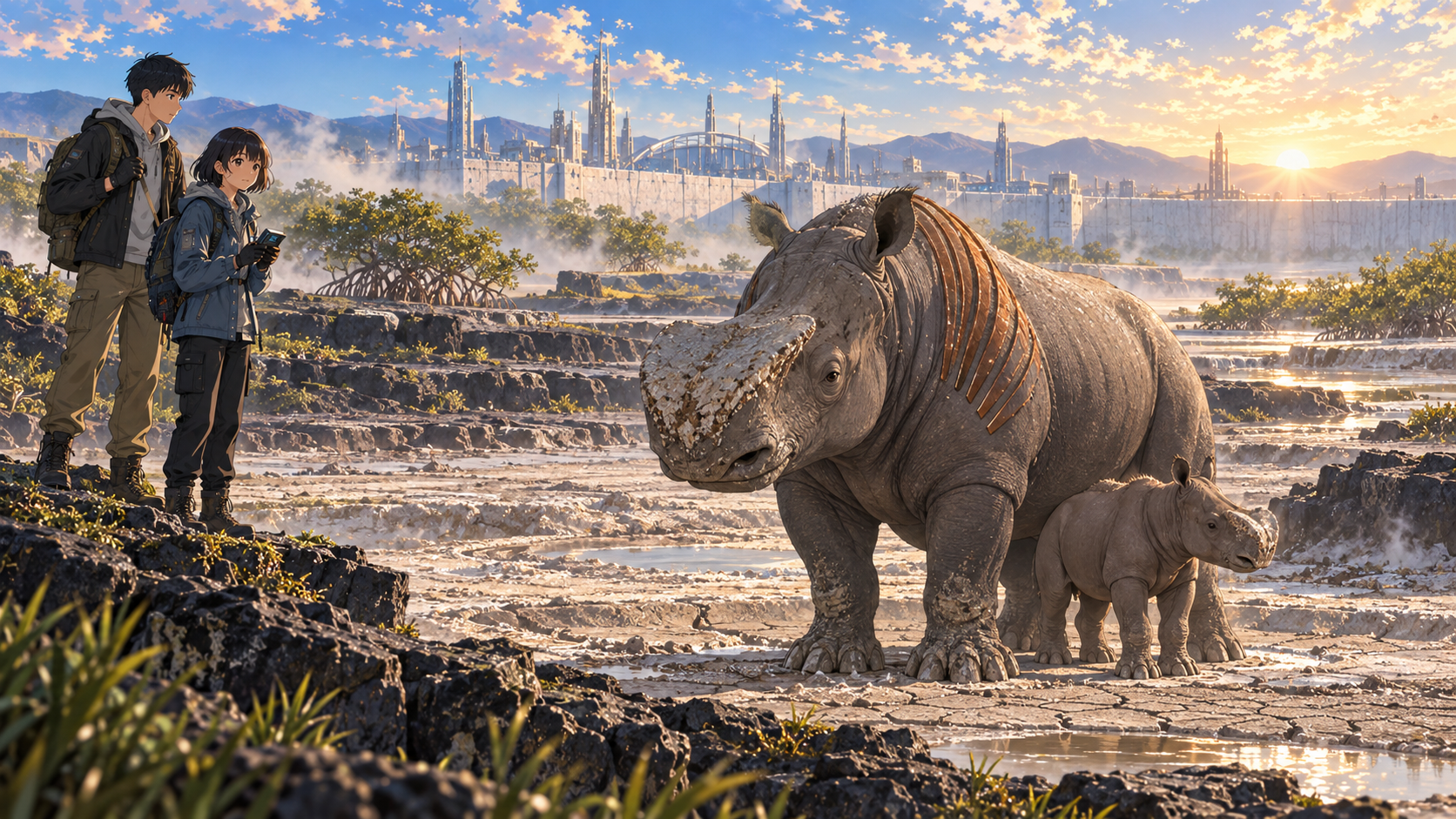
Adults use their broad nasal shields to pry up brittle salt crust and repeatedly deepen spring pools. Low copper lamellae along the shoulders conduct body heat into cool mud, while broad feet spread their weight across soft ground. A protective female holds position between a dry pool and her calf, but does not advance. She waits for water to return, then follows her own old tracks and enlarges the new shallow pool for the calf.
Observation LevelCoastal field note
First SeenDay 03 · Day 03 · Shield-Nose Cold Pool
HabitatCold-spring pools, salt-crust margins, rift mud veins, black-lava shelter, and gravity-fed return-water hollows within the Earthsong Cold-Spring Migration Gate
VariantsGray-brown calves with still-soft nasal shields, five-meter slate-gray adults, and one adult female traveling with a calf
Habitat and Mechanism
Cold-spring pools, salt-crust margins, rift mud veins, black-lava shelter, and gravity-fed return-water hollows within the Earthsong Cold-Spring Migration Gate。The rhinoceroses deepen cold mud pools that serve as cooling nodes along the megafaunal corridor. Continuous extraction thinned the Subsurface Cold-Water Lens, while a valve jammed shut by ground subsidence allowed water to leave the high-dike system but prevented gravity-fed return flow. Three pools dried and the adult female's old tracks repeatedly turned back at the same dry wall. Releasing the human-made one-way lock without starting a pump let high-elevation cool water follow the old mud vein. The female and calf returned by their own tracks after water began seeping into Rhino-Wallow Return-Water Hollow.
Enter Earthsong Cold-Spring Migration Gate ↗Behavior and Ecological Role
Adults use their broad nasal shields to pry up brittle salt crust and repeatedly deepen spring pools. Low copper lamellae along the shoulders conduct body heat into cool mud, while broad feet spread their weight across soft ground. A protective female holds position between a dry pool and her calf, but does not advance. She waits for water to return, then follows her own old tracks and enlarges the new shallow pool for the calf.
By opening salt crust and deepening cold mud basins, the rhinoceroses maintain cooling stops for calves and other large animals moving through the geothermal corridor. Their abandoned wallows expose a broken recharge route. Their return reconnects the Sulfur-Crown Tube Worm Colony's thermal boundary, the Salt-Porcelain Seed Beetles' grass seam, and a large-animal cooling point along the same migration path.
Form and Identification
Gray-brown calves with still-soft nasal shields, five-meter slate-gray adults, and one adult female traveling with a calf
- Biologically plausible heavy rhinoceros anatomy at roughly five meters long
- Broad flat nasal shield rather than a horn
- Smooth matte slate-gray hide without decorative armor
- Low copper-colored cooling lamellae along both shoulders
- Wide mud-adapted feet and a protective adult female with one calf, without charging
Observation Rule
Fang and K do not approach, herd, lure, tranquilize, touch, or redirect the female or calf. Fang observes from high ground with noninvasive instruments. K works only on the human-built valve, starts no pump, secures the bypass, keeps his weapon stowed, and withdraws before the animals enter. The rhinoceroses choose the timing, route, and shape of the restored pool.
At Shield-Nose Cold Pool, an adult female stood between the dry basin and her calf with her nasal shield facing outward. Fang remained beyond the territorial boundary and used a noninvasive BCI to read heat flow from the shoulder lamellae. K lowered his equipment, withdrew behind black rock, kept his weapon stowed, and marked the location High Risk because the animals had lost every safe retreat.