Rift-Listening Wild Dog Pack
Members occupy separate lava platforms and tap short patterns with their forepaws. The pack divides those patterns into warning, passage, and withdrawal signals rather than relying on calls. The lead animal waits for stable replies from both flanks before crossing. Adults test a narrow ridge first, one member holds a high station, and a member traveling with a juvenile crosses last. When the distant bovid herd calls, the entire pack turns toward it and withdraws in sequence to a side ridge.
Observation LevelCoastal field note
First SeenDay 04 · Day 04 · Tremor-Listening Wild Dog Ridge
HabitatBlack-lava ridges, geothermal markers, stable rock stations, sulfur-mist terraces, and the approach to Double-Crown Migration Gate within the Earthsong Cold-Spring Migration Gate
VariantsGray-brown juveniles with still-rounded ear margins, ochre-and-black patched adults, and one coordinated seven-member relay pack
Habitat and Mechanism
Black-lava ridges, geothermal markers, stable rock stations, sulfur-mist terraces, and the approach to Double-Crown Migration Gate within the Earthsong Cold-Spring Migration Gate。The pack reads natural microtremors through its ears and pressure-sensitive forepaws, then passes safe thermal windows and retreat routes from station to station. An abandoned city beacon emitted a fixed pulse every eight minutes, almost imitating a pre-quake signal and breaking the relay beside the same marker. K cut only the beacon's output and preserved its passive record. Once both flanks confirmed stable ground, the lead animal crossed and the pack extended a restored relay toward the migration gate.
Enter Earthsong Cold-Spring Migration Gate ↗Behavior and Ecological Role
Members occupy separate lava platforms and tap short patterns with their forepaws. The pack divides those patterns into warning, passage, and withdrawal signals rather than relying on calls. The lead animal waits for stable replies from both flanks before crossing. Adults test a narrow ridge first, one member holds a high station, and a member traveling with a juvenile crosses last. When the distant bovid herd calls, the entire pack turns toward it and withdraws in sequence to a side ridge.
The pack converts microtremors into a distributed map of safe geothermal windows. Its relay carries a stable route from the restored cold pools and black-lava terraces to the large-animal migration gate. After the false pulse and active radar are silenced, the pack can yield the corridor without surrendering its own distance or social order.
Form and Identification
Gray-brown juveniles with still-rounded ear margins, ochre-and-black patched adults, and one coordinated seven-member relay pack
- Lean, biologically plausible African-wild-dog-derived canine anatomy
- Tall rounded ears directed toward the ground while listening
- Broad matte ochre, black, and white coat patches without feline striping
- Amber pressure-sensing pads on the forepaws
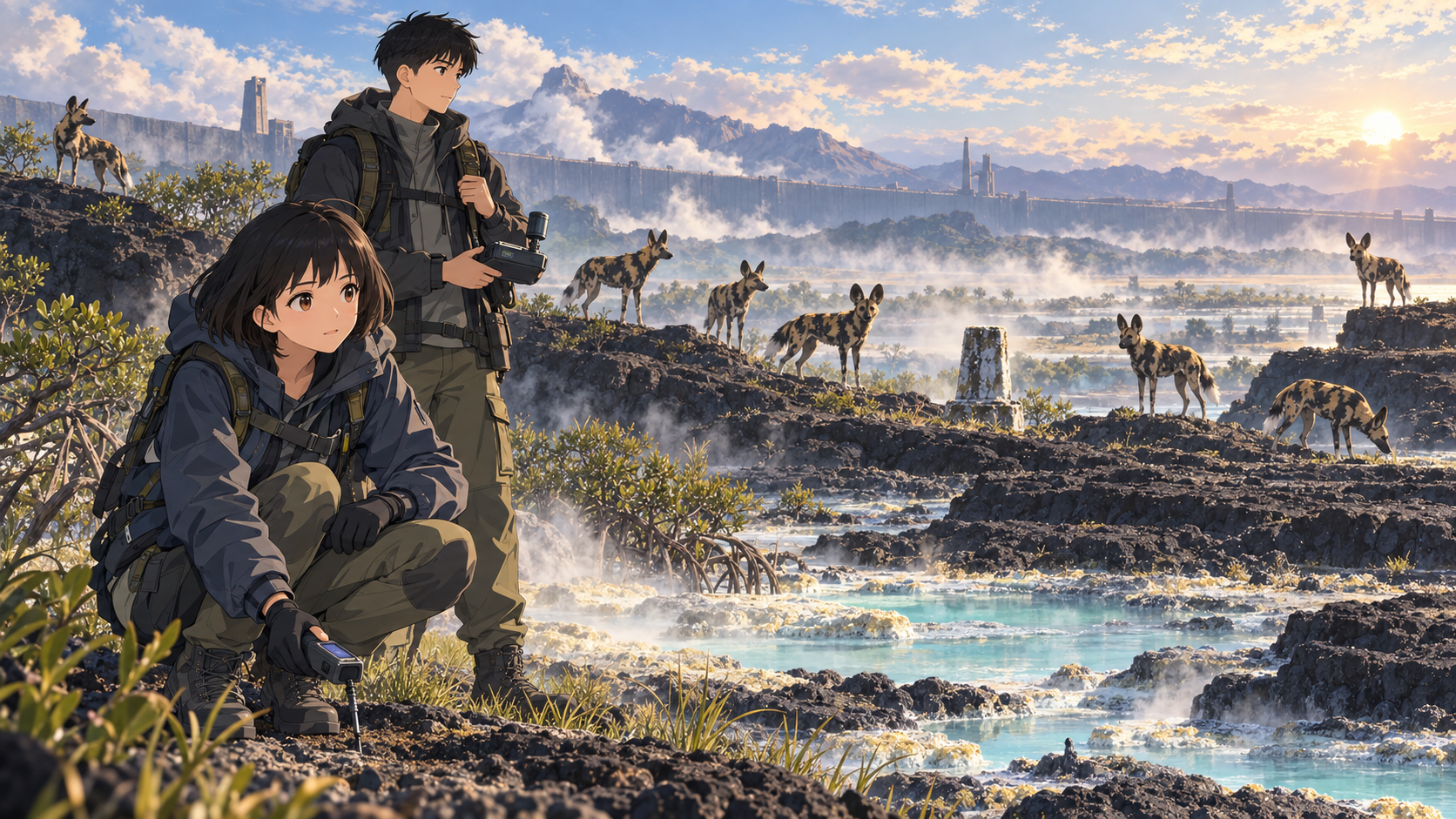
- Seven animals spaced across lava stations in a nonaggressive relay formation
Observation Rule
Fang and K do not follow, lure, surround, separate, touch, or direct the pack. Fang reads the relay from a safe distance and transfers its rhythm only to low-power warning lights. K modifies human equipment alone, preserves passive records, turns off active radar, keeps his weapon stowed, and never uses the pack as a guide animal. The wild dogs choose their stations, crossing order, and distance.
At Tremor-Listening Wild Dog Ridge, seven animals stood on separate lava platforms and relayed short forepaw taps without calling. Fang recognized that the sequence failed beside an old geothermal beacon. K recorded the repeated retreat to one stable rock while remaining at a safe distance. The pack neither approached Fang and K nor chased the rhinoceros or beetles; its positions passed the safest thermal window to the next member.