Salt-Porcelain Seed Beetle
Adults use broad shovel heads and powerful digging legs to shape megafaunal dung and salt-tolerant seed into compact balls. Small groups push the balls along repeated tracks and avoid ground that has become hollow and overheated below. When cool recharge water reaches a grass seam, the first beetle tests the damp edge several times before crossing; the rest follow the same line without human direction.
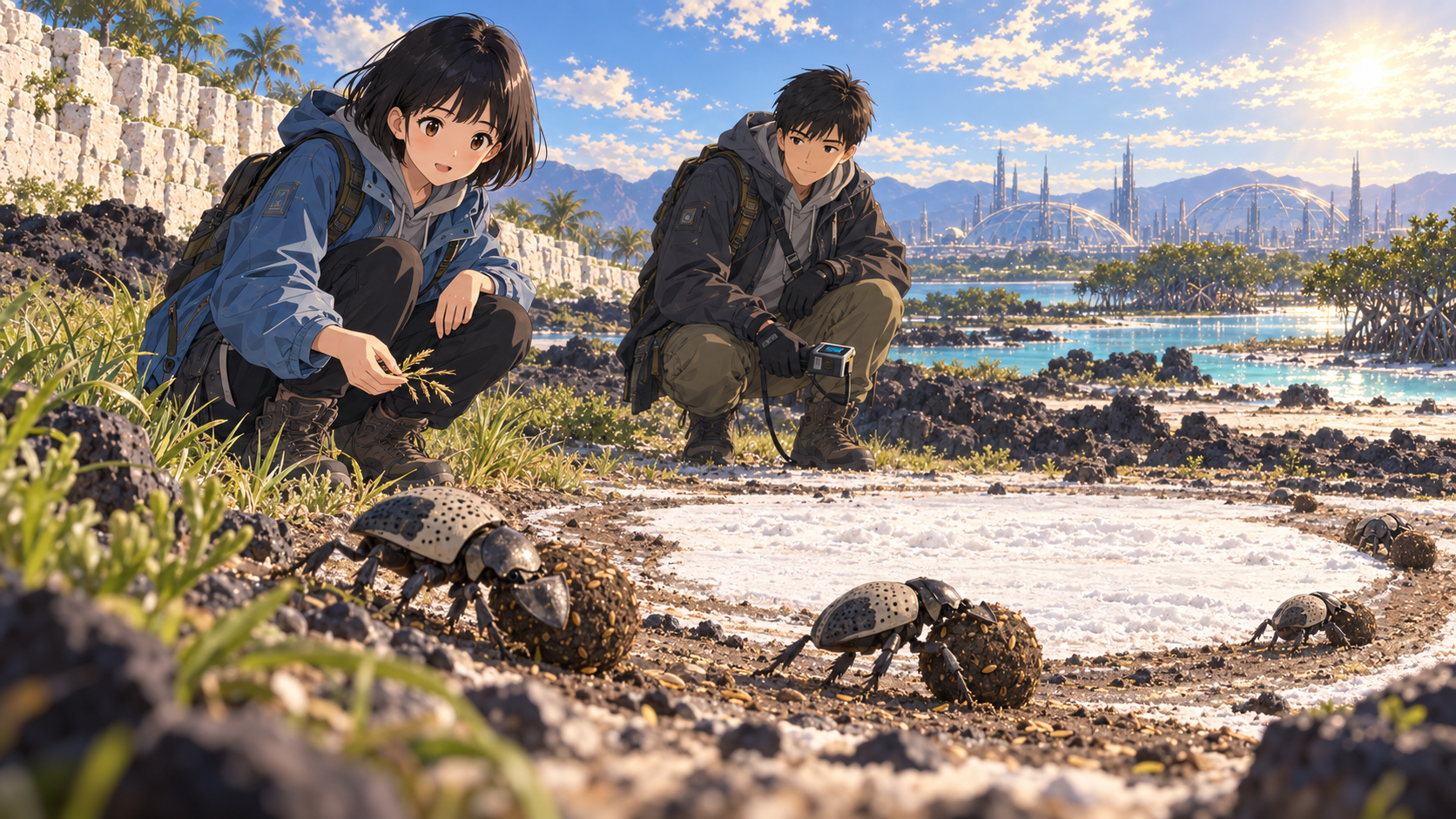
Observation LevelCoastal field note
First SeenDay 02 · Day 02 · Salt-Crust Dung-Trace Slope
HabitatSalt-crust slopes, black-lava grass seams, geothermal marsh edges, and salt-tolerant grass belts leading through the Earthsong Cold-Spring Migration Gate
VariantsThumb-sized gray-white larvae, palm-sized black-and-cream adults, and groups of three to seven rolling seed-rich dung balls together
Habitat and Mechanism
Salt-crust slopes, black-lava grass seams, geothermal marsh edges, and salt-tolerant grass belts leading through the Earthsong Cold-Spring Migration Gate。The beetles wrap megafaunal dung together with salt-tolerant grass seed and carry both fertility and future ground cover across the migration corridor. Their porous cream-white elytra release heat, but they still curved around the center of the salt crust. Thermal imaging and a fine probe showed that loss of the Subsurface Cold-Water Lens had left a brittle cavity accumulating geothermal heat below the surface; each distant rise in pumping pressure forced hot air upward through microfractures. The second pumping well therefore had to be shut down. Gravity-fed recharge restored damp soil along Black-Lava Grass Seam, after which the beetles tested the ground and resumed their own route without being guided.
Enter Earthsong Cold-Spring Migration Gate ↗Behavior and Ecological Role
Adults use broad shovel heads and powerful digging legs to shape megafaunal dung and salt-tolerant seed into compact balls. Small groups push the balls along repeated tracks and avoid ground that has become hollow and overheated below. When cool recharge water reaches a grass seam, the first beetle tests the damp edge several times before crossing; the rest follow the same line without human direction.
The beetles move nutrients and viable seed from large-animal dung into bare ground, helping grass roots bind the migration route. A sudden bend in their rolling path exposes a hidden thermal break before the surface collapses. Their return shows that recharge is restoring soil that can support grass, beetles, and the giant herbivores that follow.
Form and Identification
Thumb-sized gray-white larvae, palm-sized black-and-cream adults, and groups of three to seven rolling seed-rich dung balls together
- Biologically plausible dung-beetle anatomy at roughly palm size
- Broad shovel-shaped head without rhinoceros-like horns
- Matte cream-and-charcoal porous elytra that release heat
- Strong digging legs suited to compact seed-rich dung balls
- Small cooperative groups of three to seven that detour around overheated hollow crust
Observation Rule
Fang and K do not touch, collect, bait, chase, place, or redirect the beetles or their dung balls. Fang examines only abandoned seed and a naturally split old ball. K probes only the edge of the salt crust and adjusts human infrastructure while weapons remain stowed. The insects test the restored ground and choose their own route.
At Salt-Crust Dung-Trace Slope, the beetles pushed their seed-rich dung balls into a curved line rather than crossing the central white ground. Fang inspected abandoned salt-tolerant seed outside the route. K used thermal imaging from the edge and followed the last straight rolling trace, with weapons stowed and no attempt to redirect the insects.