A Road That Needed No Witness
The flock read the change at Wind-Curtain Ostrich Valley before the mirror field raised an alarm. Six adults closed into a half arc and took turns opening their layered wings. Gray-down chicks and the seed slope disappeared inside the shade. Fang measured the temperature difference from beyond their activity line. I shut down active scanning and recorded the hot spot's turn. The birds did not charge or flee. They were calculating where the next safe shadow would fall.
Field Observation
At dawn, we entered Wind-Curtain Ostrich Valley and read how the adults used layered wings to shield chicks and the seed slope from oblique mirror heat. At noon, Fang compared naturally shed crop seeds with the old wind line at Mirror-Back Seed-Sand Slope while I disabled the routine that treated the flock's shade as mirror fouling. Before sunset, we withdrew beyond Sunset Shadow Line and let the flock carry its chicks and drought seeds along the restored cooling route.
Morning · Wind-Curtain Ostrich Valley
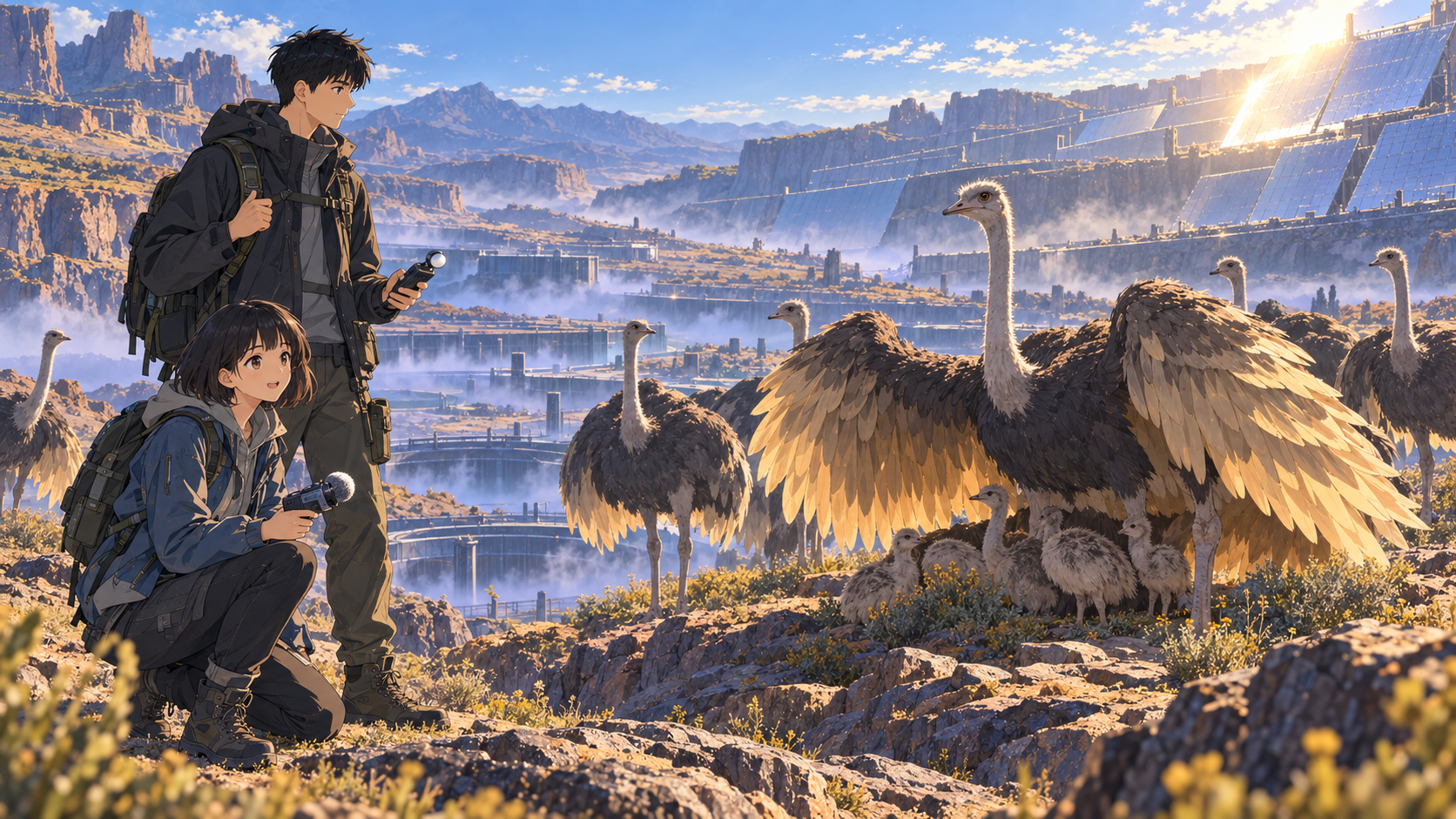
Mist from the night-cooling wells still lay along the edge of the mirror field. The adults stood three meters tall, bare gray necks turned toward the mirror rows, powerful two-toed legs steady on black-glass scree. Before the first oblique beam crossed the slope, they lowered sand-gold wing curtains over the chicks. Each time the flock shifted, the mirror-cleaning program corrected its angle as if a living shadow were dirt. Fang told me not to disturb their formation. I stood between her and the mirror field, my weapon secured, and watched one adult lower its wing another inch. A chick stepped quietly into the shade. Our first evidence was not an alarm. It was a group of living bodies turned into shelter.
Noon · Mirror-Back Seed-Sand Slope
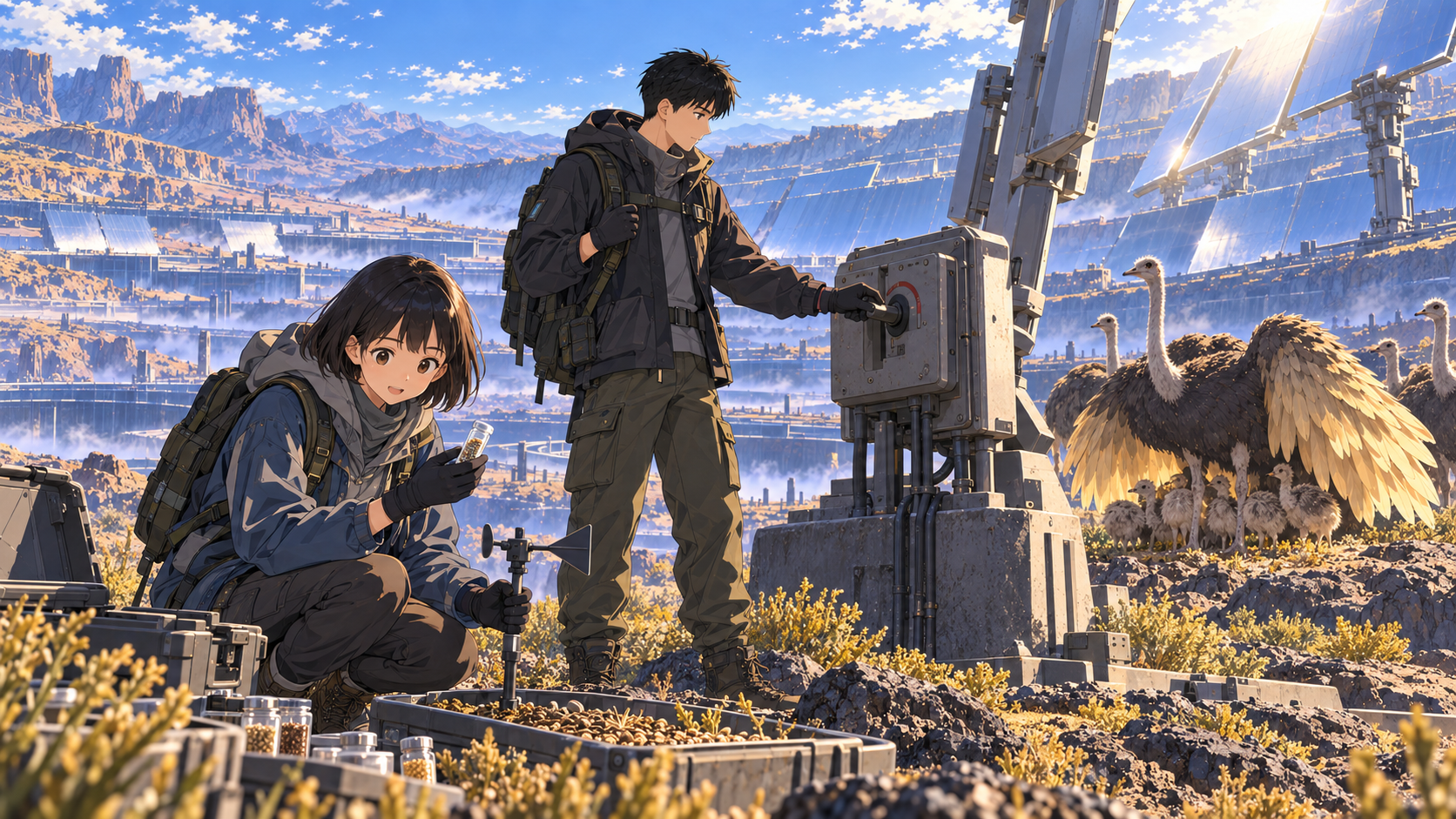
There was nowhere for the fault to hide at noon. Fang crouched beside a layer of naturally shed crop seeds and matched the drought-tolerant grains against old wind marks. I opened the passive service box behind the mirror rack. The cleaning program was reading the broad shade beneath the wing curtains as fouling. Every time an adult turned to shelter a chick, the mirrors added another strip of slanting heat and forced the flock to change course again. The birds stayed beyond the slope line. Fang collected no feathers and touched no animal; the seeds and wind traces were enough. I returned the tracking group to neutral and disabled automatic compensation. One panel stopped, then the second, then the third. The chicks did not move immediately. They waited until the surface temperature actually fell. We were not choosing a route for them. We were stopping a human system from choosing against them.
Evening · Sunset Shadow Line
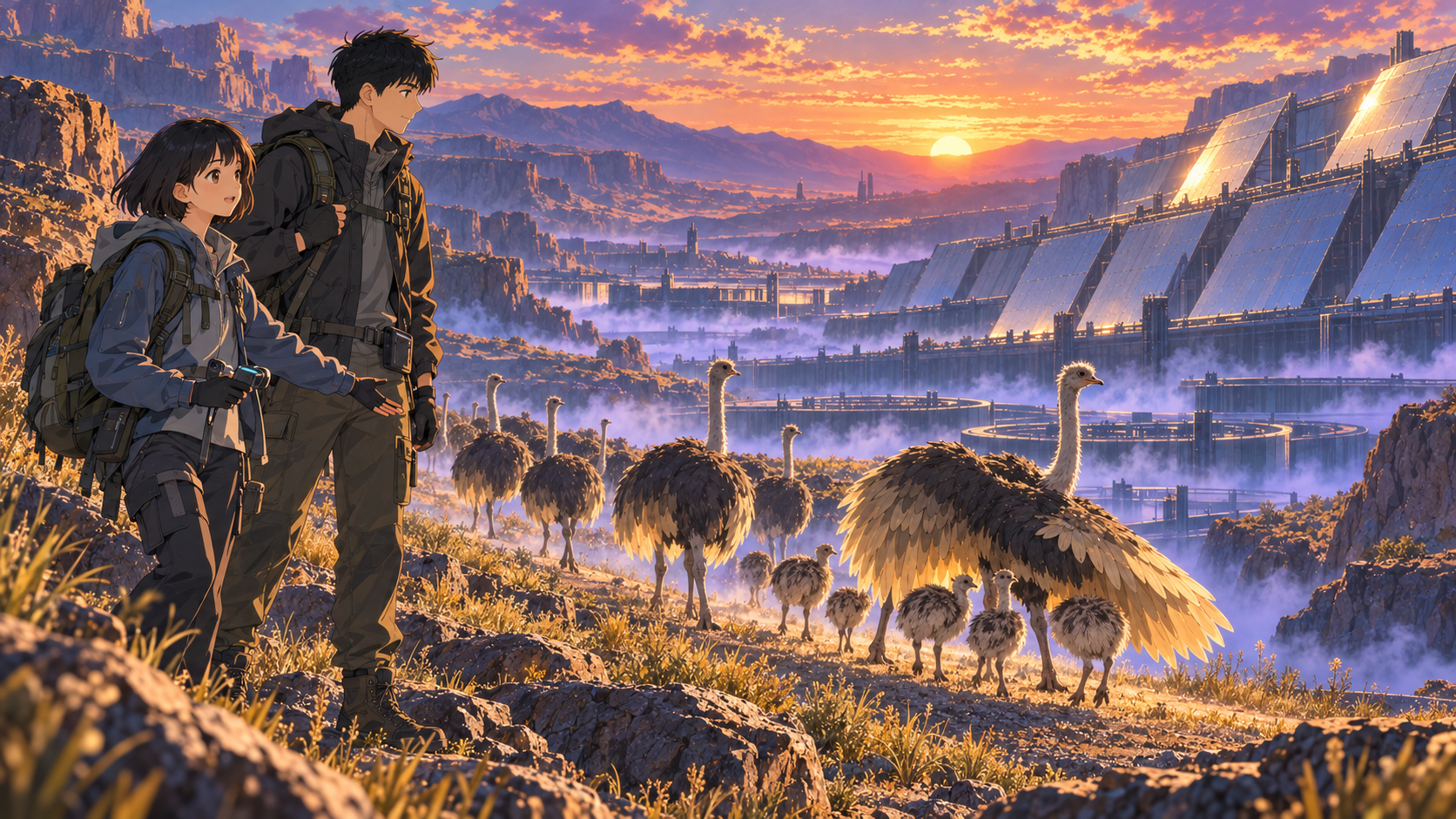
Before sunset, we withdrew beyond the shadow line and left the recalibrated mirrors at a safe angle. Cool-well mist joined into a low blue-violet band along the valley. The first adult stepped into it, its two-toed feet landing cleanly on the black-glass fragments. Chicks followed beneath the wing shade. A few drought seeds slipped from the edge of a crop and fell onto the cooled slope. Fang kept her sensor at her waist and recorded only seed positions and falling ground temperature. I locked the disconnected controller into passive mode and did not restart it for another test. The last adult waited at the edge of a warm patch with its sand-gold curtain open until every chick had crossed. Then it followed the flock. They did not stay for us or leave because of us. They carried the seed source back into the corridor along the restored cold-air line. I marked the record: passage restored.
Habitat Causality
The mirror field should gather heat by day and lock into a lights-out angle at night, allowing descending valley air to pass through underground tunnels and rise from three cold wells. A restarted controller mistook moving animal shade for mirror fouling and kept adding oblique heat wherever the flock tried to shelter its chicks. Returning the faulty tracker to neutral stopped the forced detours. As the ground cooled, the flock reopened the wind-aligned seed route and carried drought-tolerant seeds back into the corridor.
Species Behavior
Wind-Curtain Gray-Neck Ostriches form protective half arcs and rotate adults through shade duty. Their layered wing feathers block oblique heat for chicks and seed ground, while long two-toed legs cross unstable black-glass rubble. They transport drought-tolerant seeds in their crops and wait for a real decrease in surface temperature before using a restored route.
「Fang said a road that is truly open does not need a person standing in its center to prove it. I watched the last tracking beam leave the mirrors. My weapon had not left its restraint all day. The shade was enough of a result.」