Wind-Curtain Gray-Neck Ostrich Flock
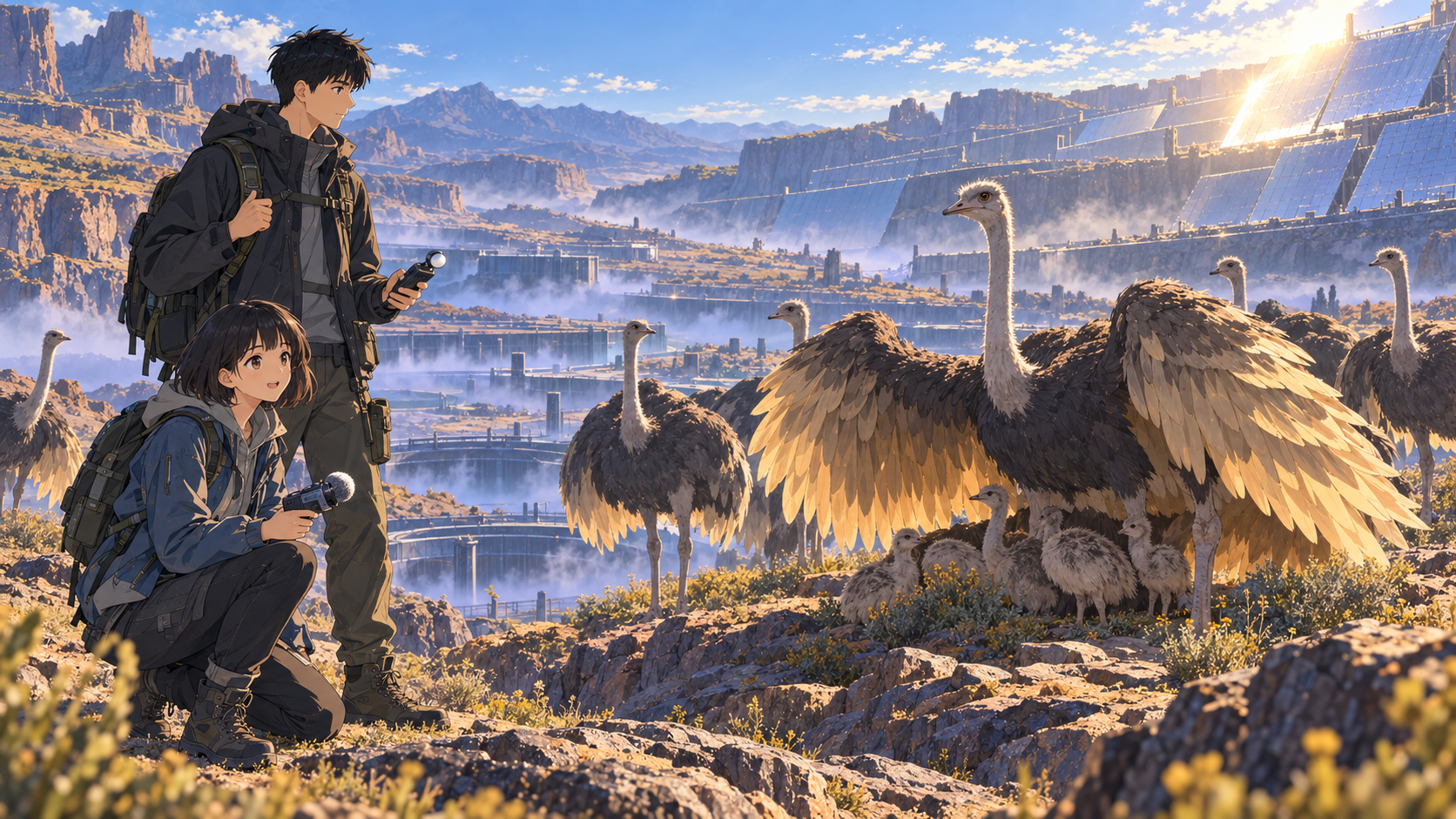
These flightless birds form a half arc and take turns opening layered wing feathers into heat screens. The adults keep chicks and the seed slope inside the shade, step across black-glass rubble on powerful two-toed legs, and wait for a genuine drop in surface temperature before moving. Their crops carry drought-tolerant seeds, which fall onto cooled sand as the flock follows the restored cold-air line.
Observation TypeField observation
First SeenDay 03 · Day 03 · Wind-Curtain Ostrich Valley
HabitatDry ocher valleys beyond the Atlas Gate, abandoned solar-mirror terraces, black-glass scree, seed slopes, underground cooling tunnels, and three night-cooling wells within the Lights-Out Cold-Well Corridor
VariantsGray-down chicks, three-meter gray-necked adults, and protective seed-carrying flocks of six to ten birds
Habitat and Mechanism
Dry ocher valleys beyond the Atlas Gate, abandoned solar-mirror terraces, black-glass scree, seed slopes, underground cooling tunnels, and three night-cooling wells within the Lights-Out Cold-Well Corridor. The abandoned mirror field gathers heat by day. At night, the mirrors should lock into a lights-out angle so descending valley air can pass through underground tunnels and rise from three cold wells as the Night Cooling Return Tide. A restarted controller mistook the flock's moving shade for dirt on the mirrors. Whenever adults turned to shelter their chicks, the array added another band of oblique heat, forcing the flock away from the cold-air seed route.
Enter Lights-Out Cold-Well Corridor ↗Behavior and Ecological Role
These flightless birds form a half arc and take turns opening layered wing feathers into heat screens. The adults keep chicks and the seed slope inside the shade, step across black-glass rubble on powerful two-toed legs, and wait for a genuine drop in surface temperature before moving. Their crops carry drought-tolerant seeds, which fall onto cooled sand as the flock follows the restored cold-air line.
The mirror field's pursuit of their wing-curtain shadows forces the flock to keep rerouting, exposing a cleaning routine that is tracking living animals and extending daylight heat. Once the human system stops following those shadows, the flock can reopen a seed route between the dry valley and the cooling corridor without being captured, handled, or directed.
Form and Identification
Gray-down chicks, three-meter gray-necked adults, and protective seed-carrying flocks of six to ten birds
- Biologically plausible ostrich and ratite anatomy, with no capacity for flight
- Adults approximately three meters tall with long bare gray necks
- Powerful two-toed legs suited to stable movement across black-glass rubble
- Matte charcoal body plumage and layered sand-gold wing feathers opened as shade
- Protective half-arc formations around gray-down chicks and seed-bearing slopes
Observation Rule
Fang and K do not chase, trap, touch, sample, redirect, bait, aim at, strike, or use the ostriches as test subjects. Fang takes noninvasive measurements outside the activity boundary. K changes only the human-made tracking system, keeps active equipment off and weapons secured, and does not restart the array for a second confirmation. The flock preserves its own formation and chooses its own route.
At Wind-Curtain Ostrich Valley, six adults closed into a half arc before the first oblique hot spot crossed the slope. They opened their layered wings over the chicks and seed slope while keeping their necks oriented toward the mirror rows. Fang measured the temperature difference from beyond the activity boundary. K disabled active scanning and recorded the mirror angles without touching the flock or changing its formation.