A Map That Was Still Alive
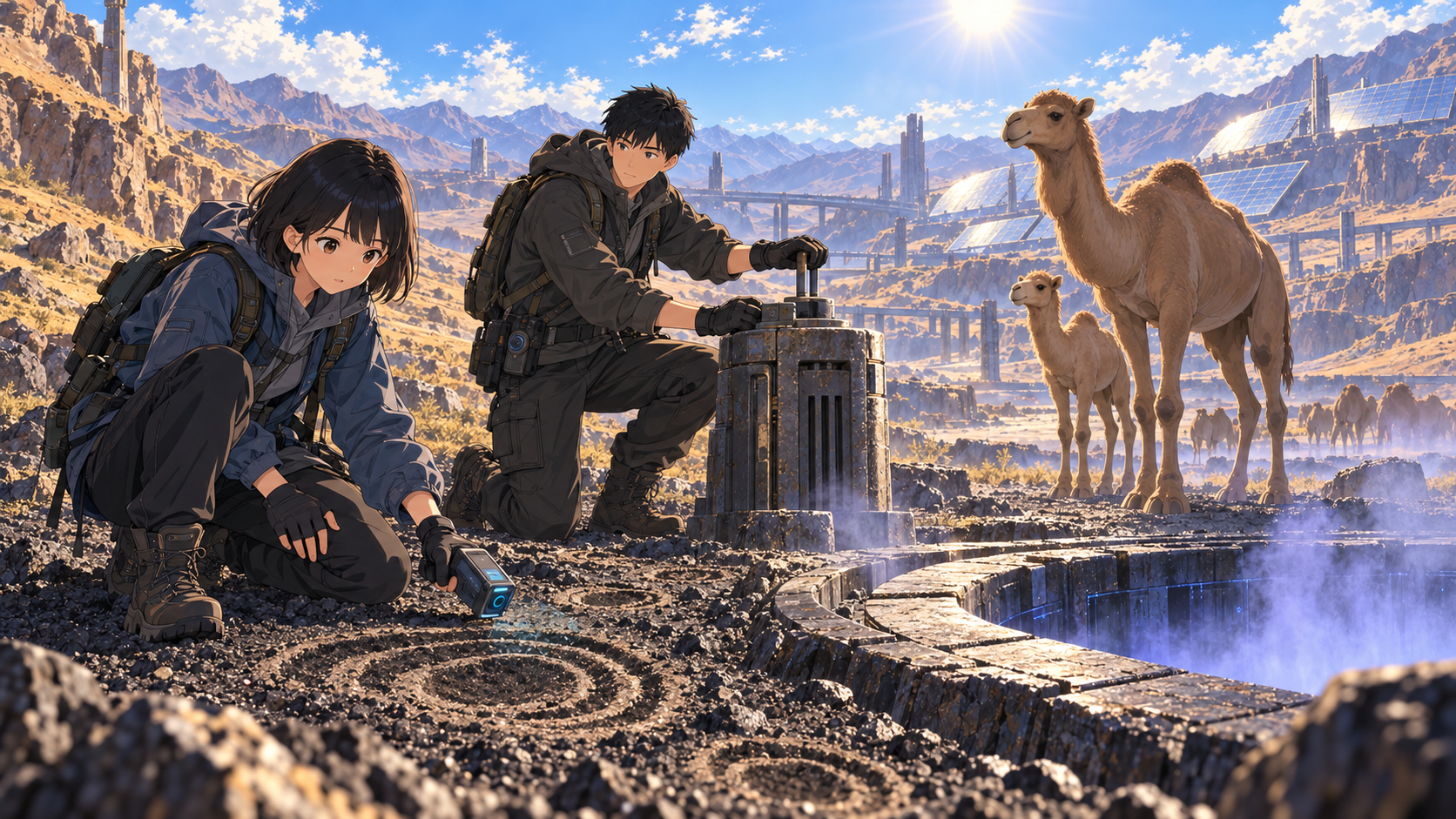
There was no usable city navigation at Route-Memory Camel Marker. The weathered signs had lost half their outlines, but three generations of camels still stopped between them in matrilineal order. The lead female lowered the resonance sac beneath her throat. A short call ran across the black-glass slope. A calf repeated it several steps later. Fang checked the mist from beyond their activity line. I shut active positioning down. The herd was not lost. It was a map that was still alive.

Field Observation
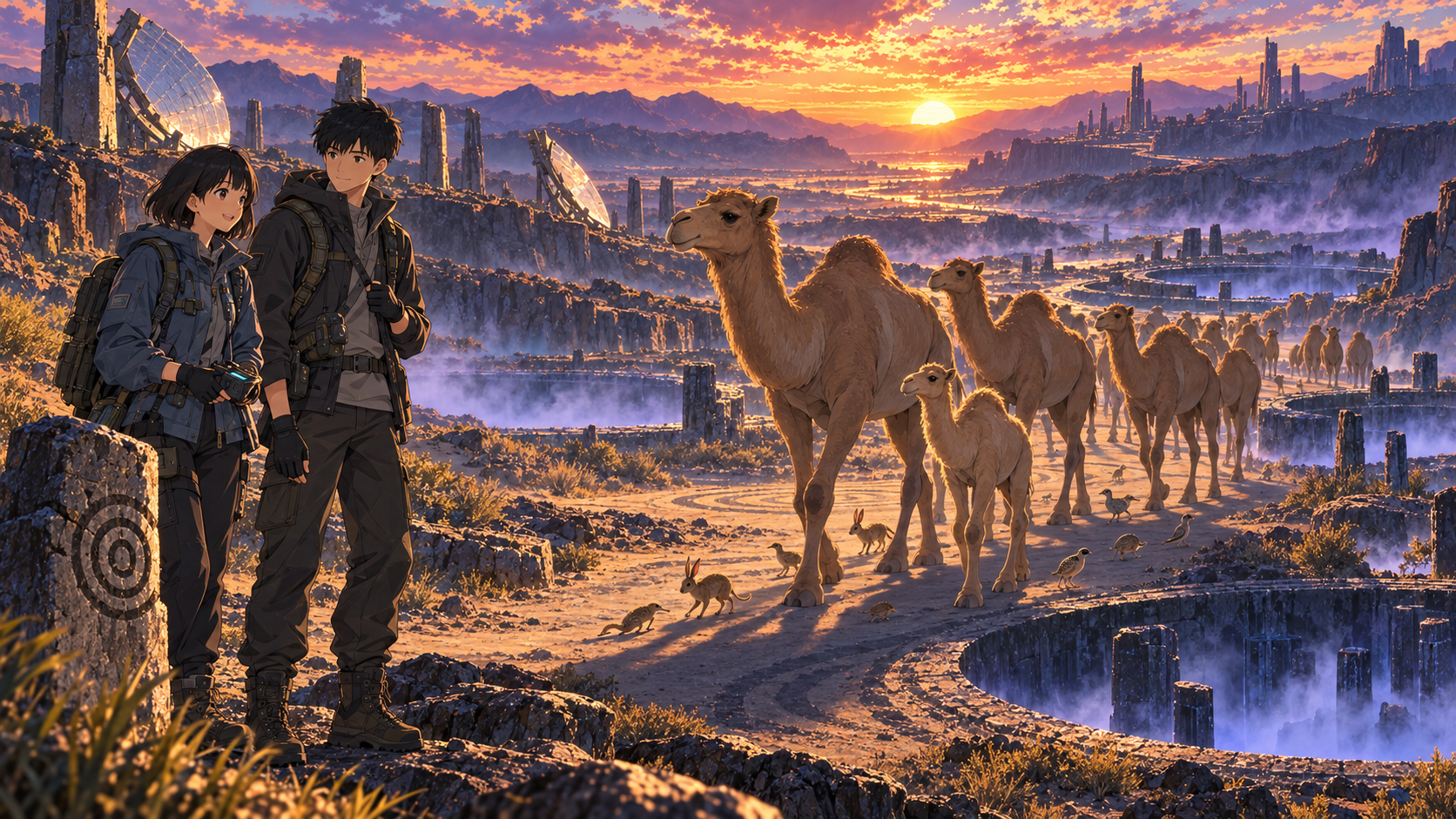
At dawn, we reached Route-Memory Camel Marker and learned how three generations read cold air through calls and inherited pad marks. At noon, Fang traced the rings around Third Cold-Well Ring while I powered down the port navigation pulse masking their route. Before sunset, we withdrew behind the safety marker at Well-Pattern Corridor, sent no instructions, and let the herd reconnect all three wells in its own order.
Morning · Route-Memory Camel Marker
The herd waited until air returned through the correct stone fissure. Only then did the lead female set a broad pad inside a ring left by the generation before her. Fang crouched outside the route and compared the cold mist inside the marker with the flow along the ground. I kept only passive wind readings and stood between her and the old mirror field. The camels did not approach, and they had not stopped because of us. Their compact humps, pale rib folds, and low calls were all part of the same instrument: a body built to remember where the valley cooled. My weapon stayed on its restraint. I entered the first line in the record: the route exists; the human signal is wrong.
Noon · Third Cold-Well Ring
Noon exposed every print. The concentric marks did not point toward the nearest water. They linked the three cold wells in sequence. At regular intervals, a clean geometric interference pattern from the port navigation pulse cut across them. Fang compared depth and stride from the outer ring. She took no hair and touched no animal. I opened the old transmitter beside the well and returned the signal masking the inherited path to an unpowered state. The adult female remained across the ring. A calf stayed in her shadow until all ground vibration stopped. The old route did not return at once. The herd listened first. Then the oldest animal took one step. Fang signaled that I should not send a test pulse. I did not. A city system would ask for a return value to prove the repair. The only return worth trusting was their decision to place the next mark.
Evening · Well-Pattern Corridor
Before sunset, one ribbon of blue-violet mist finally joined all three wells. Fang and I withdrew behind the safety marker and sent no further instructions. The adult female crossed the first well. The others formed a loose line by age, and the calves stepped into the shallower rings without leaving the formation. Smaller nocturnal mammals and ground birds waited inside the herd's broad shade, crossing the black-glass rubble only after the mirror light moved away. Fang lowered her instrument to her waist and recorded only airflow, prints, and passage time. I confirmed that port navigation remained off. When the lead female reached the third well, she looked back and gave one low call. Only then did the line open. We had not built this route, and I did not mark it as ours. My last entry was shorter: three wells connected; passage returned.
Habitat Causality
The mirror terraces collect heat by day. At night, they must lock into a lights-out angle so descending valley air can pass through underground tunnels and rise from three cold wells. A navigation pulse overlaid the camels' inherited track, cutting through their concentric pad marks with regular interference and adding false ground vibration. Once K powered the transmitter down, the herd could again use airflow, resonance, and matrilineal memory to verify the route. Reconnecting the wells also restored a shaded crossing for smaller animals.
Species Behavior
Well-Pattern Route-Memory Camels travel in a loose matrilineal line. Adults use throat resonance, pale rib cooling folds, and broad patterned pads to read air and leave route information. Calves repeat calls after a delay and follow shallower inherited rings. The oldest female does not move until vibration falls silent, and the formation waits long enough for smaller animals to shelter in its shade.
「Fang said they were preserving more than memory. They were preserving an order other lives could use. There was no prey today and no victory. I kept the navigation silent and left the route unnamed on our system. It already had owners.」