Well-Pattern Route-Memory Camel Herd
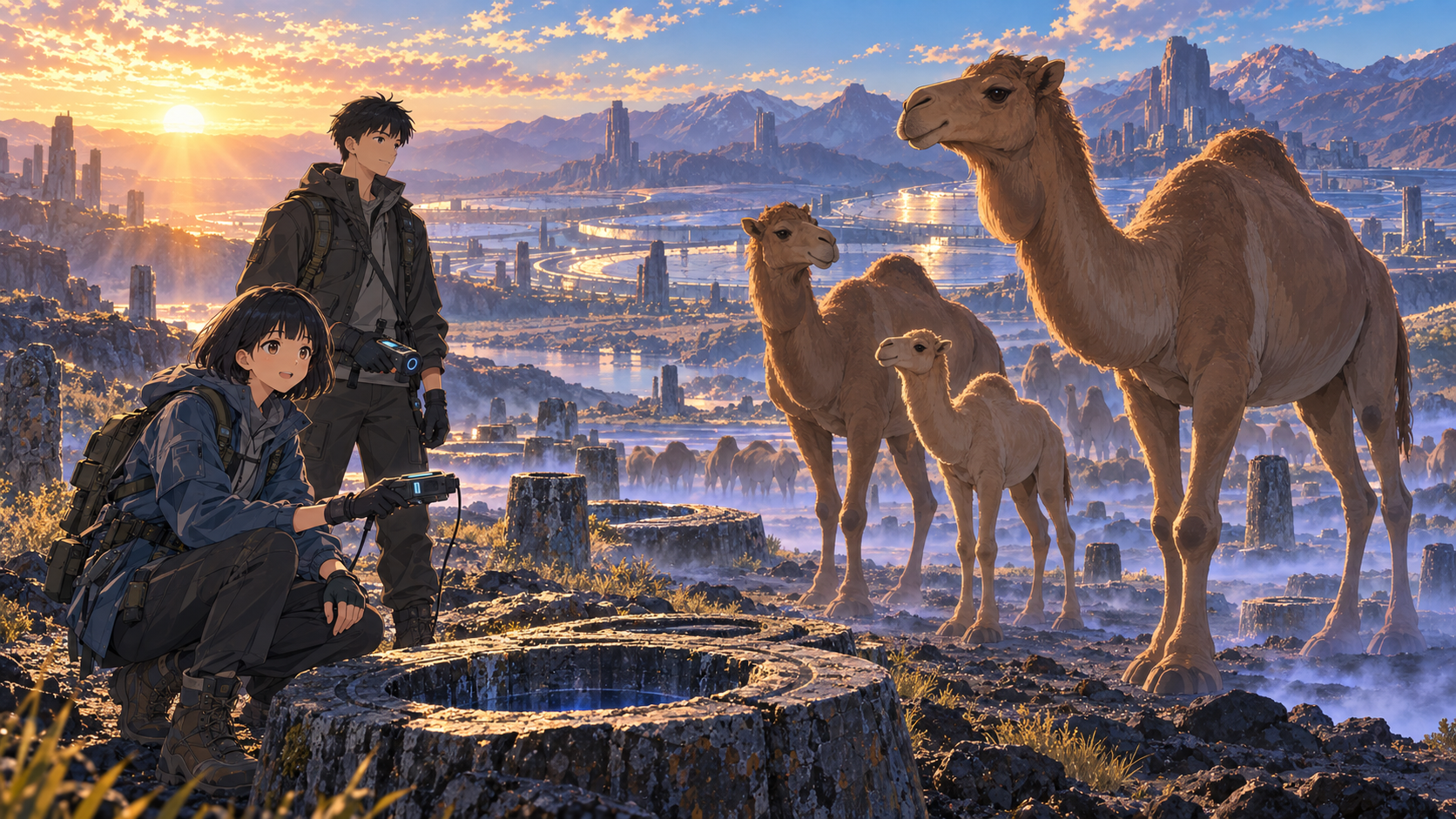
The herd stops at weathered markers in matrilineal order. Adults lower their throat sacs and send short resonant calls through the black-glass slope, then wait for cold air to return through the correct fissure. Broad pads leave concentric route marks linking the three wells. The oldest female takes the first step only after ground vibration ceases, while calves follow shallower inherited prints. The formation also holds long enough for smaller nocturnal animals to enter its shade.
Observation TypeField observation
First SeenDay 04 · Day 04 · Route-Memory Camel Marker
HabitatThe dry ocher valley beyond Atlas Gate, with abandoned solar-mirror terraces, black-glass scree, weathered well markers, underground cooling tunnels, and three night-cooling wells in the Lights-Out Cold-Well Corridor
VariantsLight-brown calves whose pad patterns are still shallow, four-meter rock-brown adults, and small matrilineal groups in which three generations travel together
Habitat and Mechanism
The dry ocher valley beyond Atlas Gate, with abandoned solar-mirror terraces, black-glass scree, weathered well markers, underground cooling tunnels, and three night-cooling wells in the Lights-Out Cold-Well Corridor. The mirror terraces should collect heat by day and lock into a lights-out angle after sunset, allowing descending valley air to pass through underground tunnels and rise from three cold wells. A port navigation pulse overlaid the inherited route and interrupted the concentric marks left by the herd. Powering that pulse down restored quiet ground and let the camels verify the route through airflow, vibration, and memory rather than human guidance.
Enter Lights-Out Cold-Well Corridor ↗Behavior and Ecological Role
The herd stops at weathered markers in matrilineal order. Adults lower their throat sacs and send short resonant calls through the black-glass slope, then wait for cold air to return through the correct fissure. Broad pads leave concentric route marks linking the three wells. The oldest female takes the first step only after ground vibration ceases, while calves follow shallower inherited prints. The formation also holds long enough for smaller nocturnal animals to enter its shade.
The herd preserves a verifiable cooling route when city navigation fails. Its multigenerational sequence identifies the order in which the main mirrors must be locked out, reconnects the three cold wells, and creates a moving shaded passage for smaller animals without requiring capture, herding, or imposed direction.
Form and Identification
Light-brown calves whose pad patterns are still shallow, four-meter rock-brown adults, and small matrilineal groups in which three generations travel together
- Biologically plausible dromedary anatomy with one compact hump
- Adults approximately four meters tall, accompanied by smaller light-brown calves
- Broad matte pads that leave concentric well-pattern marks on black-glass scree
- Pale cooling folds along the ribs and restrained resonance sacs beneath the throat
- A loose matrilineal line ordered by age, with calves stepping into shallower inherited prints
Observation Rule
Fang and K do not capture, touch, sample, herd, bait, chase, aim at, or command the camels. Fang reads only naturally left prints, mist, airflow, and passage times. K changes only the human navigation system, keeps active signals off and his weapon secured, and does not claim the restored route as a human achievement. The matriarch chooses the first step, the herd maintains its own order, and passage belongs to the animals using it.
At Route-Memory Camel Marker, three generations paused among half-erased well signs. The lead female lowered her throat sac and sent a short call across the slope; a calf repeated it several steps later. Fang compared mist inside the marker with the surface flow from beyond the herd's activity line. K disabled active positioning and kept only passive wind readings. The herd approached neither observer. It waited for air from the correct fissure, then pressed its pads into the previous generation's rings.