Floating-Seed Quill Porcupine
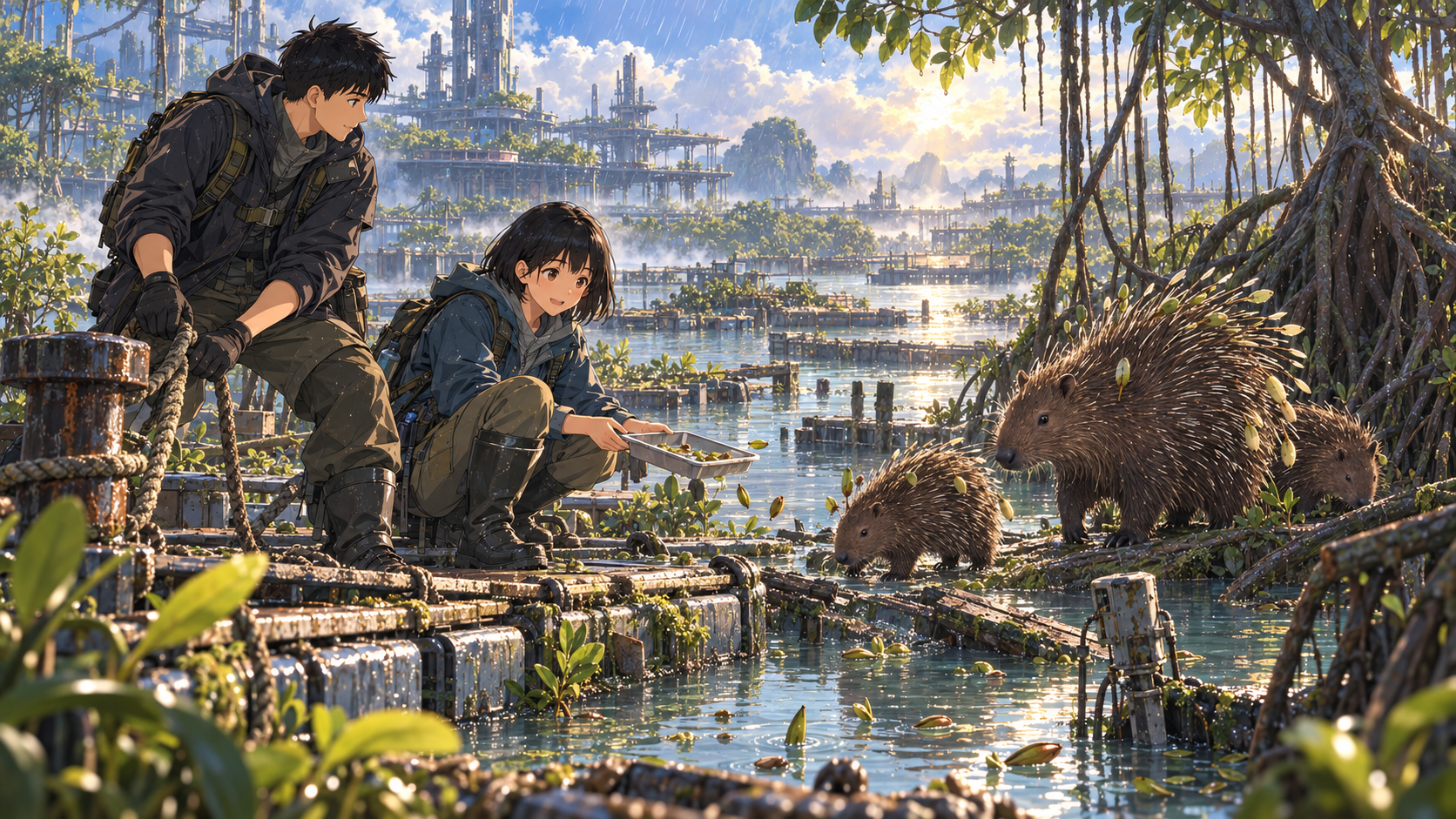
The broad, barbless ends of the chestnut quills pick up floating seeds without piercing them. Wide splayed toes spread body weight between rafts and wet roots. Families use raised mounds as seed caches and avoid root rafts destabilized by reverse flow. After the pump sequence slows and the rafts settle, they return without being driven and transport seeds across washed-out mud ridges.
Observation LevelCoastal field note
First SeenDay 02 · Day 02 · First Floating Seed Raft
HabitatFloating seed rafts, wet mangrove roots, raised seed-cache mounds, and replanted mud forks within the Rain-Vein Floating-Root Seedbank
VariantsSoft-quilled juveniles, adults with pale basket-like quill tips, and seed-caching family groups of two to four
Habitat and Mechanism
Floating seed rafts, wet mangrove roots, raised seed-cache mounds, and replanted mud forks within the Rain-Vein Floating-Root Seedbank。Detachable seed rafts preserve salt-tolerant crops and wild seed stock as monsoon water redraws the delta. A fixed reverse pump flow broke the rafts' continuity and stripped seeds from low mud ridges. The porcupines avoided the unstable sections and concentrated their caches on higher embankments. Their tracks, quill-borne seeds, and cache locations mapped the breaks. When people secured only the loose artificial cables and slowed the pump sequence, the root rafts stabilized and the animals carried seeds back across the emptied ridges on their own route.
Enter Rain-Vein Floating-Root Seedbank ↗Behavior and Ecological Role
The broad, barbless ends of the chestnut quills pick up floating seeds without piercing them. Wide splayed toes spread body weight between rafts and wet roots. Families use raised mounds as seed caches and avoid root rafts destabilized by reverse flow. After the pump sequence slows and the rafts settle, they return without being driven and transport seeds across washed-out mud ridges.
The porcupines reconnect the seedbank by carrying viable seeds between separated rafts and exposed mud. A sudden concentration of caches on high ground shows where reverse flow has broken the network. Their voluntary return across stabilized roots shows that the monsoon dispersal route is becoming continuous again.
Form and Identification
Soft-quilled juveniles, adults with pale basket-like quill tips, and seed-caching family groups of two to four
- Biologically plausible semiaquatic porcupine anatomy at roughly one meter in length
- Matte chestnut quills with pale, broad, barbless seed-carrying tips
- Broad splayed paws adapted to floating rafts and wet roots
- Compact muzzle, short buoyant tail, and cautious family groups of two to four
- Floating mangrove seeds carried on quill tips without hooks or forced attachment
Observation Rule
Fang and K do not chase, aim at, touch, capture, relocate, or redirect the porcupines. Fang collects only naturally shed seeds and quills from outside the family range. K secures artificial cables and restores the root raft without entering cache burrows, while active weapons remain stowed and a retreat route stays open. The family decides when and where to return.
At First Floating Seed Raft, changing rain pressure, raft height, and old sensor readings framed the animals' route. Fang separated quill-borne seeds, broad-toed tracks, and cache locations into repeatable evidence. K remained on the outside, marked load points, waterlines, and retreat routes, and kept every active weapon stowed.