Magnet-Whisker Crab
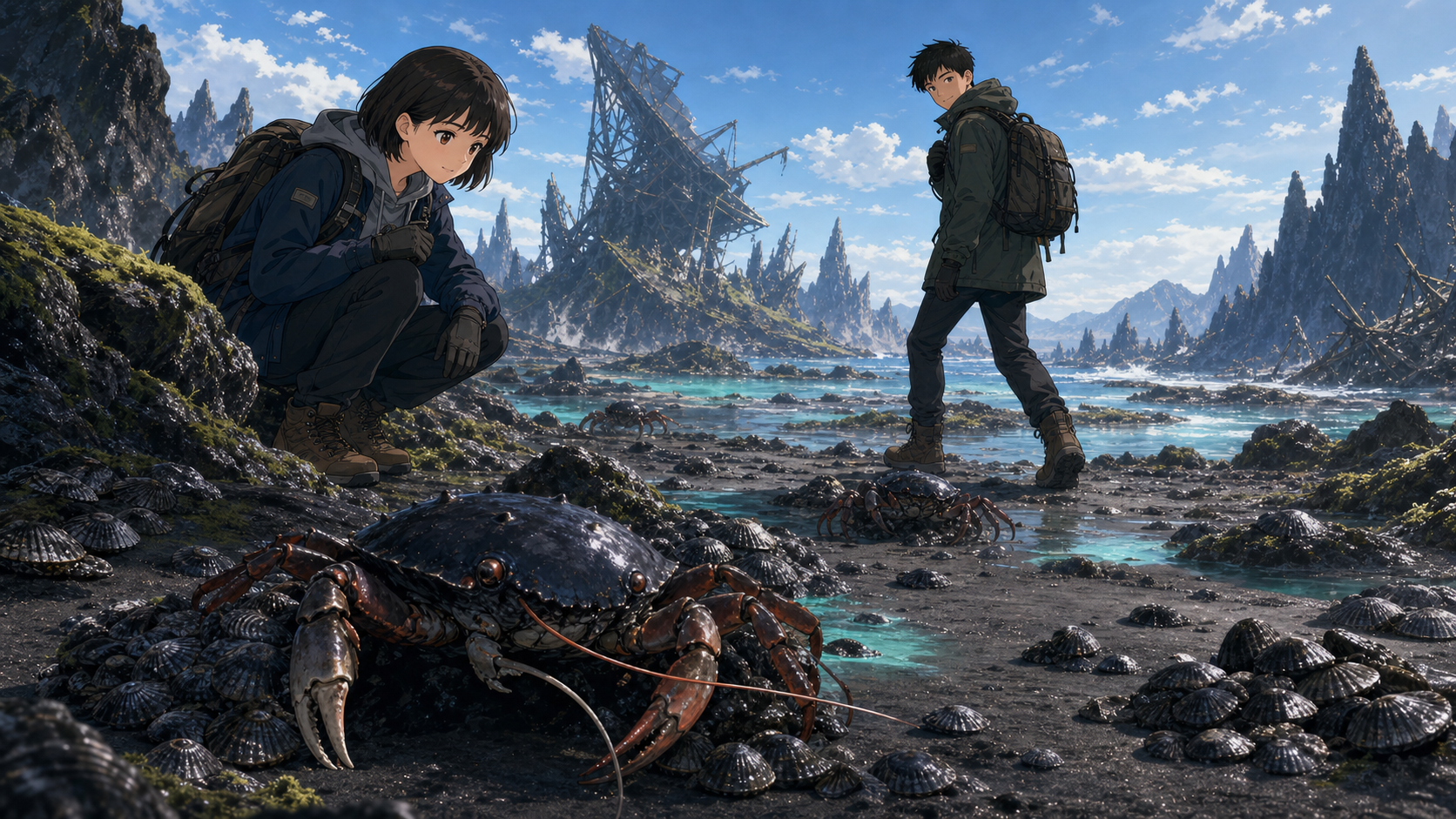
The crabs use two long magnetosensory whiskers to find limpet eggs, algae clumps, and detritus after low tide. They drag discarded shells to stabilize burrow entrances and follow established carrying routes across the reef. They remain wary but do not attack; when observers step outside the route, they continue working. When a group exchanges shells, the movement produces a brief wave of metallic sound.
Observation LevelCoastal field note
First SeenDay 03 · Day 03 · Collapsed Radar Reef
HabitatBlack-sand reef flats, exposed maintenance trenches, and low-tide channels inside Broken-Needle Thermal Fjord
VariantsRust-red soft-shelled juveniles, adults with carapaces roughly one meter across, and groups that share connected burrows
Habitat and Mechanism
Black-sand reef flats, exposed maintenance trenches, and low-tide channels inside Broken-Needle Thermal Fjord。The crabs concentrate magnetized discarded limpet shells around their burrows. The densest shell trails coincide with the strongest residual current, tracing the still-live radar cable beneath the black sand without exposing it.
Enter Broken-Needle Thermal Fjord ↗Behavior and Ecological Role
The crabs use two long magnetosensory whiskers to find limpet eggs, algae clumps, and detritus after low tide. They drag discarded shells to stabilize burrow entrances and follow established carrying routes across the reef. They remain wary but do not attack; when observers step outside the route, they continue working. When a group exchanges shells, the movement produces a brief wave of metallic sound.
Their daily movement of magnetized shell fragments turns hidden electrical activity into a visible map, allowing the buried cable to be traced without opening a burrow or moving an animal.
Form and Identification
Rust-red soft-shelled juveniles, adults with carapaces roughly one meter across, and groups that share connected burrows
- A reef-crab body about one meter across
- Cobalt-black carapace with rust-red joints
- Two long magnetosensory whiskers
- Asymmetrical but biologically plausible claws and sturdy walking legs
- Discarded magnetite limpet shells arranged around burrow entrances
Observation Rule
Fang and K stay outside the carrying line, use a remote probe, leave every burrow intact, and wait for the crabs to pass before moving. The route remains the crabs' route, even when the mission is urgent.
At Collapsed Radar Reef, the crabs had arranged old shells more neatly than an engineering crew. Fang held back a laugh. K moved one boot outside their carrying line, and the crabs kept fortifying their black-sand burrows instead of approaching.