Lava-Vein Double-Crown Giant Bovid Herd
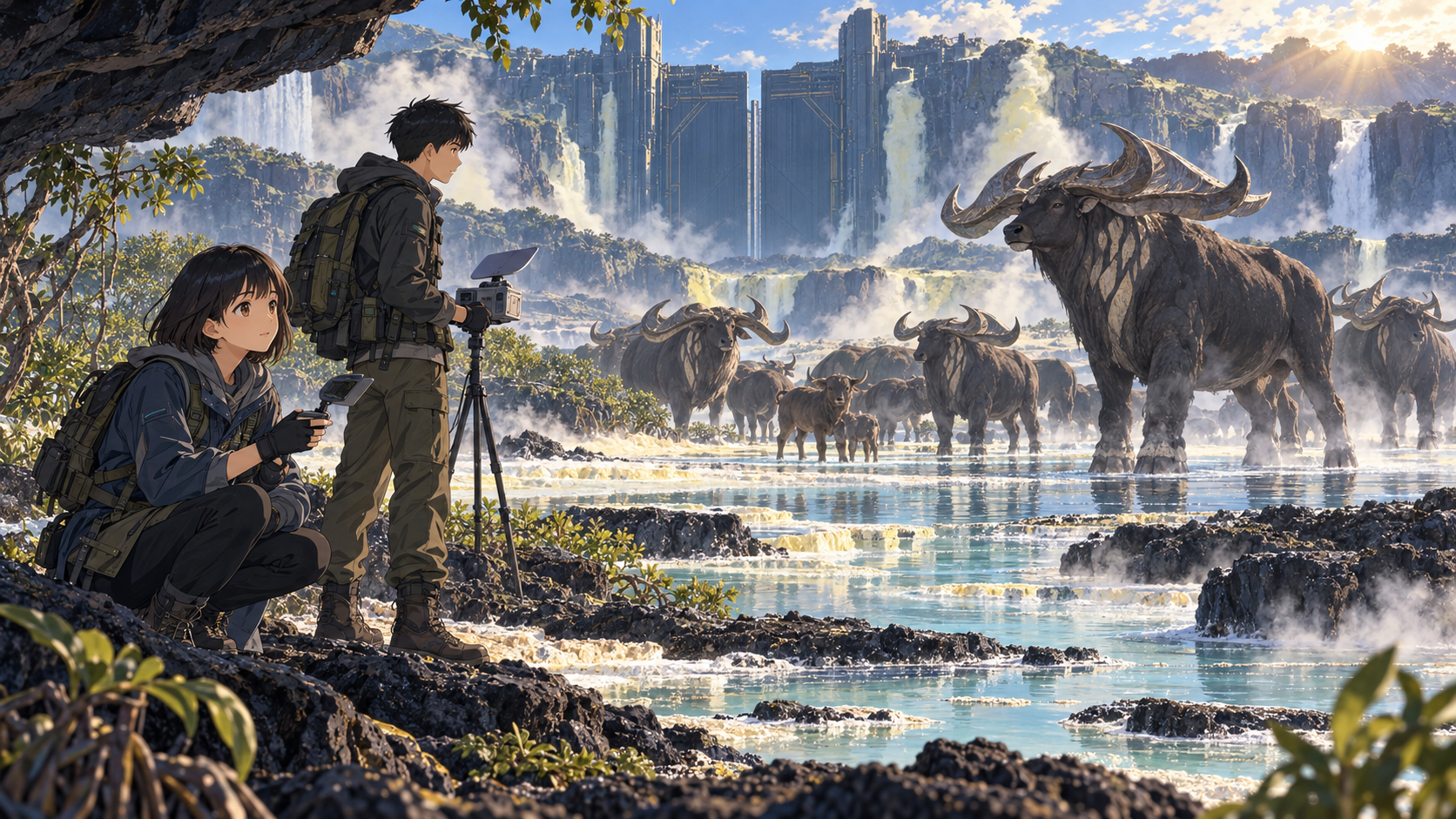
The herd reads subsurface heat veins through resonance in its double-layered horn crowns. Pale windows along the neck release body heat, and immense split hooves cross hot mud while spreading each step's pressure through the marsh. When a false tremor threatens calves, the bull stands broadside across the remaining gap instead of charging. During passage, calves stay inside the formation, adult cows use their crowns to separate them from sulfur-spring edges, and the bull leaves the dike last.
Observation LevelCoastal field note
First SeenDay 05 · Day 05 · Double-Crown Migration Gate
HabitatGeothermal salt marsh, restored cold pools, salt-tolerant grass bands, black-lava approaches, recharge channels, and the segmented high-dike passage within the Earthsong Cold-Spring Migration Gate
VariantsDeep-brown calves whose double crowns have not yet closed, eleven-meter matte-charcoal adults, a maternal migration herd, and one gate-guarding bull
Habitat and Mechanism
Geothermal salt marsh, restored cold pools, salt-tolerant grass bands, black-lava approaches, recharge channels, and the segmented high-dike passage within the Earthsong Cold-Spring Migration Gate。Dry cold pools and the remaining false geothermal pulse trapped the maternal herd outside a closed high-dike gate. The animals' double horn crowns amplified the false rhythm into a territorial low resonance, while the gate-guarding bull blocked the only gap between the mothers, calves, and wall. Fang aligned the wild dogs' restored safety rhythm with the herd's horn resonance and found a thirty-seven-second window without natural microtremors. K cut the false output before raising the Ninth Condensation Sluice only high enough to release cold mist and recharge water. The herd crossed only after the cold pools returned, and the gate was reset to open when both natural microtremors and cold-water level allowed it.
Enter Earthsong Cold-Spring Migration Gate ↗Behavior and Ecological Role
The herd reads subsurface heat veins through resonance in its double-layered horn crowns. Pale windows along the neck release body heat, and immense split hooves cross hot mud while spreading each step's pressure through the marsh. When a false tremor threatens calves, the bull stands broadside across the remaining gap instead of charging. During passage, calves stay inside the formation, adult cows use their crowns to separate them from sulfur-spring edges, and the bull leaves the dike last.
The herd is the largest moving force in this geothermal corridor. Its passage reopens the ancient large-animal route only when cold pools, grass bands, true microtremors, and a safe gate interval align. Dung left in its tracks supplies seed-rich material to Salt-Porcelain Seed Beetles, which restore the salt-tolerant grass band and reconnect traction, forage, and migration across the corridor.
Form and Identification
Deep-brown calves whose double crowns have not yet closed, eleven-meter matte-charcoal adults, a maternal migration herd, and one gate-guarding bull
- Believable heavy African-bovid-derived bodies reaching roughly eleven meters in height
- Immense double-layered horn crowns sweeping laterally from the head
- Matte charcoal hide with pale heat-release windows along the neck
- Huge split hooves with stone-like pads adapted to hot mud
- A maternal formation with calves protected inside and one bull holding the gate line without charging
Observation Rule
Fang and K do not charge, herd, bait, tranquilize, strike, aim at, or force the bovids into formation. Fang observes from beyond the territorial boundary and uses the wild dogs' voluntary relay only as an environmental signal. K works on the city's pulse and sluice, keeps weapons stowed, opens the passage in stages, and withdraws before the herd moves. The herd decides whether and when to cross, maintains its own maternal order, and leaves the gate under its own power.
At Double-Crown Migration Gate, the ground felt like another heart. The herd stood in sulfur mist while its horn crowns amplified the residual fixed pulse. The bull did not charge. It held its body across the only gap between the maternal group and the wall. Fang separated breathing, true microtremors, and the human-made rhythm with a distant noninvasive BCI. K shut down every active instrument and remained beyond the bull's territorial line.