Warm-Fissure Ceramic-Barbel Catfish
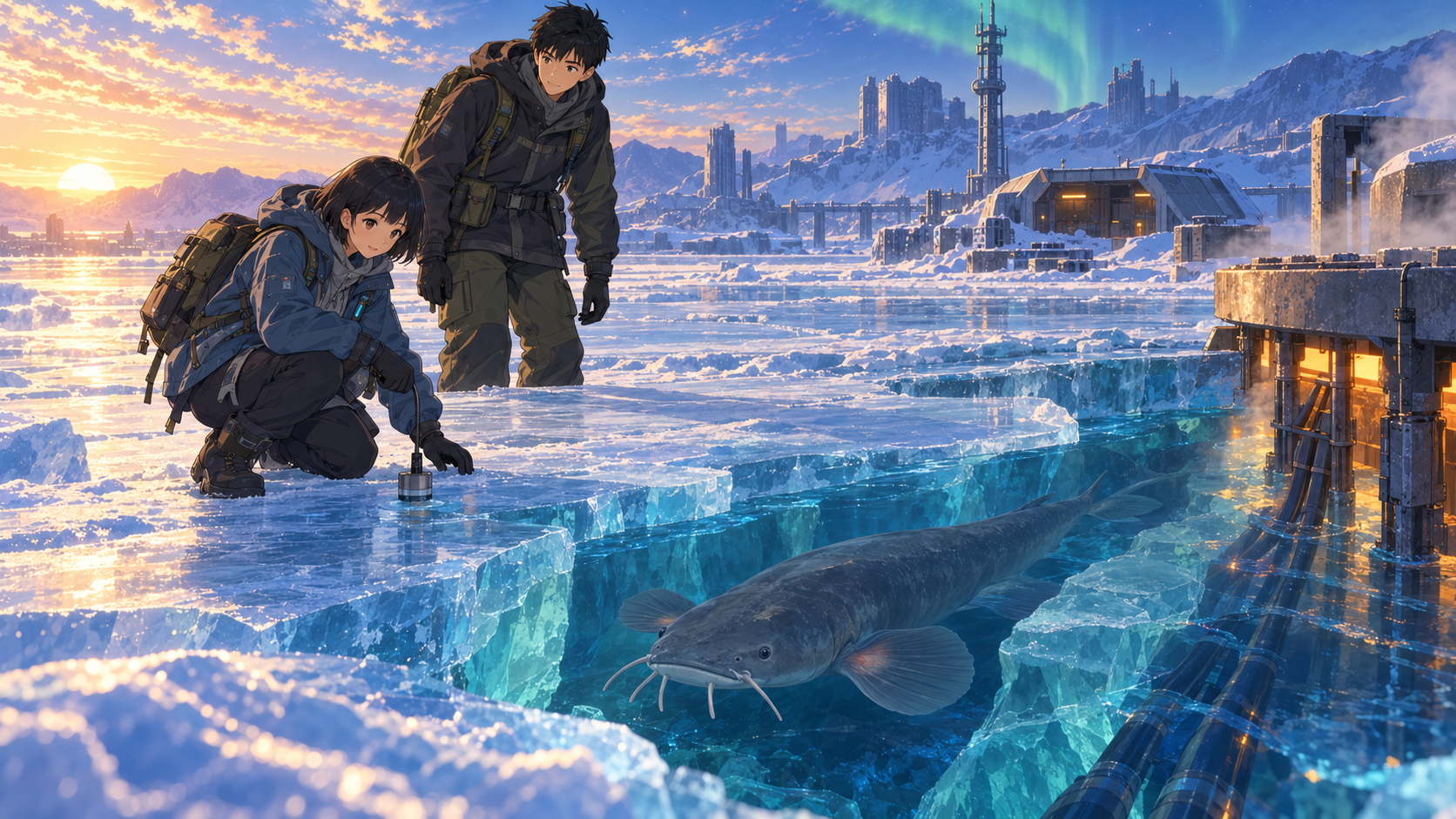
Six short, blunt, porous barbels read salinity and residual cable heat. Countercurrent heat-exchange sacs at the pectoral-fin bases direct warm brine beneath the body. The fish feed on under-ice annelids and small mollusks that fall into the fissure. They approach the overheated return-water inlet, turn back to the natural warm fissure, and keep foraging along its brine line. After the channel diverts the warm water, two fish swim through the cable well again, an adult moving its pectoral fins gently with a juvenile behind it.
Observation LevelCoastal field note
First SeenDay 02 · Day 02 · Warm-Fissure Cable Well
HabitatA natural warm brine fissure beside the sunken under-ice data cable east of New Scandia Ice Harbor. The nearby cable well and human-made return-water inlet lie among old city roofs half buried in blue ice.
VariantsDark gray juveniles with short barbels, slate-gray adults about 1.5 meters long, and small groups of two to four fish following the same brine seam.
Habitat and Mechanism
A natural warm brine fissure beside the sunken under-ice data cable east of New Scandia Ice Harbor. The nearby cable well and human-made return-water inlet lie among old city roofs half buried in blue ice.。Aurora current, under-ice brine tide, and natural windbreaks sustain the Frostlamp–Sunken-Cable Rhythm. The harbor's fixed-frequency de-icing pulses prematurely melt snow ridges, block brine breathing holes, and mask the animals' low-frequency bearings. Continuous heat also overheated the water beside the cable. Three cable joints had swollen from the heat, and warm water was running toward thin ice. The catfish repeatedly turned away from the inlet and followed the one natural fissure that still held a stable salinity and temperature gradient. Opening the Blue-Brine Diversion Channel first carried the warm water outside the thick-ice route; only then could the de-icer be turned down without using the fish as a test.
Enter Frostlamp Sunken-Cable Windbreak Ring ↗Behavior and Ecological Role
Six short, blunt, porous barbels read salinity and residual cable heat. Countercurrent heat-exchange sacs at the pectoral-fin bases direct warm brine beneath the body. The fish feed on under-ice annelids and small mollusks that fall into the fissure. They approach the overheated return-water inlet, turn back to the natural warm fissure, and keep foraging along its brine line. After the channel diverts the warm water, two fish swim through the cable well again, an adult moving its pectoral fins gently with a juvenile behind it.
The detour identifies three heat-swollen joints and the remaining natural route for brine. The fish are indicators of a fault in human equipment, not a route to force or capture. Their return after the diversion shows that the waterway is passable again without directing their movement.
Form and Identification
Dark gray juveniles with short barbels, slate-gray adults about 1.5 meters long, and small groups of two to four fish following the same brine seam.
- Scaleless slate-gray body with six short, blunt, porous ceramic barbels
- Countercurrent heat-exchange sacs at the pectoral-fin bases
- Juveniles with dark gray short barbels and adults reaching about 1.5 meters
- Small groups of two to four fish following one brine fissure
- A repeated turn away from the overheated cable inlet toward the stable natural fissure
Observation Rule
Fang uses noninvasive sampling from a safe distance. K stops active scanning, keeps his weapon secured low, and stands between Fang and the incoming wind. They adjust the human-made channel and de-icer, never chase or aim at the catfish, and do not make the animals prove the repair.
At Warm-Fissure Cable Well, K shut down active scanning. One slate-gray catfish opened its six short barbels near a cable joint, then turned into the natural fissure. Fang sampled salinity and residual heat from a safe line on thick ice without putting an instrument in the fish's path. K checked the ice and the retreat route, stood on the windward side, and kept his weapon secured low.