
Frostlamp Sunken-Cable Windbreak Ring
The Frostlamp Sunken-Cable Windbreak Ring joins the iceport's human-made cables to the Aurora Microbial Sea and the natural snow ridges of a frozen city. Aurora current creates a faint frostlamp glow along the cables beneath the ice. Brine tides breathe through openings in the sea ice, while bare rock and old towers split the wind into quiet layers that life can use. Sea butterflies, catfish, walruses, snow macaques, and a snowy owl each read light, heat, salinity, sound, or air pressure at a different scale.
- Parent Domain
- NB-10 · North Atlantic Iceport and Siberian Storm Corridor
- Location
- Beyond the fragmented floating-ice platforms east of New Skandia Iceport, an annular buffer zone follows submerged under-ice data cables, half-buried roofs of a frozen old city, bare-rock windbreaks, and abandoned signal towers.
The iceport restarted the old data-cable de-icers to reconnect research towers on the Siberian perimeter. The mistimed heat pulses warmed submerged cables, collapsed windbreaks, and pushed the extremely dangerous snowy owl's nesting territory toward the rescue-tower line. Fang and K had to replace continuous high heat with staggered low-heat cycles, reopen the brine vents, and rebuild the snow-ridge windbreaks. The mission stops outside the canonical magnetic-storm snowfield: it neither depicts nor alters the established Azure Gale Lion-Tiger.
How Frostlamp Sunken-Cable Windbreak Ring Works
The Frostlamp–Sunken-Cable Rhythm depends on aurora-band current, under-ice brine tides, and natural windbreaks working in sequence. A fixed-frequency de-icing pulse from the port heats the cable joints too early, melts through snow ridges, seals brine breathing holes, and masks the low-frequency signals used by wildlife. Aurora-Sail Sea Butterflies warn of the pulse by folding their wing-feet and sinking. Warm-Fissure Ceramic-Barbel Catfish trace salinity and residual cable heat. Frost-Chisel Hammer-Tusk Walruses keep breathing holes open. Tower-Ring Snow Macaques preserve wind and exclusion routes with ceramic insulator rings. The Silent-Pressure Snowy Owl depends on the restored quiet layer for its nesting territory. Together, their responses show whether the ring is still functioning as habitat.
Observation Ethic
Fang and K work from outside feeding bands, family rings, inherited routes, and the owl's pressure boundary. Fang keeps the non-invasive BCI and samplers at a safe distance. K stands between her and the incoming wind or pressure, with every weapon stowed or fixed low. They do not chase, aim at, strike, bait, or redirect wildlife. They change only human equipment—de-icing pulses, cable timing, signal tests, and blocked vents—then leave every species free to remain, pass through, or withdraw.
Five-Day Route
- At Frostlamp Under-Ice Window, use the sea butterflies' folding line to confirm that the heat pulse has crossed its intended boundary.
- At Warm-Fissure Cable Well, follow the catfish patrol to locate swollen cable joints and natural brine-diversion fissures.
- At Hammer-Tusk Breathing Hole, use feeding remains, the calf-protection ring, and thin-ice fractures to define the walruses' High Risk boundary without entering it.
- At Tower-Ring Old-City Ridge, stop the test pulse that masks the ceramic-ring tones and restore the troop's inherited wind-shelter map.
- At Silent-Pressure Owl Boundary, rewrite the main cable's de-icing rhythm and remain outside the pressure line while the owl returns to its remote nesting ridge.
Five species maintaining this local ecology
 Day 01
Aurora-Sail Sea Butterfly
They glide close beneath the ice on two broad, thin wing feet and feed on the aurora-algal film. A visible orange-cyan storage gland runs inside the milky mantle. Before a de-icing pulse arrives, the group folds its sails and sinks in a coordinated line. Once the first mismatched cable connector is switched off and the trough turns cold and dark again, the sea butterflies spread their wing feet and resume their own course beneath the ice.
 Day 02
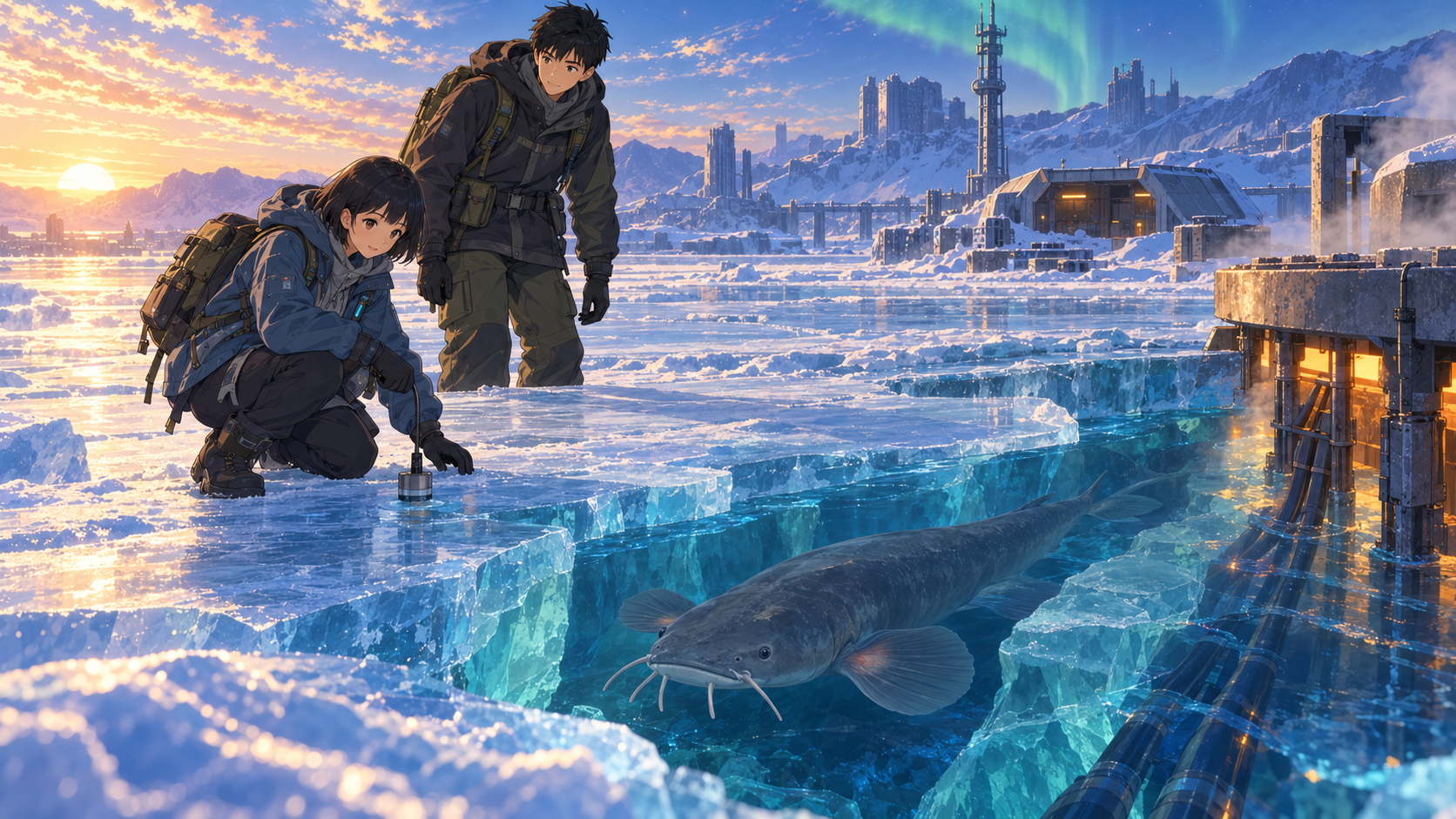
Warm-Fissure Ceramic-Barbel Catfish
Six short, blunt, porous barbels read salinity and residual cable heat. Countercurrent heat-exchange sacs at the pectoral-fin bases direct warm brine beneath the body. The fish feed on under-ice annelids and small mollusks that fall into the fissure. They approach the overheated return-water inlet, turn back to the natural warm fissure, and keep foraging along its brine line. After the channel diverts the warm water, two fish swim through the cable well again, an adult moving its pectoral fins gently with a juvenile behind it.
 Day 03
Frost-Chisel Hammer-Tusk Walrus Herd
Adults use wide, flattened tusks to chisel newly formed ice from the breathing hole. Their whiskers locate beds of bivalves and under-ice cephalopods. Broken shells and a cephalopod beak confirm feeding here. The families form a broad bodily ring around their calves and close the route across thin ice without advancing on Fang and K. After the pulse stops, the guarding male clears the last film of ice and the families guide their calves along their established waterway.
 Day 04
Tower-Ring Snow Macaque Troop
Adults lift fallen ceramic insulator rings with broad hands and hang them on low tower crossbars according to wind direction. Their short tails stay close to their bodies, and hollow white shoulder manes help retain warmth. Three pitches mark sheltered snow caves, a bend around brine breathing holes, and the boundary before the snowy owl's patrol. Young animals copy the pattern beside safe crossbars. New rings do not cover older ones: the arrangement keeps a route learned across generations. Its three-part knocks also signal de-icer timing to walruses and smaller animals. When the tower-line test masks the pitches, several young macaques stop at the platform edge. After the test ends, adults sound the sequence again and leave a sheltered stair passage open without approaching Fang and K.
 Day 05
Silent-Pressure Snowy Owl
She senses pressure through the concentric facial disk and flies low in the quiet layer over snow ridges on nearly soundless, continuous soft-edged feathers. The forked tail works as a pressure rudder when she turns between towers. She hunts large fish in warm fissures, seabirds, and medium-sized mammals. While guarding her young, downwash from a boundary patrol can lift snow cornices and close retreat routes. At first encounter her disk tracked the mistimed main cable from the highest rescue tower. Once the human pulses were reduced, she stopped tracking it, folded out of her low-pressure patrol crouch, and returned along distant towers to her nesting ridge without being driven.
「The synchronized sinking of sea butterflies, the catfish patrol around heated joints, the walruses' guarded breathing holes, the macaques' ceramic-ring map, and the snowy owl's advance toward the rescue towers were all responses to the same mistimed infrastructure. Fang and K did not drive any species away. They segmented the de-icing cycle, reopened the brine vents, restored the snow-ridge windbreaks, and let the Frostlamp–Sunken-Cable Rhythm return. Light, heat, salt, sound, and pressure became readable again. The animals chose their own routes, and the iceport regained a refuge without turning wildlife into tools of repair.」