The Breathing Hole We Left to the Walruses
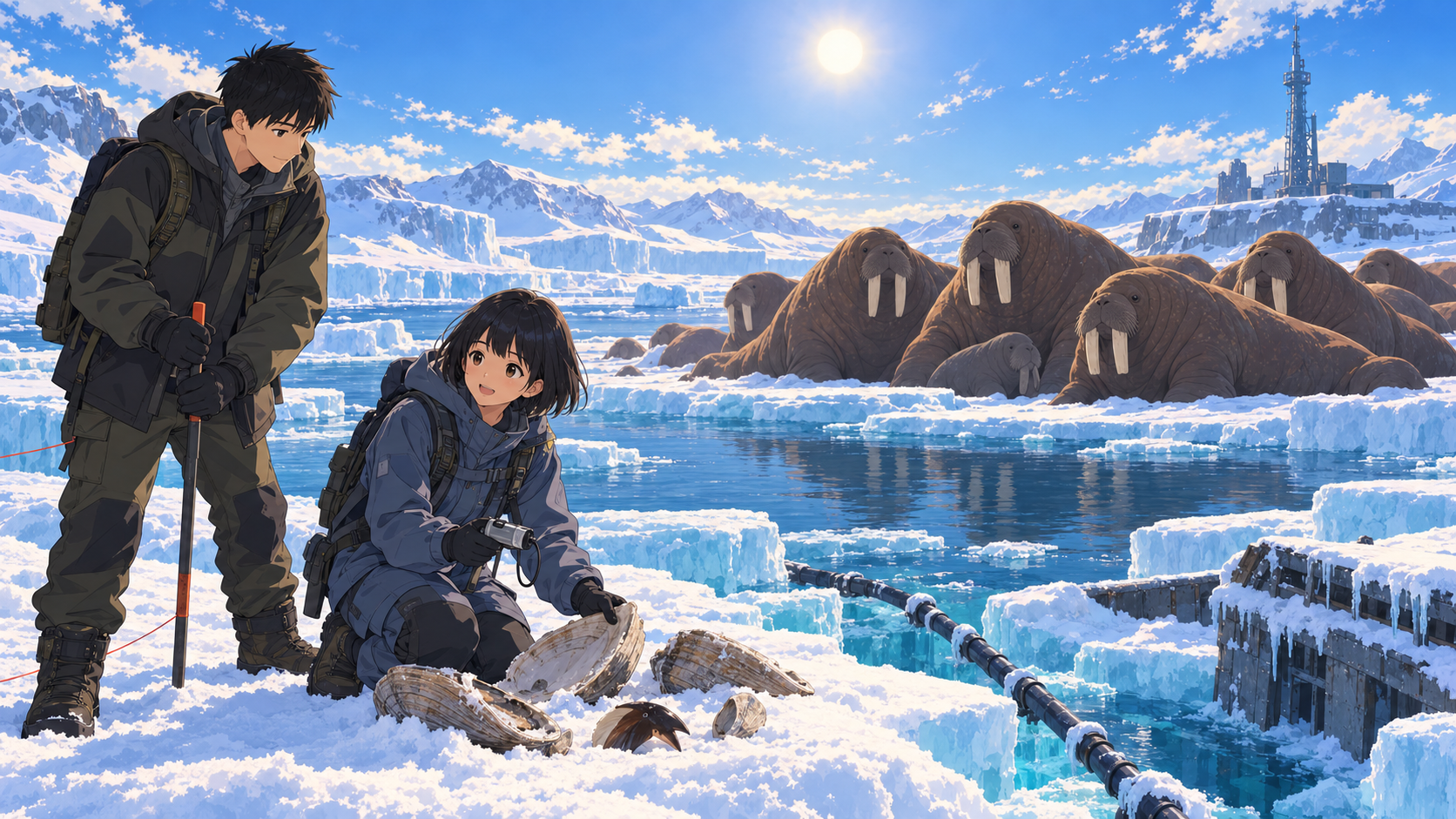
A skin of frost had sealed Hammer-Tusk Breathing Hole again before dawn. Blue light flickered below the sunken cable; the distant signal tower split the wind in two. We stopped on hard ice upwind and shut down active scanning. Across the opening, a gray-brown adult drove its broad, flat tusks through the new ice. Three matrilineal families held their short-tusked calves inside a ring. They did not move toward us, but their bodies closed the path over thin ice.

Field Observation
Morning at Hammer-Tusk Breathing Hole: observe the herd and its feeding traces. Noon at Bivalve Snowbank: sample from hard ice and locate the overheated cable joint. Evening at Frost-Chisel Breathing Ring: stop continuous de-icing remotely and let the herd clear its own exit.
Morning · Hammer-Tusk Breathing Hole
Fang read the low-frequency signals from across the channel. She gathered brine and ice residue only inside the safe line. I saw broken bivalve shells and one cephalopod beak beneath the thin ice. That was enough to tell us what they ate here. Closer observation would have become interference. The harbor's fixed de-icing pulse came down the cable again. The rim melted, then froze, forcing the herd to chisel the same exit open over and over. I stood on the side the wind pressure came from and marked Fang's way back. She asked if we should move the walruses away. I said no. Our equipment was what needed to leave their air route.
Noon · Bivalve Snowbank
The bank was narrower than the map showed. Sunlight passed through the loose snow, revealing thin ice hollowed from below by a mistimed heat pulse. I marked a retreat on hard ice before switching off the active scan that would cross the breathing hole. Inside the line, Fang picked up two shell fragments and a cephalopod beak. Her passive sampler traced the brine flow. Far away, the families kept their calves in a broad ring. A male at the hole sometimes lifted its flat tusks to break refrozen ice from the rim. We were seeing an order built around feeding and calf protection, not an enemy preparing to strike. Fang found a heated joint below the cable. Here the pulse cut the natural warm fissure off from the safe snow ridge. I mapped the joint and the cracks without crossing the herd's boundary. When she packed the samples, she checked my line; I nodded. We could repair a human machine without asking a whole walrus family to change its route.
Evening · Frost-Chisel Breathing Ring
Two sounds reached us at dusk: wind over the old-city roofs and the cable de-icer still tapping the ice at one fixed frequency. Fang overlaid the day's brine readings on cable temperatures. Continuous heating was making the opening close again and again. She stayed on the stable outer platform while I switched the remote controller off beside her. We did not enter the calf-protection ring or draw a walrus away. Once the heat pulse stopped, water around the rim resumed its slow flow. The guarding male broke the last thin ice with its wide tusks. The families led their calves along their old channel, and a stretch of hard ice emerged again beside our rescue line. Fang said we still had to check tomorrow whether the snow ridge could hold under a new low-heat rhythm. I sealed the equipment log, and we left along the outer retreat route.
Habitat Causality
Aurora current, under-ice brine tide, and natural windbreaks sustain the Frostlamp–Sunken-Cable Rhythm. The harbor's fixed-frequency pulse melts through the snow ridge prematurely, blocks brine breathing holes as their rims refreeze, and masks low-frequency bearings. At the Bivalve Snowbank, a hot joint had hollowed the ice and severed the natural warm fissure from the safe ridge. Fang compared brine readings with cable temperatures; then we stopped continuous de-icing from outside the herd's boundary. Water slowed back to its natural flow. The walruses reopened their breathing route themselves. Tomorrow's lower-heat rhythm still needs a ridge check.
Species Behavior
Seven-meter adults have hammer-flat tusks for chiseling ice, whiskers that find bivalves and under-ice cephalopods, and low insulated chambers of thick chest and belly blubber. Three matrilineal families ringed their short-tusked calves. A guarding male reopened the hole; the families moved along their established waterway on their own.
「The high risk here was more than a seven-meter walrus. Treating a habitat as a machine we could reset at will had turned each breathing hole into a trap. Tonight the herd found its own way out. We only stopped the pulse that should never have kept running.」