The Light Beneath the Ice Lip
A band of light ended beneath the ice lip. I kept the safety line on the rocky shore while Fang measured it; we had no reason yet to say what had broken it.

Field Observation
Morning at Ice-Window Edge: measure the broken light band from rock. Noon at Silica Light Face: record the shells through a passive shore camera. Evening at Algae-Window Slow Current: compare samples and mark the slow current before discussing the dock channel.
Morning · Ice-Window Edge
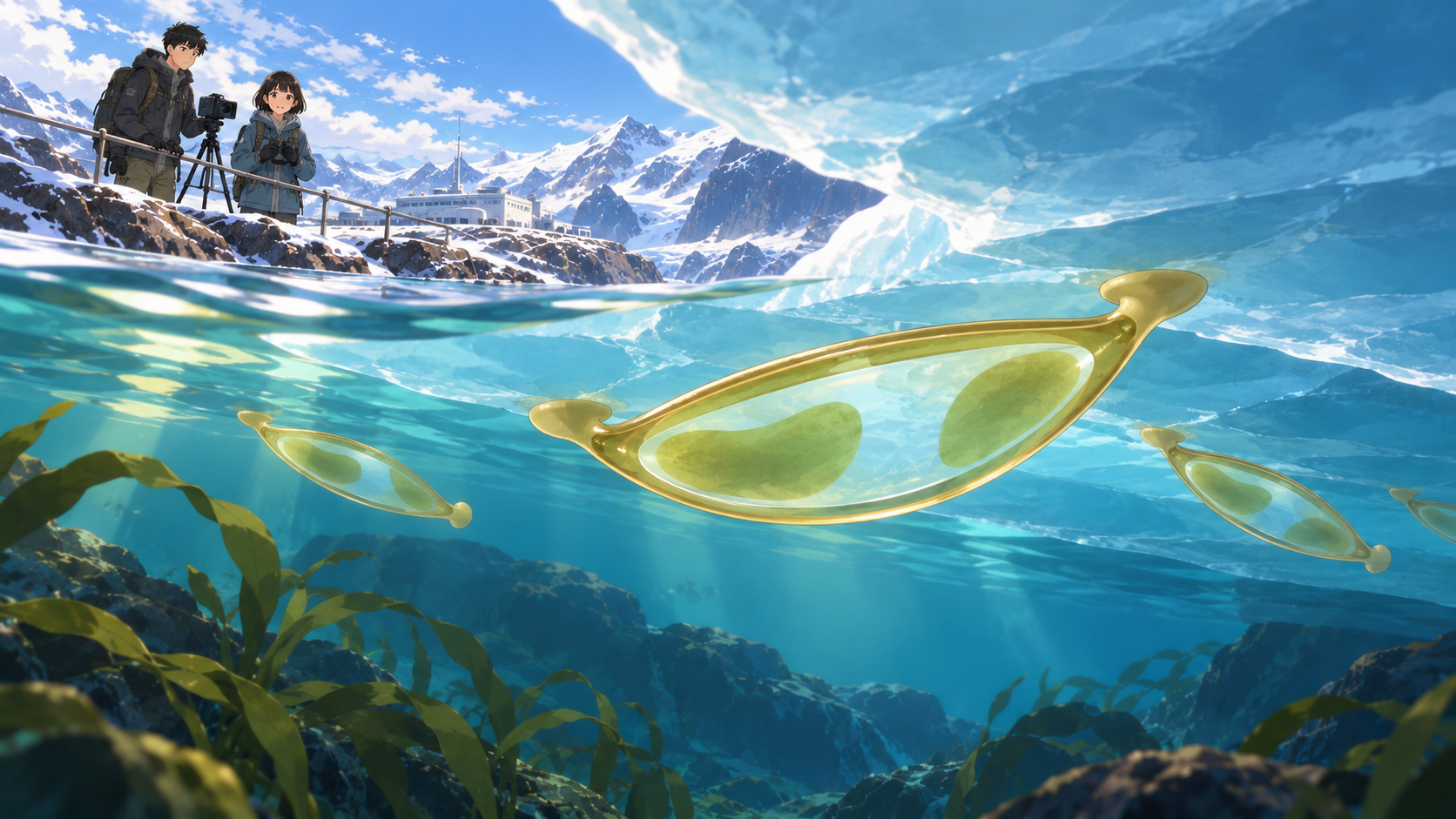
Cold water stretched the floe boundary a long way from Ice-Window Edge. The polar-night station was still in mist, but a blue crack in the ice brought morning light to our feet. I fixed the safety line on the rocky shore so Fang could compare the bright and dark patches without stepping onto thin ice. She lowered the light meter and followed a band of light that ended abruptly. Beneath the transparent ice lip, a few pale-gold outlines finally separated from the giant kelp. Each Ice-Window Diatom had a silica shell shaped like a boat leaning to one side, a broad clear window through its middle, and a blunt rounded attachment pad at either end. The cells could continue photosynthesis in the dim water beneath the ice. We did not need to lift the whole sheet to see them. The old buoy's low pulse returned at fixed intervals, but the water did not move to the same rhythm. I recorded the sound and current separately and left the break in the light band unexplained. Fang turned to ask if the line was long enough. I said it was long enough for us to stay on shore. She smiled and did not move closer to the ice. Our first record began at that distance.
Noon · Silica Light Face
At Silica Light Face, daylight struck more directly, yet wide shadows remained under the ice. Fang and I fixed a passive camera on safe shore rock and let the equipment take the closer view while our feet stayed put. On the image, the asymmetrical boat-shaped silica shell had a distinct rim, but its middle was clear. Light passed through the ice lip and the broad window into the cell. Blunt rounded pads at both ends held to the underside of the ice; the scattered cells had not crowded together into an opaque layer. Fang set the morning light readings beside the image. A patch with algae was not necessarily the brighter patch. Ice thickness, water flow, and colony density all mattered. I had wanted to circle the dark area as an anomaly. She asked me to leave it open for now. The old buoy pulse returned once more. I wrote down the time, without making it the answer to every change. These diatoms use the little light beneath thin ice for primary production. Cells shed from the colony also enter the plankton food web. That narrow window served more than today's sunlight. I put away the extra lamp and let the passive camera continue. Fang looked at me; she did not need to remind me again.
Evening · Algae-Window Slow Current
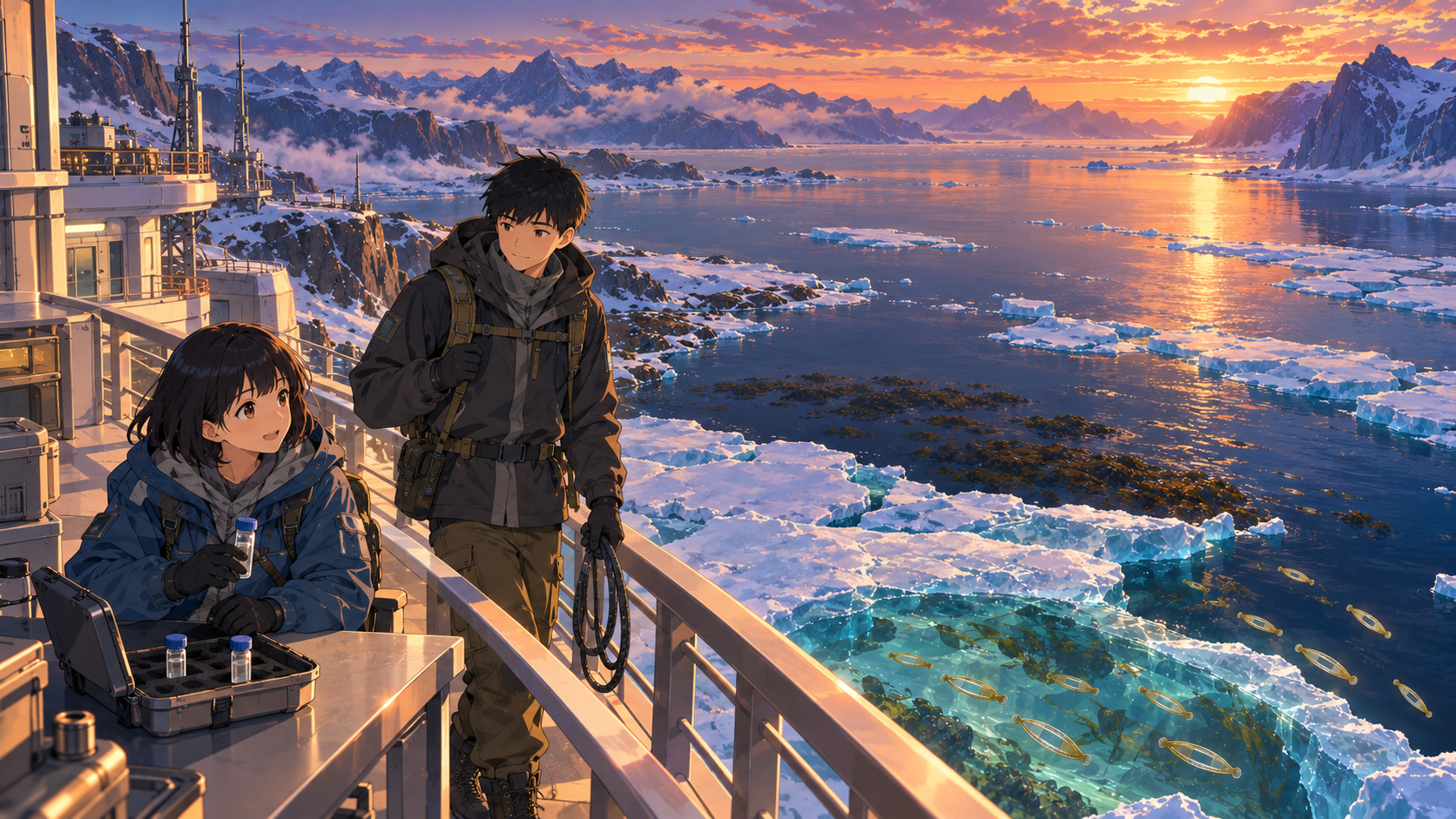
By evening, above Algae-Window Slow Current, the small boats we had seen by day were scattered pale traces. Cells detached at the colony edge and drifted slowly out toward the bay with the natural flow. They did not follow the old buoy's fixed pulse in tidy intervals. Those were two different observations. One overlap was no reason to join them as cause and effect. I left the ice lip and carried our equipment back to the station, where Fang was sorting the day's water samples. She spread out the light readings and pointed me to the least orderly section first. In some places the algal band was sparse; elsewhere the current had turned. We would need another sample and another light reading to check both. We had not entered the enclosed sea beneath the Antarctic shelf. Every clue remained in the broken-ice fjord outside the Tierra del Fuego polar-night station. I recorded that boundary too, so a neat line would not turn the unknown into something we claimed to know. Reopening the dock would need a channel. Plankton also needed the cells carried away by this water. I saved the positions of the algal band and slow current separately so the first route discussion could go around them. As I coiled the line, Fang asked what we had found. I said we had found a reason not to move closer yet. She placed the last sample in its case and held the station door for me.
Habitat Causality
The buoy's fixed low-frequency pulse returns along the ice lip, while light, ice thickness, colony density, and natural water flow also shape the diatom band. Detached cells feed plankton. Fang and K compare these signals before drawing a dock channel around the slow current; one coincidence does not prove that the buoy caused the light-band gap.
Species Behavior
Sparse diatoms attach beneath thin ice by blunt pads on both ends of asymmetrical boat-shaped silica shells. Their broad transparent windows admit dim light for photosynthesis. Edge cells detach and drift with the natural current into the plankton food web.
「We found a reason to stay on shore a little longer.」