Ice-Window Diatoms
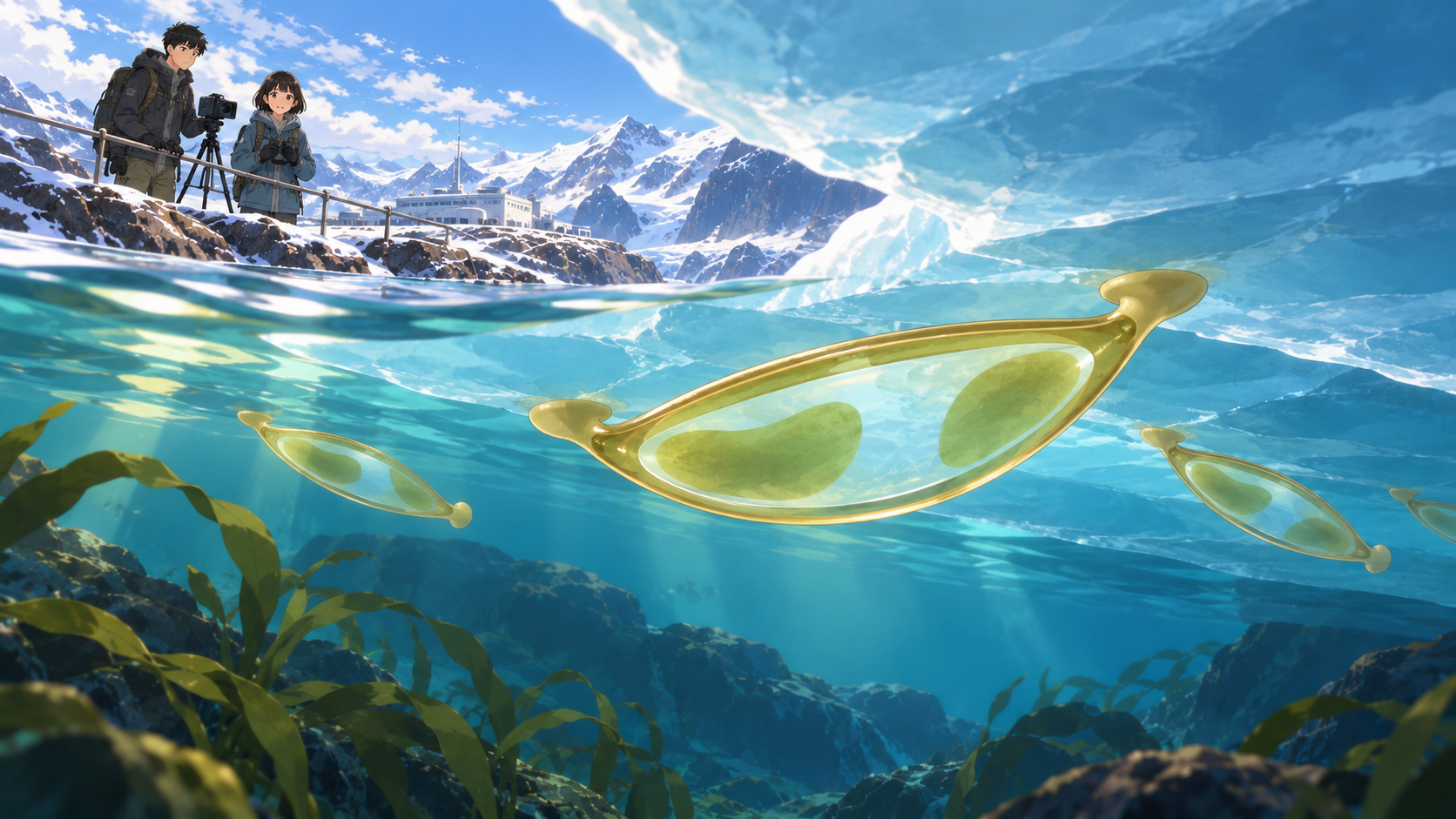
Each asymmetrical, boat-shaped silica shell has a broad transparent light window and a blunt attachment pad at either end. The pads hold cells to the underside of the ice lip without forming a dense, opaque sheet. Sunlight passes through the window to the cell. At the colony edge, cells detach and drift with the natural current rather than following the buoy's fixed pulse in lockstep.
Observation TypeField observation
First SeenDay 01 · Day 01 · Ice-Window Edge
HabitatUnder the ice lip of a broken-ice fjord outside the Tierra del Fuego polar-night station. Sparse colonies attach beneath the thin ice near giant kelp and open channels. This observation remains outside the enclosed sea beneath the Antarctic shelf.
VariantsIndividual thin cells, sparse ringlike colonies, and naturally attached patches beneath the ice window.
Habitat and Mechanism
Under the ice lip of a broken-ice fjord outside the Tierra del Fuego polar-night station. Sparse colonies attach beneath the thin ice near giant kelp and open channels. This observation remains outside the enclosed sea beneath the Antarctic shelf.. A residual fixed low-frequency pulse from an old sonar buoy returns along the ice lip. It may alter flow through the kelp belt, but a break in the light band alone cannot establish its cause. Fang and K compare water samples, light measurements, current direction, and pulse timing. Colony density reflects both light and flow under the ice; the diatoms continue photosynthesis in dim water, and detached cells enter the plankton food web.
Enter Still-Tide Broken-Ice Outer Bay ↗Behavior and Ecological Role
Each asymmetrical, boat-shaped silica shell has a broad transparent light window and a blunt attachment pad at either end. The pads hold cells to the underside of the ice lip without forming a dense, opaque sheet. Sunlight passes through the window to the cell. At the colony edge, cells detach and drift with the natural current rather than following the buoy's fixed pulse in lockstep.
A primary producer in the outer bay. Its light-guiding patches turn dim light into the base of the plankton food web. Detached cells become food for plankton. Differences in patch density are clues to light and current changes, to be checked against samples and measurements before the dock route is drawn around the slow-flow band.
Form and Identification
Individual thin cells, sparse ringlike colonies, and naturally attached patches beneath the ice window.
- Asymmetrical boat-shaped silica shell, sometimes edged in pale gold
- Broad, transparent light-guiding window through the shell
- Blunt rounded attachment pads at both ends beneath the ice lip
- Sparse patches rather than a solid opaque layer; detached cells follow the current
Observation Rule
Fang and K work from safe rock and use a passive camera. They do not step onto thin ice, lift the ice lip, disturb attached cells, or treat the buoy pulse as a proven cause. They keep the slow-current habitat visible when planning the dock channel.
At Ice-Window Edge, a band of light ended abruptly beneath the transparent ice lip. Fang measured the bright and dark patches from the rocky shore while I held the safety line behind her. We recognized the boat-shaped cells without stepping onto thin ice or lifting it.