Anchor-Pore Reefbuilder Crab
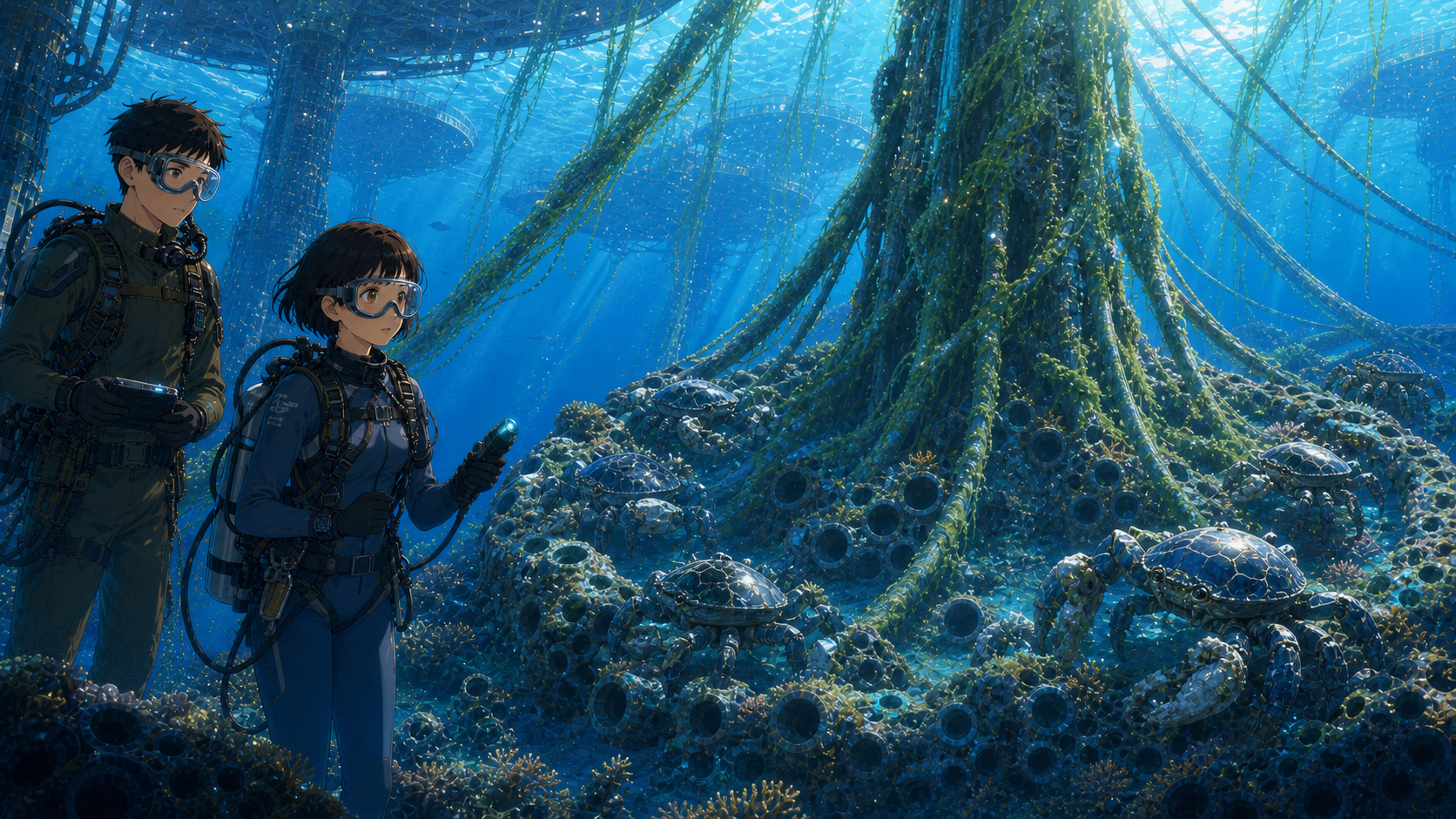
The crabs use six sturdy walking legs to brace against the current and two blunt claws to compact shell, mineralized algae, and loose cable fiber. They keep some pores open as slow-water passages while sealing openings exposed to the strongest repeated pulse. They are wary but do not attack Fang or K, and the group continues building when the observers remain outside the nursery core.
Observation LevelCoastal field note
First SeenDay 03 · Day 03 · Ninth Deep-Anchor Well
HabitatDeep anchor cables, mineralized algae, discarded shell, cable fibers, and porous artificial reef beneath the floating cities of Silent-Frequency Algae Canopy Corridor
VariantsSoft-shelled gray-blue juveniles, cobalt-black adults with carapaces about one meter wide, and groups that build a shared reef ring around a deep-anchor well
Habitat and Mechanism
Deep anchor cables, mineralized algae, discarded shell, cable fibers, and porous artificial reef beneath the floating cities of Silent-Frequency Algae Canopy Corridor。Fibers shed from deep city anchor cables catch mineralized algae and empty shells. The crabs press those materials into porous rings around the cables. Water slows inside the openings, creating refuges for cleaner shrimp, juvenile algae bream, and microorganisms. Repeating sonar from the drowned city changes how the newest pores are sealed, so the reef itself preserves the direction of the false acoustic source.
Enter Silent-Frequency Algae Canopy Corridor ↗Behavior and Ecological Role
The crabs use six sturdy walking legs to brace against the current and two blunt claws to compact shell, mineralized algae, and loose cable fiber. They keep some pores open as slow-water passages while sealing openings exposed to the strongest repeated pulse. They are wary but do not attack Fang or K, and the group continues building when the observers remain outside the nursery core.
The porous reef ring supports a nursery habitat that travels beneath the moving city. Its low-flow cavities shelter shrimp, juvenile bream, and microorganisms while linking the algae canopy to the deeper cable system. The shared direction of newly sealed pores marks Drowned-City Sonar Lane and shows where the artificial feedback is coming from.
Form and Identification
Soft-shelled gray-blue juveniles, cobalt-black adults with carapaces about one meter wide, and groups that build a shared reef ring around a deep-anchor well
- A biologically plausible reefbuilder crab with a carapace about one meter wide
- A broad cobalt-black shell marked by mineral-white pore patterns
- Six sturdy walking legs and two blunt construction claws
- Gray-blue soft-shelled juveniles inside the protected reef core
- Porous reef rings made from empty shell, mineralized algae, and loose anchor-cable fiber
Observation Rule
Fang and K do not lift, tag, restrain, or displace the crabs. They remain beyond the nursery core, scan the reef without contact, preserve every slow-water passage, and follow the structures the animals have already built instead of forcing a path through them.
At Ninth Deep-Anchor Well, the crabs pressed mineralized algae and empty shell around the city cable. Fang and K stayed on the outer ring and read the direction of the reef pores. The animals were not blocking the route at random. The newest seals faced the same repeated sound.