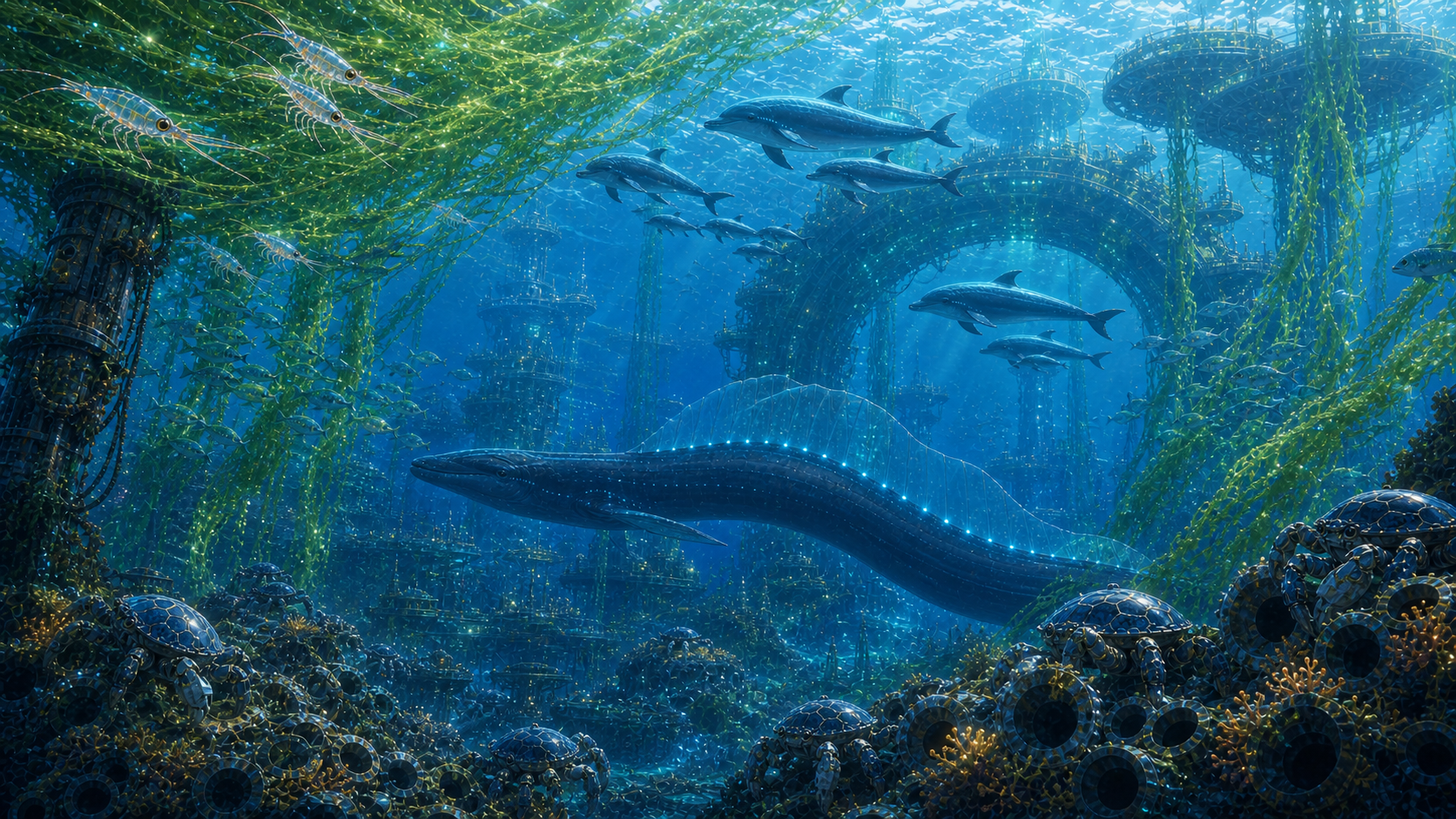
Silent-Frequency Algae Canopy Corridor
The corridor was built for anchor changes, maintenance, and the passage of marine life. As the city moves, algae-energy membranes cast kilometers of cyan-green shadow over seasonal plankton, grazing fish, and reefbuilders. Artificial reefs travel with the deep anchor cables. Beneath them, a drowned city's military sonar began feeding back through floating-city communications, folding a once-readable Kuroshio soundscape into overlapping false routes.
- Parent Domain
- NB-04 · Kuroshio Floating City Chain
- Location
- A low-noise navigation corridor southeast of the sixth city group in Kuroshio Floating City Chain, formed by floating-city shadow, algae-energy membranes, deep anchor cables, artificial reefs, and drowned streets below.
Harmonic-Tide Pilot Dolphin Pod refused three consecutive requests to guide the sixth city group away from a deep Kuroshio trench. The city drifted toward the bream and reefbuilder-crab nursery belt. Fang and K descended from the floating-city shadow to Drowned-City Sonar Lane to learn whether the dolphins were avoiding a predator, answering a habitat disturbance, or withholding guidance to prevent the city from crushing the nursery ecology. The evidence showed that city communications had reawakened the drowned sonar array, which amplified the pod's harmonics into a False Kuroshio. The solution was to cut the feedback, use low-power communications, and let the pod reopen a route itself.
How Silent-Frequency Algae Canopy Corridor Works
The energy membrane and city shadow support microalgae, plankton, and microbial colonies on the acoustic-sand surface. Acoustic-Sand Needle Shrimp clean the membrane and return spore sacs to the water column. Curtain-Fin Algae Bream graze on naturally shed algae sheets, carry those spore sacs toward new reefs, and maintain fish passages in the shadow belt. Anchor-Pore Reefbuilder Crabs compress spent shells, mineralized algae, and shed anchor fibers into porous rings that shelter shrimp, juvenile fish, and microorganisms in slower water. Echo-Sail Eels feed on injured fish and control trench-cephalopod numbers, while their response to overloaded echoes marks acoustic dead zones. Harmonic-Tide Pilot Dolphin families use a layered low-frequency chorus to synchronize anchor changes, fish turns, reef pores, and the safe Kuroshio passage.
Observation Ethic
Fang and K observe, take only naturally shed samples, use passive navigation, detour, shut down obsolete equipment, and coexist. They do not chase the corridor's animals, force the eel from its guarded retreat, command the dolphins, or turn a living boundary into a target. When wildlife closes the shortest route, they leave it open; when human machinery distorts the habitat, they change the machinery.
Five-Day Route
- Read the fixed artificial pulse in shrimp sensory setae beneath Floating-City Shadow-Edge Buoy.
- Follow the bream's upstream turn from Flex-Bridge Shadow Belt to Tidal-Window Flow Gate.
- Use sealed reef pores around Ninth Deep-Anchor Well to locate feedback from Drowned-City Sonar Lane.
- Leave the shortest route to the eel and detour along Silent Maintenance Sponson.
- Cut the feedback at Old Military Sonar Tower and watch the dolphin families reopen one safe Kuroshio route from Low-Frequency Passage Gate.
Five species maintaining this local ecology
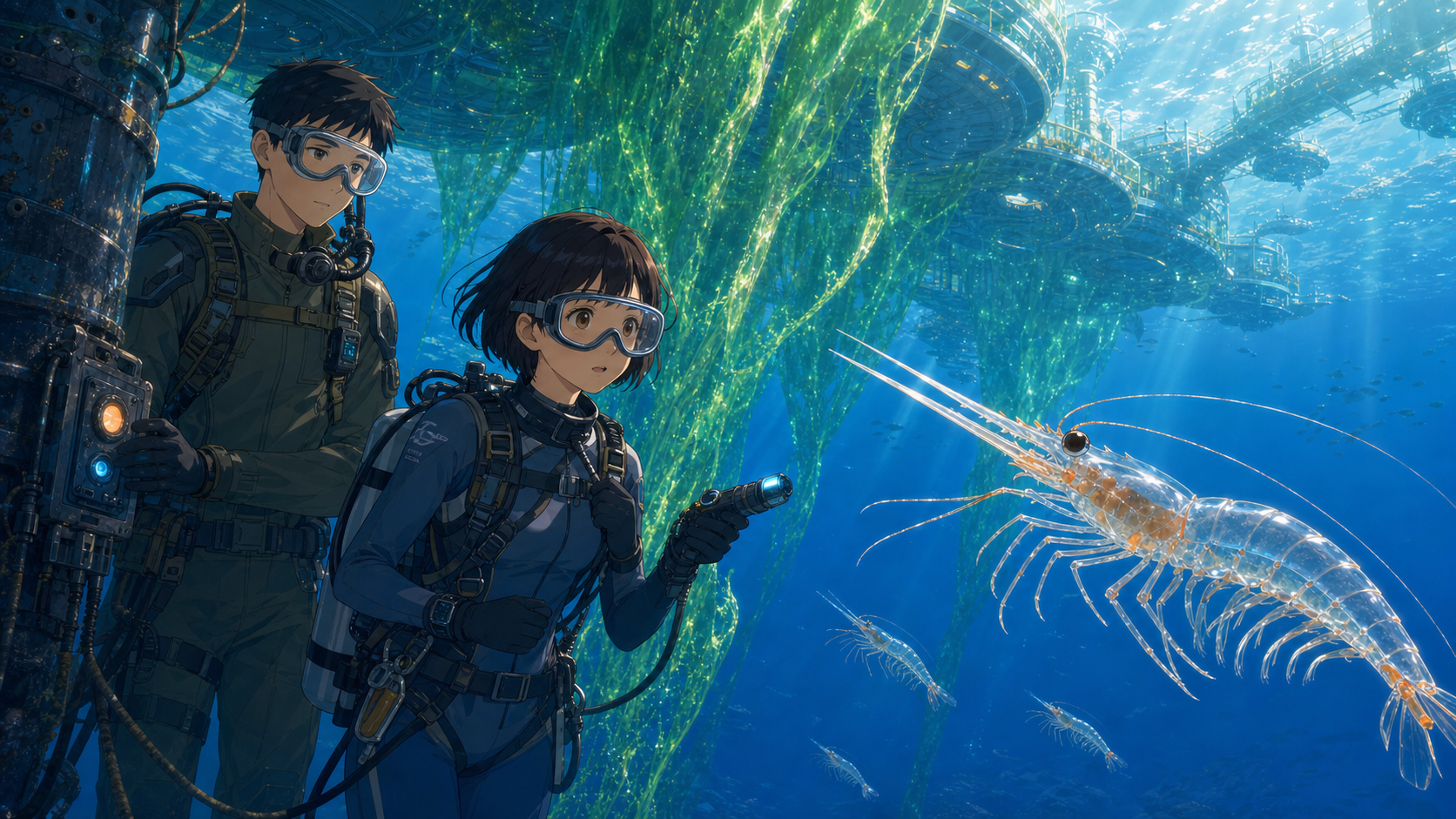 Day 01
Acoustic-Sand Needle Shrimp
The shrimp comb microalgae and acoustic sand from the membrane with slender quartz rostrums. Their pale-cyan sensory setae fold flat in unison before a high-frequency sonar pulse arrives. The entire group then burrows into reef pores on a fixed beat. They do not threaten Fang or K and resume cleaning when the active pulse stops.
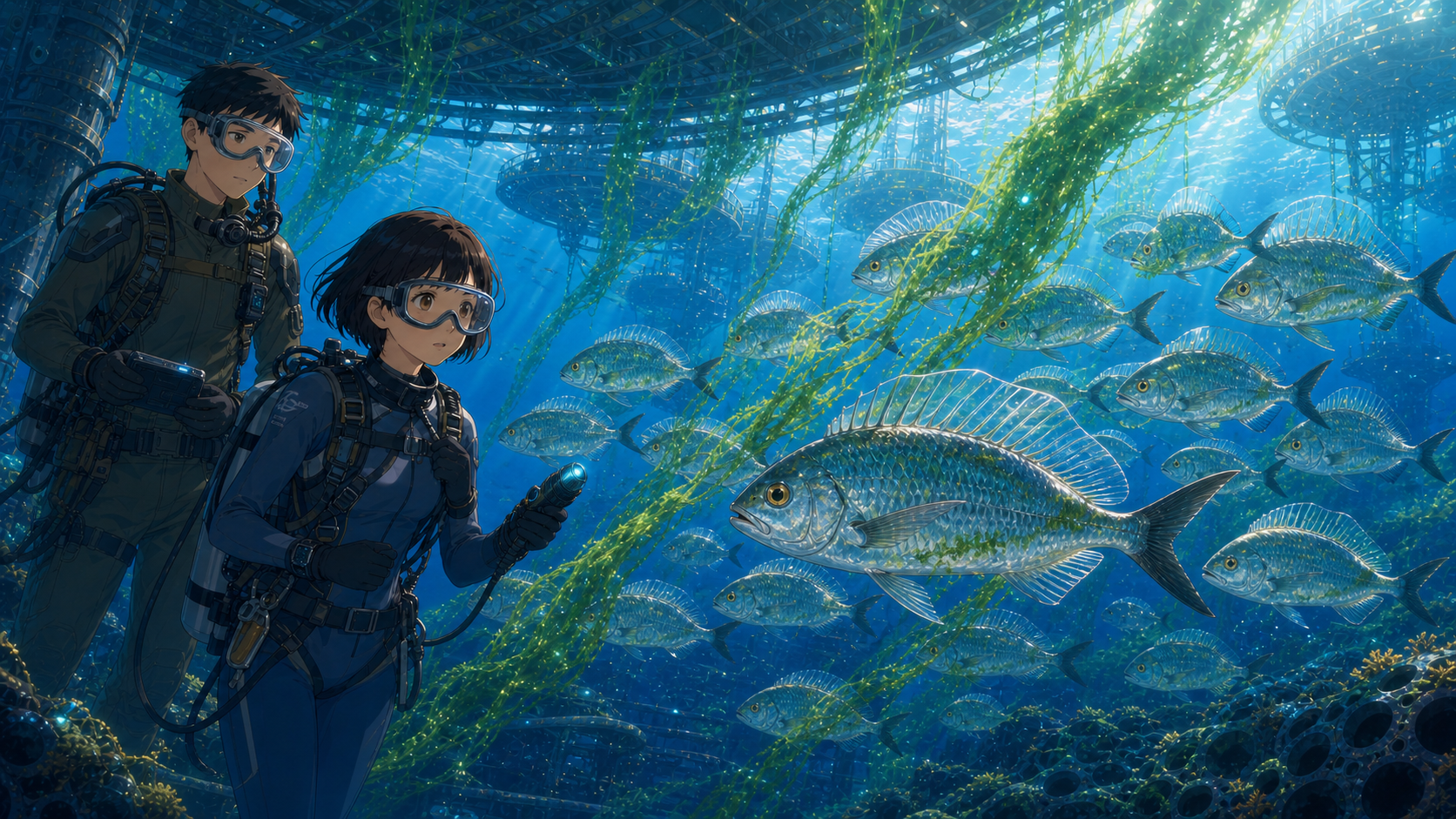 Day 02
Curtain-Fin Algae Bream
The bream coordinate their soft dorsal fins to graze drifting algae ribbons without biting the live energy membrane. When false sonar triggers the flow gate, the whole school turns against the current. After K returns the gate to manual control, the fish choose the natural warm flow on their own and continue moving spore capsules toward the reef.
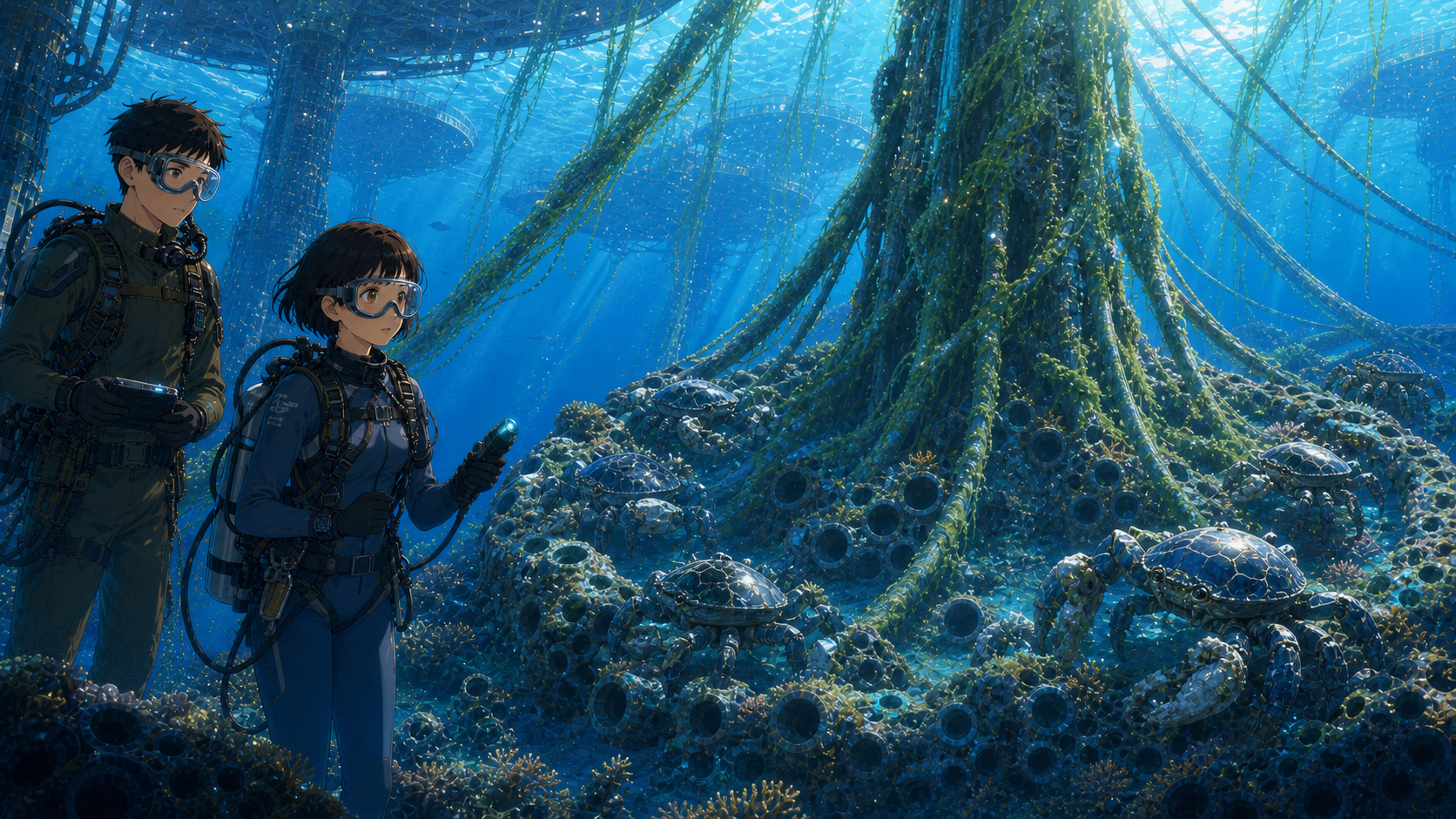 Day 03
Anchor-Pore Reefbuilder Crab
The crabs use six sturdy walking legs to brace against the current and two blunt claws to compact shell, mineralized algae, and loose cable fiber. They keep some pores open as slow-water passages while sealing openings exposed to the strongest repeated pulse. They are wary but do not attack Fang or K, and the group continues building when the observers remain outside the nursery core.
 Day 04
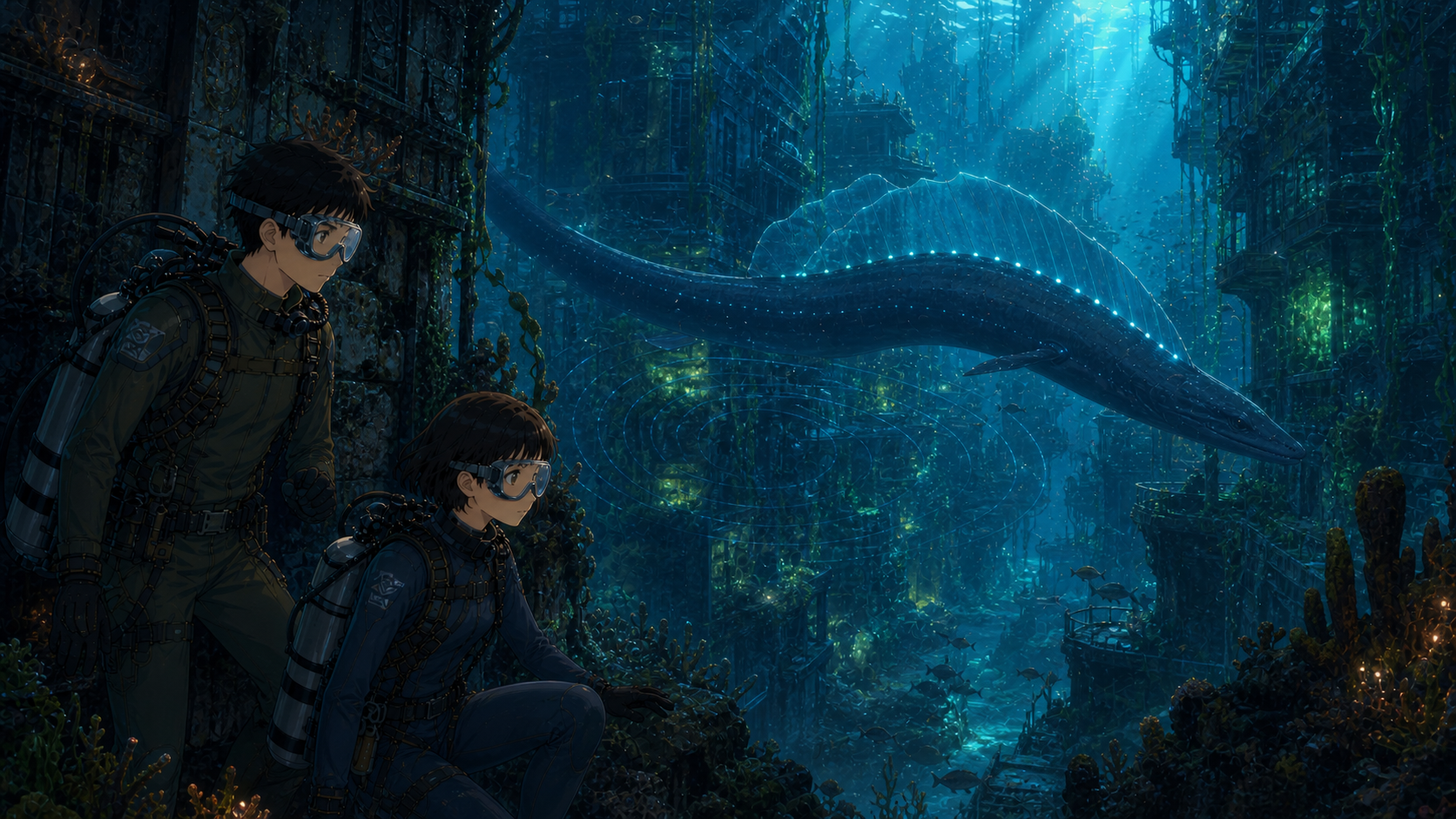
Echo-Sail Eel
The eel feeds on injured fish and deep-trench cephalopods. It normally keeps away from the floating cities. During sonar overload it stops at a strong echo and holds its ground rather than crossing the exposed sound field. The individual recorded here did not chase Fang or K after they shut down active sonar, backed into the building shadow, and stayed outside its guarded route.
 Day 05
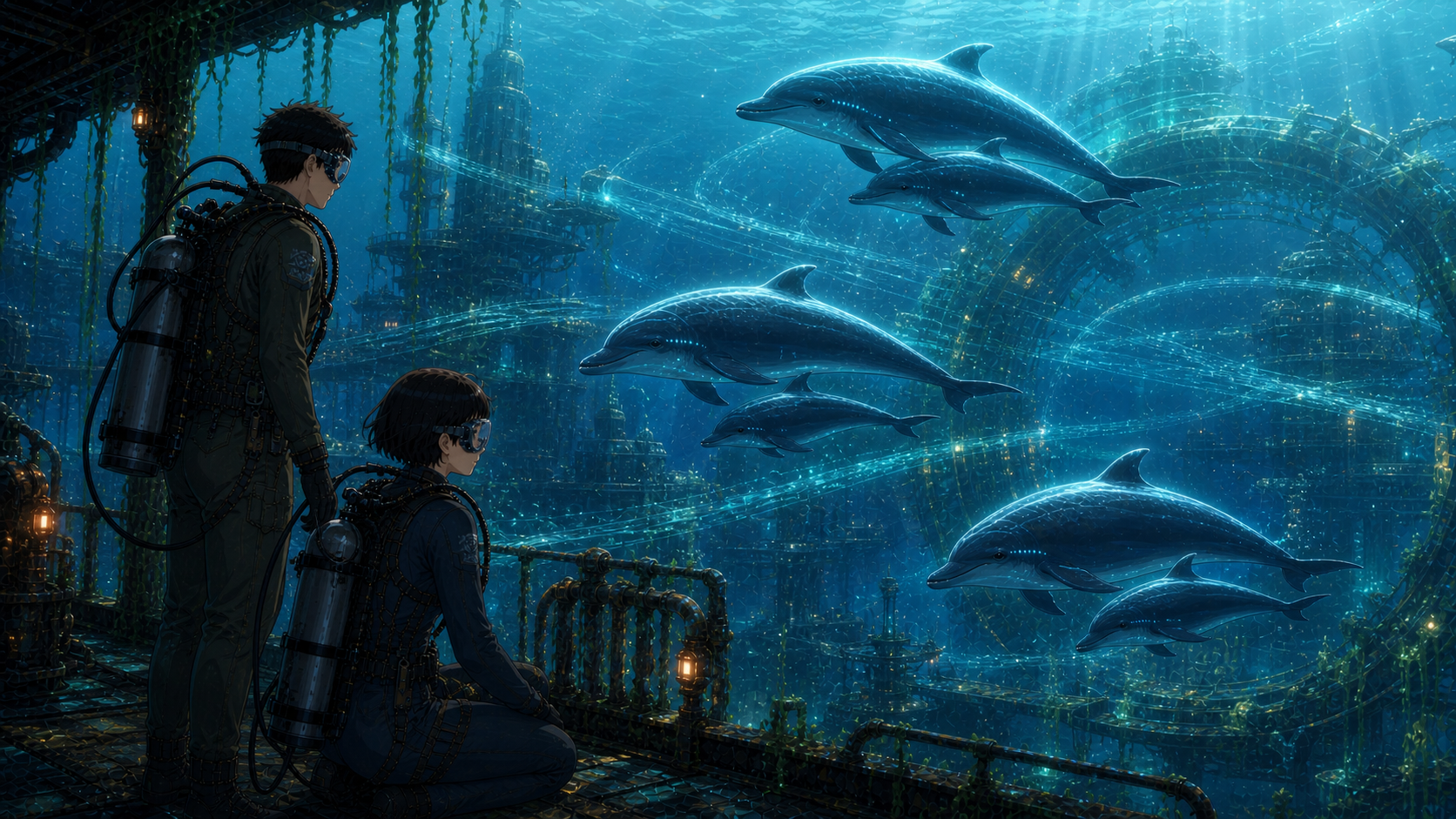
Harmonic-Tide Pilot Dolphin Pod
The dolphins do not obey city commands and do not prey on the corridor's four other core species. Each family holds a different part of a layered low-frequency chorus. They guide the floating cities only when the route preserves the pod, the nursery reef, and the shared ecological passage. During this encounter they remained calm, refused the false routes, and resumed guiding only after the human feedback ended.
「The corridor's anomaly was not caused by feral marine life. Human equipment had folded a shared soundscape into false routes. Once K physically disconnected the old sonar feedback and Fang separated the pod's natural harmonics, the dolphins redrew a passage that protected both the moving city and the nursery reef. The shrimp, bream, crabs, eel, and anchor-change cycle then recovered in sequence. Repair meant making the human system obey habitat signals again.」