Echo-Sail Eel
The eel feeds on injured fish and deep-trench cephalopods. It normally keeps away from the floating cities. During sonar overload it stops at a strong echo and holds its ground rather than crossing the exposed sound field. The individual recorded here did not chase Fang or K after they shut down active sonar, backed into the building shadow, and stayed outside its guarded route.
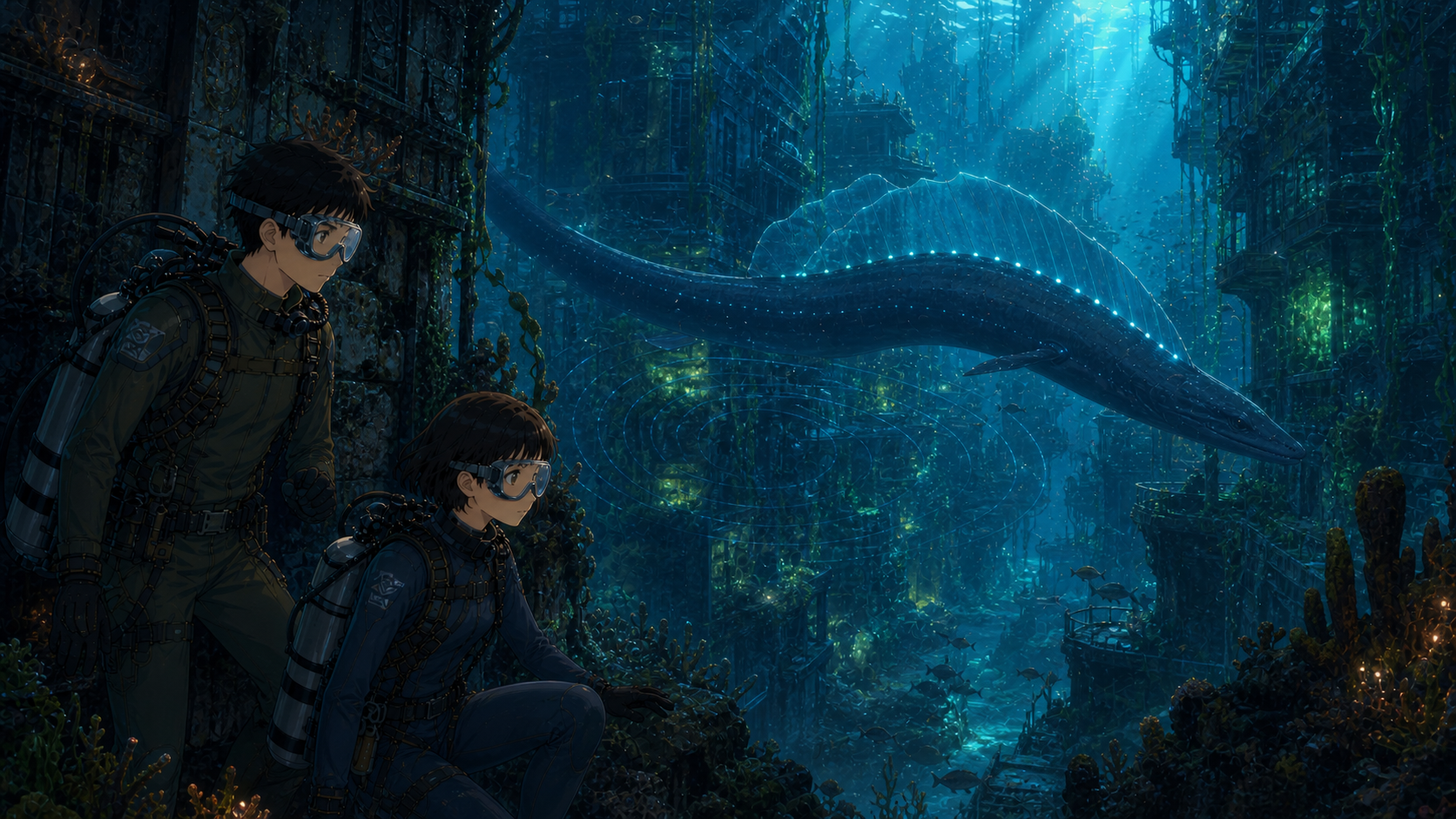
Observation LevelCoastal field note
First SeenDay 04 · Day 04 · Drowned-City Sonar Lane
HabitatFlooded streets, acoustic shadows, maintenance structures, and low-noise current windows beneath Silent-Frequency Algae Canopy Corridor
VariantsDeep-blue juveniles whose sail edges are not yet mineralized, six-meter adults, and solitary patrol animals
Habitat and Mechanism
Flooded streets, acoustic shadows, maintenance structures, and low-noise current windows beneath Silent-Frequency Algae Canopy Corridor。The eel's translucent dorsal sail channels distant low-frequency echoes toward its lateral line. Under ordinary conditions it avoids the floating cities and follows the acoustic shelter of the drowned streets. When floating-city communications reactivate the old military sonar array, their feedback overloads the soundscape. The eel then holds at the strongest reflecting intersection to protect its route of retreat. That position closes the direct passage but also marks the edge of the False Kuroshio sound field.
Enter Silent-Frequency Algae Canopy Corridor ↗Behavior and Ecological Role
The eel feeds on injured fish and deep-trench cephalopods. It normally keeps away from the floating cities. During sonar overload it stops at a strong echo and holds its ground rather than crossing the exposed sound field. The individual recorded here did not chase Fang or K after they shut down active sonar, backed into the building shadow, and stayed outside its guarded route.
By taking injured fish and deep-trench cephalopods, Echo-Sail Eels reduce weak bodies and drifting remains that could clog the porous nursery reef. Their avoidance of intense echoes also reveals acoustic dead zones. This individual blocked the drowned-city shortcut, forcing Fang and K to stop adding active sound and follow a natural current toward the outer edge of the sonar tower.
Form and Identification
Deep-blue juveniles whose sail edges are not yet mineralized, six-meter adults, and solitary patrol animals
- A biologically plausible deepwater eel about six meters long
- Midnight-blue skin and a narrow mouth that is not held open in a threat display
- A tall translucent acoustic sail extending from head to tail
- Fine cyan nodes tracing the lateral line
- A solitary animal holding position in a flooded street rather than pursuing observers
Observation Rule
Fang and K do not lure, tag, restrain, pursue, or displace the eel. They silence active equipment, preserve its retreat, use passive sensors from cover, and abandon the shortest route rather than crossing the animal's guarded space. They intervene only in the human sonar system causing the overload.
At Drowned-City Sonar Lane, the eel held at the intersection returning the strongest echo. Fang and K turned off active sonar at once and withdrew into the building shadow. The animal kept its retreat open and did not follow. Its position showed them where the artificial sound field was strongest.