Acoustic-Sand Needle Shrimp
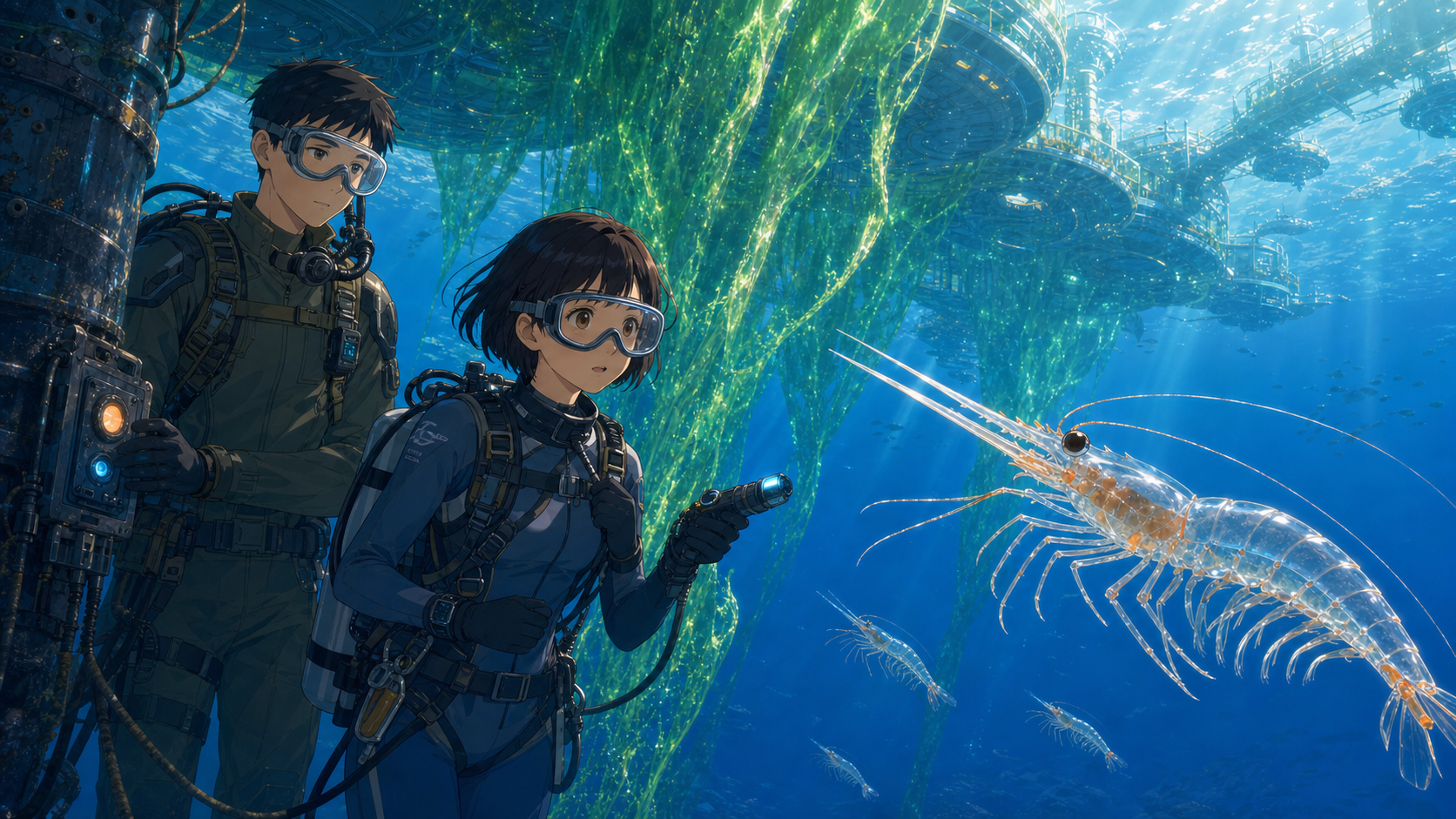
The shrimp comb microalgae and acoustic sand from the membrane with slender quartz rostrums. Their pale-cyan sensory setae fold flat in unison before a high-frequency sonar pulse arrives. The entire group then burrows into reef pores on a fixed beat. They do not threaten Fang or K and resume cleaning when the active pulse stops.
Observation LevelCoastal field note
First SeenDay 01 · Day 01 · Floating-City Shadow-Edge Buoy
HabitatLuminous algae-energy membranes, black acoustic-sand deposits, and porous artificial reefs beneath the Kuroshio Floating City Chain
VariantsRice-grain-sized milky-white juveniles, forearm-length translucent adults, and cleaning groups that move along the edge of the algae canopy
Habitat and Mechanism
Luminous algae-energy membranes, black acoustic-sand deposits, and porous artificial reefs beneath the Kuroshio Floating City Chain。The slowly moving cities cast kilometer-long shadows beneath their algae-energy membranes. Microalgae, plankton, and mineral-rich acoustic sand collect along the membrane edge, while fibers shed by deep anchor cables help form porous reef cavities. The shrimp clean this moving habitat and react to artificial sonar before the pulse becomes audible to human observers.
Enter Silent-Frequency Algae Canopy Corridor ↗Behavior and Ecological Role
The shrimp comb microalgae and acoustic sand from the membrane with slender quartz rostrums. Their pale-cyan sensory setae fold flat in unison before a high-frequency sonar pulse arrives. The entire group then burrows into reef pores on a fixed beat. They do not threaten Fang or K and resume cleaning when the active pulse stops.
By returning spores and cleaned material from the acoustic sand to the water column, the shrimp support the algae-fed reef community. Their synchronized setae and timed burrowing prove that the corridor is being struck by a repeating artificial high-frequency pulse rather than ordinary Kuroshio noise.
Form and Identification
Rice-grain-sized milky-white juveniles, forearm-length translucent adults, and cleaning groups that move along the edge of the algae canopy
- A biologically plausible translucent cleaner-shrimp body about the length of a forearm
- A slender quartz-white rostrum and coral-orange joints
- Pale-cyan sensory setae along the underside
- Many fine swimming legs used to comb the luminous algae membrane
- A non-aggressive cleaning group that burrows when high-frequency sonar arrives
Observation Rule
Fang and K do not chase, net, restrain, or remove the shrimp. They collect only naturally detached algae membrane, use passive sensors wherever possible, and silence the city's active equipment instead of trying to change the animals' response.
At Floating-City Shadow-Edge Buoy, the water went acoustically thin before the wrong pulse arrived. Fang measured the delay between the falling setae and the signal. K shut down the buoy's active pulse. The shrimp had turned an invisible human disturbance into a readable coordinate.