Curtain-Fin Algae Bream
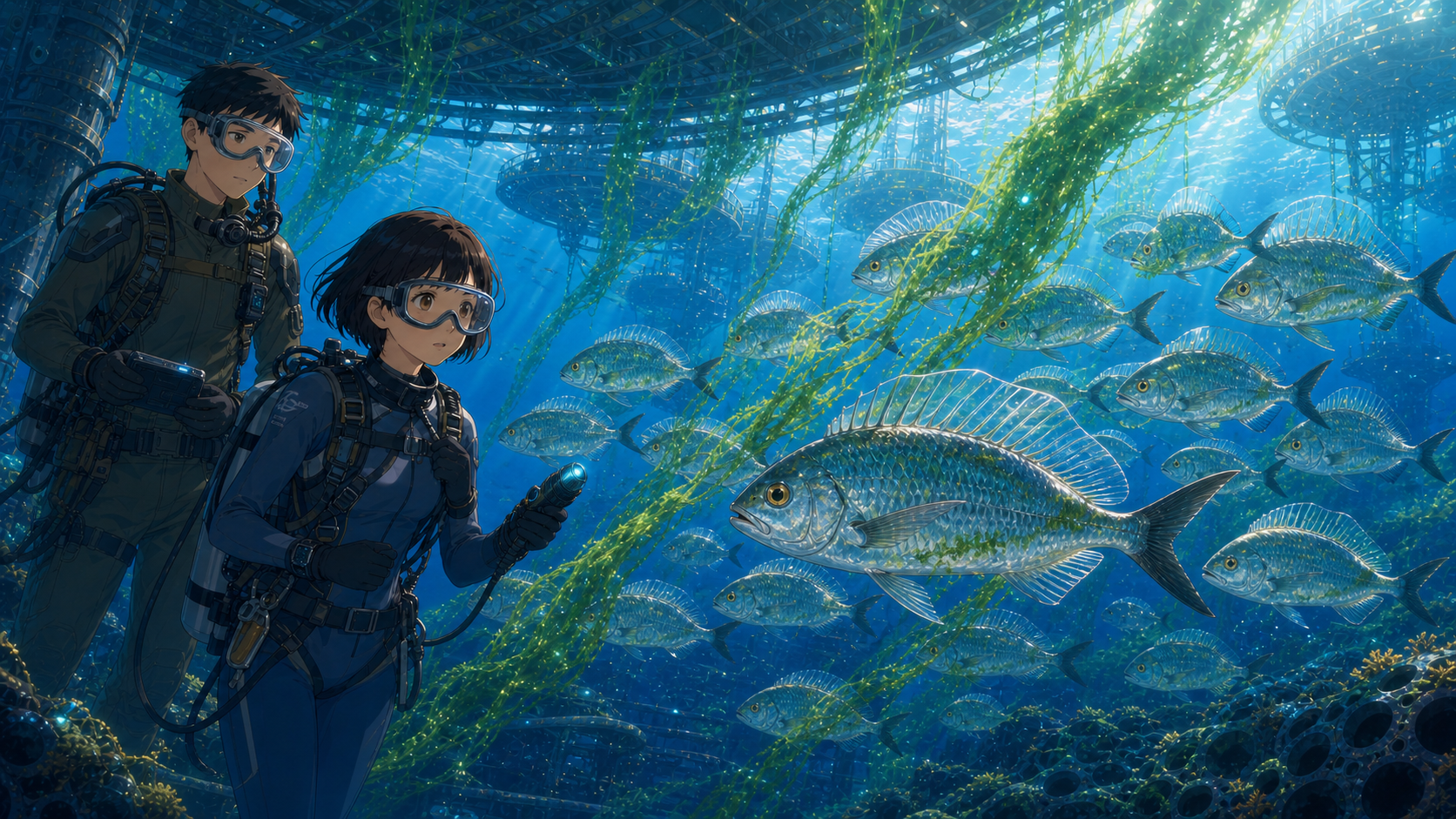
The bream coordinate their soft dorsal fins to graze drifting algae ribbons without biting the live energy membrane. When false sonar triggers the flow gate, the whole school turns against the current. After K returns the gate to manual control, the fish choose the natural warm flow on their own and continue moving spore capsules toward the reef.
Observation LevelCoastal field note
First SeenDay 02 · Day 02 · Flex-Bridge Shadow Belt
HabitatThe rising and falling currents beneath floating-city shadows, detached algae-energy membrane, slow-water grazing grounds, and young artificial reefs in Silent-Frequency Algae Canopy Corridor
VariantsTransparent short-finned juveniles, half-meter silver-teal adults, and schools that travel in bands along the shadow of flexible bridges
Habitat and Mechanism
The rising and falling currents beneath floating-city shadows, detached algae-energy membrane, slow-water grazing grounds, and young artificial reefs in Silent-Frequency Algae Canopy Corridor。The floating city's flexible bridges and algae-energy membrane create long bands of shadow and a layered updraft beneath the hull. Curtain-like dorsal fins let the fish hold position inside those currents. They graze only membrane fragments that have fallen naturally, then carry luminous spore capsules toward new reef growth. A false sonar signal opens a city flow gate at the wrong time and reverses the feeding current.
Enter Silent-Frequency Algae Canopy Corridor ↗Behavior and Ecological Role
The bream coordinate their soft dorsal fins to graze drifting algae ribbons without biting the live energy membrane. When false sonar triggers the flow gate, the whole school turns against the current. After K returns the gate to manual control, the fish choose the natural warm flow on their own and continue moving spore capsules toward the reef.
The school connects the algae canopy to new artificial reef. It consumes naturally detached algae, transports spore capsules loosened by the needle shrimp, and keeps a feeding passage open beneath the city. Its sudden upstream turn proves that the false route is not only acoustic: city equipment is also changing the water itself.
Form and Identification
Transparent short-finned juveniles, half-meter silver-teal adults, and schools that travel in bands along the shadow of flexible bridges
- A biologically plausible reef-fish body about half a meter long
- Silver-teal scales, amber eyes, and a dark forked tail
- A row of soft curtain-like dorsal fins
- Coordinated schools grazing only detached algae ribbons
- Luminous spore capsules carried toward new artificial reef
Observation Rule
Fang and K do not herd, net, feed, or pursue the school. They remain outside its turning radius, read the fish and current without contact, and correct the city flow gate so the animals can choose their own route.
At Flex-Bridge Shadow Belt, the school grazed along the floating city's shadow until the false sonar sounded. Every fish turned upstream at once. Fang recorded the angle of their curtain fins. The water had changed beneath them; the animals had not lost their route.