Harmonic-Tide Pilot Dolphin Pod
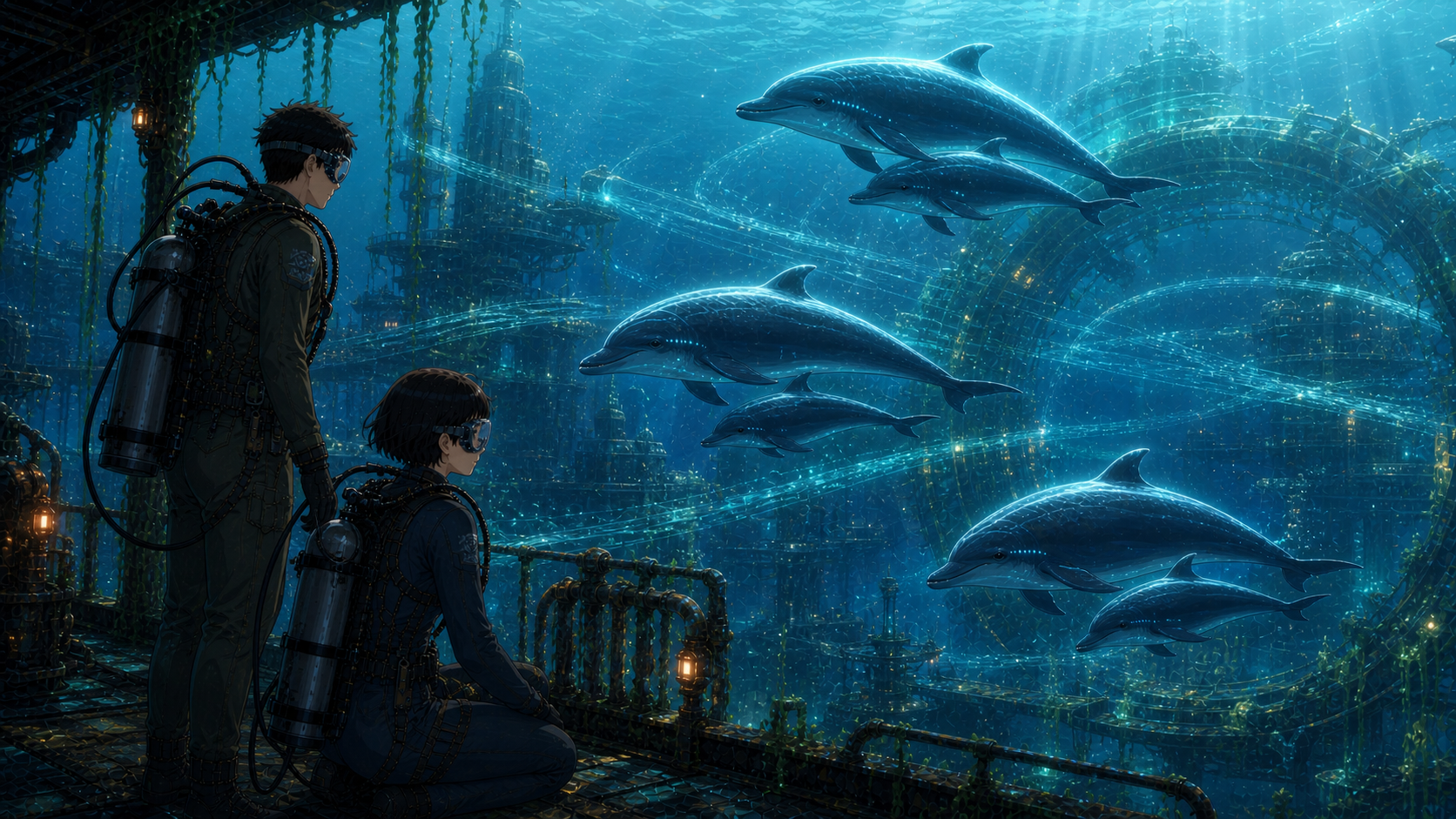
The dolphins do not obey city commands and do not prey on the corridor's four other core species. Each family holds a different part of a layered low-frequency chorus. They guide the floating cities only when the route preserves the pod, the nursery reef, and the shared ecological passage. During this encounter they remained calm, refused the false routes, and resumed guiding only after the human feedback ended.
Observation LevelCoastal field note
First SeenDay 05 · Day 05 · Kuroshio Pilot Ring
HabitatKuroshio thermoclines, deep anchor cables, nursery-reef boundaries, and the Low-Noise Ecological Passage beneath Silent-Frequency Algae Canopy Corridor
VariantsGray-white calves whose resonance crests have not formed, deep-indigo adults with silver bellies, and a pilot pod composed of three family groups
Habitat and Mechanism
Kuroshio thermoclines, deep anchor cables, nursery-reef boundaries, and the Low-Noise Ecological Passage beneath Silent-Frequency Algae Canopy Corridor。Three families sing separate low-frequency parts that jointly map the Kuroshio thermocline, anchor-cable positions, and nursery-reef boundaries. Feedback between floating-city communications and an old military sonar array amplified those natural harmonics into multiple False Kuroshio routes. The pod refused to enter because the city was drifting toward the nursery belt. After the feedback was cut and communications shifted to low power, the families redrew a route that served both the moving city and the reef.
Enter Silent-Frequency Algae Canopy Corridor ↗Behavior and Ecological Role
The dolphins do not obey city commands and do not prey on the corridor's four other core species. Each family holds a different part of a layered low-frequency chorus. They guide the floating cities only when the route preserves the pod, the nursery reef, and the shared ecological passage. During this encounter they remained calm, refused the false routes, and resumed guiding only after the human feedback ended.
The pod is an intelligent navigator rather than an apex predator. Its chorus makes shrimp sensory-setae responses, algae-bream turns, reefbuilder-crab pore closures, and floating-city anchoring part of one predictable rhythm. When the three families sang again, Acoustic-Sand Needle Shrimp, Curtain-Fin Algae Bream, Anchor-Pore Reefbuilder Crabs, Echo-Sail Eels, and the moving city returned to a shared acoustic schedule.
Form and Identification
Gray-white calves whose resonance crests have not formed, deep-indigo adults with silver bellies, and a pilot pod composed of three family groups
- Biologically plausible pilot dolphins about four meters long
- Deep-indigo backs, silver bellies, and fine luminous throat lines
- A translucent pale-cyan resonance crest on each adult forehead
- Gray-white calves without fully formed resonance crests
- Three family groups singing distinct layers of one low-frequency chorus
Observation Rule
Fang and K do not command, lure, tag, restrain, or pursue the dolphins. Fang listens with a non-invasive interface; K changes only the human equipment producing the false routes. They keep communications quiet and accept the pod's refusal to guide until the route once again protects both the families and the nursery reef.
At Kuroshio Pilot Ring, three dolphin families held outside the corridor and sang. Drowned-city equipment split their sound into several false routes. Fang separated the natural harmonics without entering the animals' bodies or directing them. K traced the added signal back to the old sonar array. Their refusal to lead was protecting the nursery reef from the drifting city.