Ark-Ridge Sirenian Herd
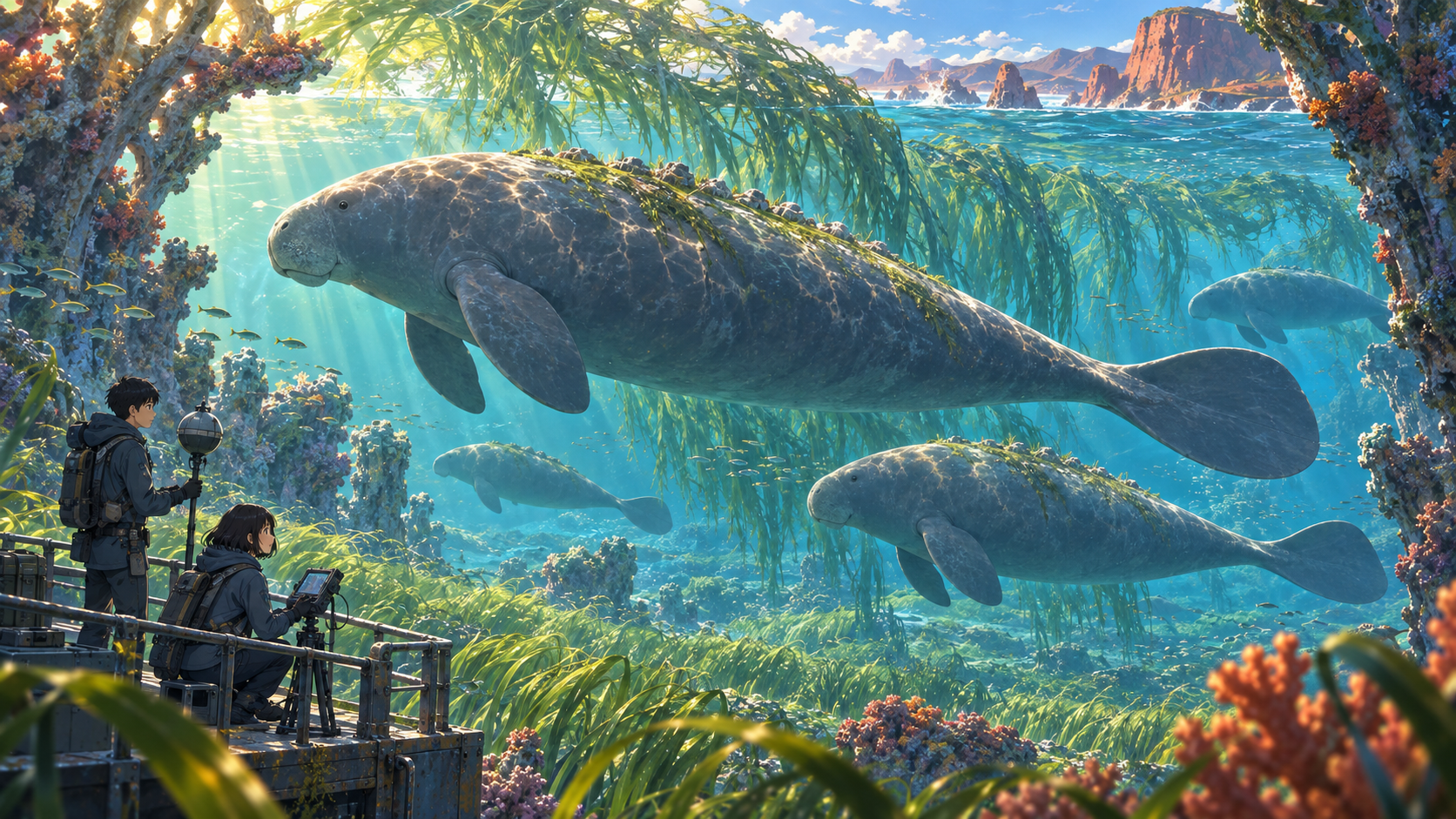
The herd selectively grazes older seagrass with rounded snouts. Its broad horizontal paddle tails move loose crystal fragments without cutting living reef, while low mineralized dorsal ridges carry seagrass seed between beds. The animals pause outside blocked gaps, follow restored water flow, and choose their own route through the corridor. They do not actively attack.
Observation LevelCoastal field note
First SeenDay 05 · Seagrass Migration Gate
HabitatSeagrass arcades, crystal-coral breakwater gaps, gravity-fed reef channels, and the Tide Vein migration corridor outside Coral Ark Harbor
VariantsJuveniles whose dorsal ridges are not yet mineralized, ten-meter adults, and a five-animal multigenerational migration herd
Habitat and Mechanism
Seagrass arcades, crystal-coral breakwater gaps, gravity-fed reef channels, and the Tide Vein migration corridor outside Coral Ark Harbor。The living breakwater works only when hard crystal reef, flexible pores, deep channels, and seagrass beds remain connected. Crystal coral traps polluted particles, parrotfish carbonate sand supports seagrass roots, and the sirenian herd carries seed while its broad horizontal tails shift loose reef fragments. Excessive harvesting had clogged the old Tide Vein and stopped the herd outside the migration gate. Once the harvesting arm was shut down, loose crystal was cleared, and the gravity gate was opened, the herd could pass through by choice and reconnect seed dispersal, sand replenishment, and water exchange.
Enter Tide-Vein Crystal-Reef Restoration Corridor ↗Behavior and Ecological Role
The herd selectively grazes older seagrass with rounded snouts. Its broad horizontal paddle tails move loose crystal fragments without cutting living reef, while low mineralized dorsal ridges carry seagrass seed between beds. The animals pause outside blocked gaps, follow restored water flow, and choose their own route through the corridor. They do not actively attack.
This is the week's principal ecosystem engineer. The herd transports seagrass seed, shifts loose reef material, and links the seagrass arcade to the natural breakwater. Its return also marks the restoration of the parrotfish sand belt and the flexible reef pores' water exchange.
Form and Identification
Juveniles whose dorsal ridges are not yet mineralized, ten-meter adults, and a five-animal multigenerational migration herd
- Biologically plausible sirenian anatomy at roughly ten meters in length
- Rounded snout and a pair of fore flippers
- A broad horizontal paddle tail rather than a vertical fish tail
- Low matte mineralized ridges along the back carrying seagrass seed
- A calm multigenerational herd that pauses at blocked migration gaps
Observation Rule
Fang and K keep outside the herd's chosen route, use non-invasive sensors and passive observation, and preserve a clear retreat line. Active weapons remain stowed. They do not chase, drive, corner, or redirect the animals. They change only human harvesting, navigation, and drainage systems, leaving the herd and the habitat to choose the restored corridor.
At Seagrass Migration Gate, the herd remained outside a gap clogged by loose crystal. Fang used non-invasive sensors to separate the herd's response into current, suspended particles, and movement direction while also reading its grazing rhythm. K stayed on the outer line, marked load-bearing points, return flow, and a retreat route, and kept all active weapons stowed. Neither of them chased the animals or tried to force them through the gate.