Fold-Fin Canopy Killifish
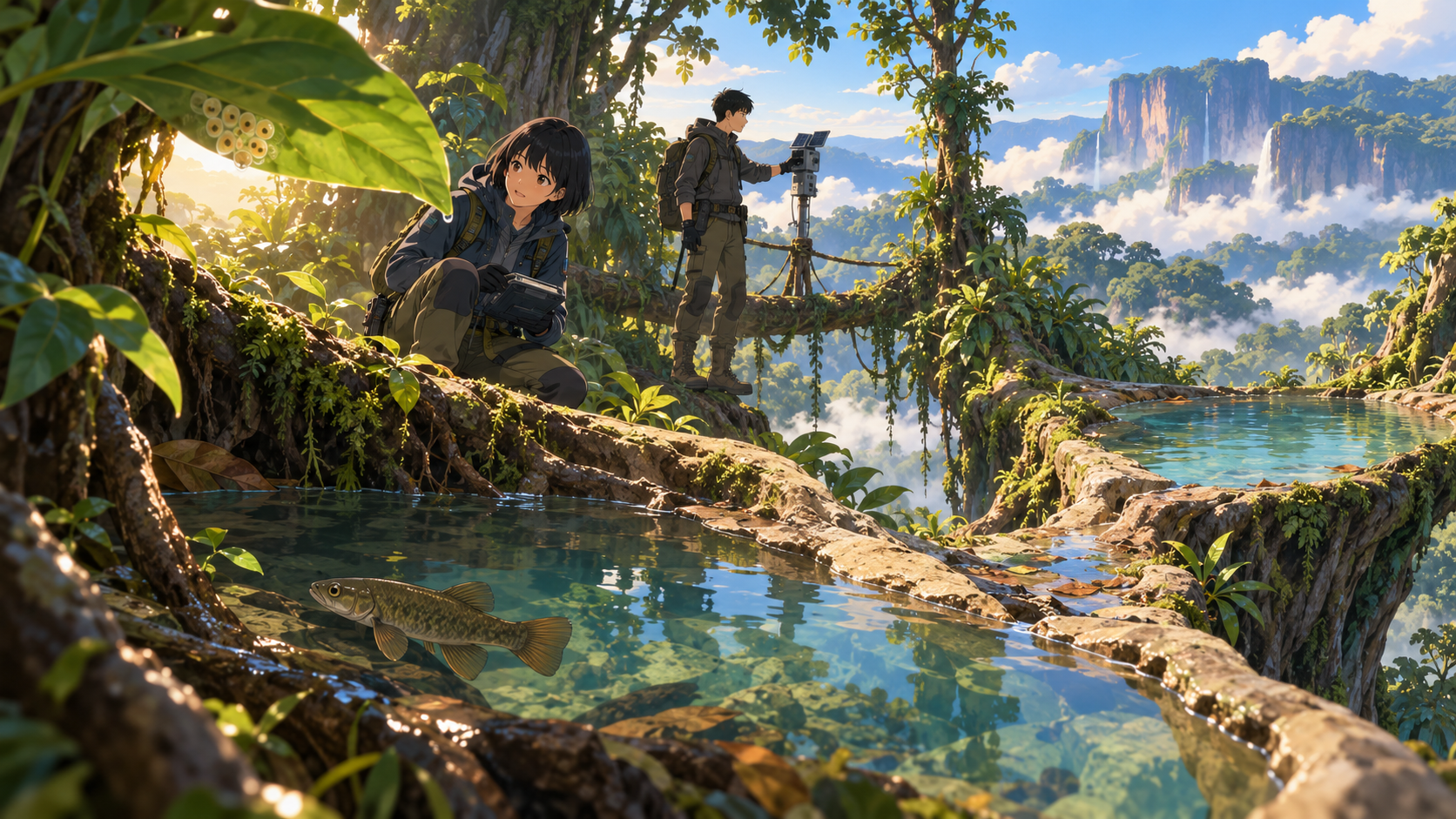
The fish hunts mosquito larvae and small insects that fall into the pools. Its broad pectoral fins fold against its body before a short, controlled leap over a wet branch. Its moist gill cover can close during that brief passage. It is a freshwater fish crossing nearby pools, not an ocean flying fish. At the dry break it tries two short leaps and stops. Eggs cling to the undersides of overflow leaves. Once the shallow channel fills slowly again, one fish passes through on its own; no one carries or drives it.
Observation TypeField observation
First SeenDay 03 · Day 03 · Fold-Fin Tree Pool
HabitatThe giant-tree canopy buffer southeast of Guiana Canopy Cloudport, at a distance from the old rocket field. Natural branch forks hold suspended freshwater pools, and a shallow mid-canopy channel links neighboring pools along wet branches. Fang and K keep outside the giant otter's restricted nursery route.
VariantsTransparent juveniles about five centimeters long; olive-brown adults about thirty centimeters long; small groups living separately in individual canopy pools. Day 03 follows one fish at the crossing, not a coordinated group migration.
Habitat and Mechanism
The giant-tree canopy buffer southeast of Guiana Canopy Cloudport, at a distance from the old rocket field. Natural branch forks hold suspended freshwater pools, and a shallow mid-canopy channel links neighboring pools along wet branches. Fang and K keep outside the giant otter's restricted nursery route.. During seasonal inverted rain, mist droplets briefly rise. Shade, leaf channels, and intermittent overflow normally connect three canopy water levels. Cloudport sensors misread natural return flow as leakage. The seed bank's continuous pumping and a closed automatic gate interrupt the middle-level connection. Water remains in separate tree pools, but the branch channel between them dries. Eggs attached beneath overflow leaves are left above the falling waterline. The fish stops crossing when the wet route disappears. Fang and K align the gate's opening direction with the natural slope and restore a gradual, continuous shallow flow rather than pouring one pool into another.
Enter Inverted-Rain Suspended Reservoir Forest ↗Behavior and Ecological Role
The fish hunts mosquito larvae and small insects that fall into the pools. Its broad pectoral fins fold against its body before a short, controlled leap over a wet branch. Its moist gill cover can close during that brief passage. It is a freshwater fish crossing nearby pools, not an ocean flying fish. At the dry break it tries two short leaps and stops. Eggs cling to the undersides of overflow leaves. Once the shallow channel fills slowly again, one fish passes through on its own; no one carries or drives it.
By eating mosquito larvae and fallen insects, the killifish links the suspended pools to the insects above them. Egg height and the failed crossing reveal the severed mid-canopy overflow. When water returns, the fish's own passage is one observable response, not proof that the whole forest has recovered.
Form and Identification
Transparent juveniles about five centimeters long; olive-brown adults about thirty centimeters long; small groups living separately in individual canopy pools. Day 03 follows one fish at the crossing, not a coordinated group migration.
- Olive-brown, matte-scaled adult about thirty centimeters long; transparent juvenile about five centimeters long
- Broad pectoral fins that fold tightly before a short leap
- Moist gill cover that can close briefly while crossing a wet branch
- Eggs adhering beneath overflow leaves above a retreating waterline
- Stops at a dry branch channel instead of making a long airborne flight
Observation Rule
Fang records eggs, water, wind, and behavior from a safe distance. K stays on the bridge side with a clear retreat and changes only the human-made gate and pumping settings. They neither catch nor move the fish, do not startle it into jumping, and do not call one successful crossing a restored ecosystem.
At Fold-Fin Tree Pool, K stopped active tracking. One killifish folded its pectoral fins and tried to cross toward the next pool twice, then stopped at a dry branch channel. Fang measured water level and wind from a safe bridge. Eggs remained beneath a leaf above the falling waterline. The fish's halt and the egg height pointed to a broken water route, not a failure of the animal to leap.