Inverted-Rain Suspended Reservoir Forest
This forest stores water above the ground. Seasonal inverted-rain windows briefly lift mist droplets, while branch shade, leaf channels, and intermittent overflow keep three canopy water levels connected. Five species leave different records along that shared route: flatworms trace the first reversal, sloths slow the drip, killifish mark the middle overflow, bees remember flowering windows, and a giant otter guards the upper reservoir.
- Parent Domain
- NB-11 · Guiana Canopy Cloudport
- Location
- A giant-tree canopy buffer southeast of Guiana Canopy Cloudport. Natural branch forks hold suspended reservoirs; overflow channels between trees reach the edge of an automated seed bank. The old rocket site remains at observation distance.
Fang and K must identify the artificial pressure difference, change the pumps to intermittent remote recharge, and reopen the connected overflow without entering the otter's nursery boundary. Their observations stay in the canopy buffer. They do not enter the canonical inverted-rain exclusion core, establish the candidate Light-Feather Fox, or alter the giant python's established story in the neighboring domain.
How Inverted-Rain Suspended Reservoir Forest Works
The Inverted-Rain Belt is seasonal, but the seed bank's continuous withdrawal from the upper reservoir is human-made. Its sensors mistake natural recharge for a leak. The cloudport closes overflow gates and keeps pumping to protect the seed bank. Water levels separate, pollinating bees lose their relay route, and the giant otter's nursery channel is pushed toward station cables. The species do not cause this failure; their movements reveal where the flow changed.
Observation Ethic
Fang measures water lines, wind, biofilm, eggs, and colony rhythms with non-invasive tools from safe branches. I keep our retreat route open and compare those signs with equipment timing. We do not chase, move, bait, or direct any animal. We change the pumps and gates that people installed, then wait for the water and wildlife to choose their own routes.
Five-Day Route
- At Rain-Vein Branch Channel, compare the flatworms' collective turn with rising mist and locate the first pump-dried branch.
- At Bell-Crown Shaded Branch, read the slow drip from sloth guard hairs and the moss below before restoring the shaded lower-water route.
- At Fold-Fin Tree Pool, use egg height and the missing short leaps to locate the middle-tier overflow break; reopen a shallow channel without handling the fish.
- At Cloud-Bee Resin Drum, stop the pump noise and observe whether the three-beat relay and pollination route return.
- At Split-Web Restricted Reservoir, remain beyond the nursery line; use Remote Recharge Platform to restore intermittent flow and let the otters retreat.
Five species maintaining this local ecology
 Day 01
Rain-Vein Ribbon Flatworm
The broad, unsegmented body lies close to wet bark. Two low head lobes sense the flow; fine cilia underneath carry bacterial film and detritus toward the digestive groove. When inverted rain lifts mist above the branch, the animals turn together against the water film. At Rain-Vein Branch Channel, their turn runs opposite the rising droplets. At Rising-Mist Drop Vent, their cilia continue working in one direction beside fresh bacterial film and a withdrawn waterline. Once the First Overflow Leaf Gate is opened a little from afar, the film runs downhill again and the flatworms spread along the natural recharge line. None has a leech's sucker, shell, or legs.
 Day 02
Bell-Crowned Canopy Sloth
Three curved claws on each long forelimb grip a giant-tree crossbranch. Broad, bell-shaped hollow guard hairs at the shoulders catch a few droplets, then release them one by one. The sloth feeds quietly on tender leaves and does not leave its shaded branch while Fang and K work. Its slow dripping supports moss below and, through the leaf channel, the next canopy level. The animal does not operate the reservoir or respond on command to the pump adjustment.
 Day 03
Fold-Fin Canopy Killifish
The fish hunts mosquito larvae and small insects that fall into the pools. Its broad pectoral fins fold against its body before a short, controlled leap over a wet branch. Its moist gill cover can close during that brief passage. It is a freshwater fish crossing nearby pools, not an ocean flying fish. At the dry break it tries two short leaps and stops. Eggs cling to the undersides of overflow leaves. Once the shallow channel fills slowly again, one fish passes through on its own; no one carries or drives it.
 Day 04
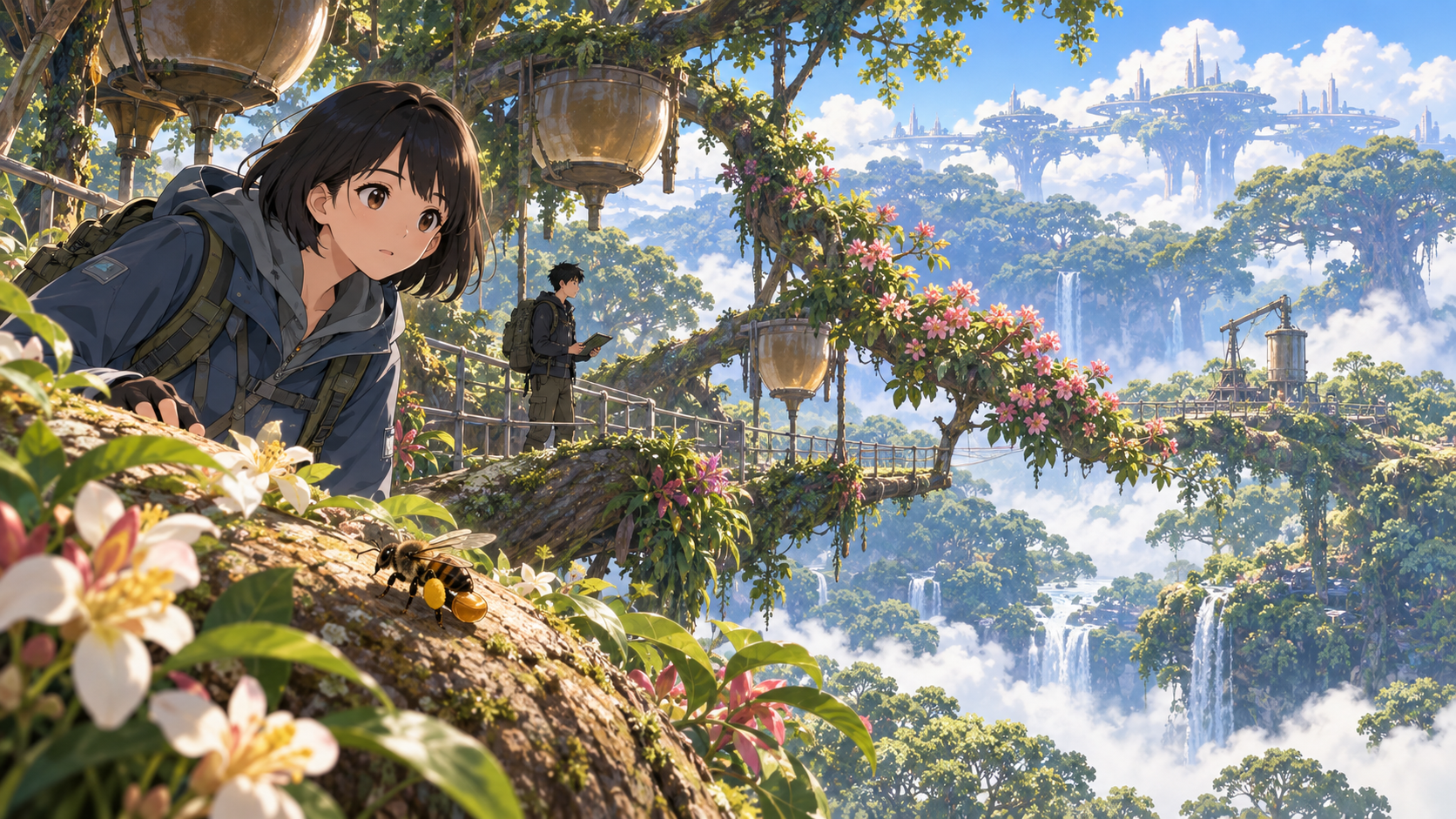
Pulse-Beat Cloud Bees
These stingless bees tap a three-part rhythm on natural resin tubes with one matte resin drum plate under the abdomen. Workers carry pollen on short, broad hind legs and pollinate mist-belt flowers. The colony retains the timing of inverted-rain wind windows and bloom periods. Under pump noise, cross-tree replies stop; after the noise falls, workers resume visiting flowers and the distant relay begins to answer. No individual worker is a commander, and the bees do not signal for human rescue.
 Day 05
Split-Web Reservoir Giant Otter
The adult waits along wet branches and overflow seams between suspended pools. Its broad forepaws carry flexible webbing divided into lobes that spread between the toes; water falls from their edges as it steps onto a branch. Short, dense waterproof fur stays raised after immersion, and its thick flattened tail steers through water and can throw a strong wave across a branch channel. Fish scales, waterbird feathers, and ambush marks support a carnivorous diet including medium fish and waterbirds; the wider canon also records small arboreal mammals. It guards a nursery and patrols its boundary without approaching Fang or K. When the overflow returns inward, the adult and its dark-brown young swim back through the restored route of their own accord.
「The flatworms' turn, the sloths' slow drip, the killifish eggs, the bees' interrupted beat, and the otters' guarded waterline are evidence at five scales along one water route. They are not five links in a single food chain. Fang and K correct the seed bank's continuous pumping and closed gates from a distance. The three levels can overflow in sequence again, pollination can cross the trees, and the nursery channel stays open. I record what returns; I do not call the forest repaired on the strength of one image.」