Gate-Pore Reef-Weaver Octopus
The octopus uses eight arms and pale cyan suckers to loosen, tighten, and rebuild flexible knots as tidal pressure changes. It works with empty shells, naturally fallen coral branches, and seagrass fibers rather than cutting living reef. When mechanical debris jams a pore, it closes the exposed entrance while maintaining water exchange through safer openings. It remains alert but does not attack.
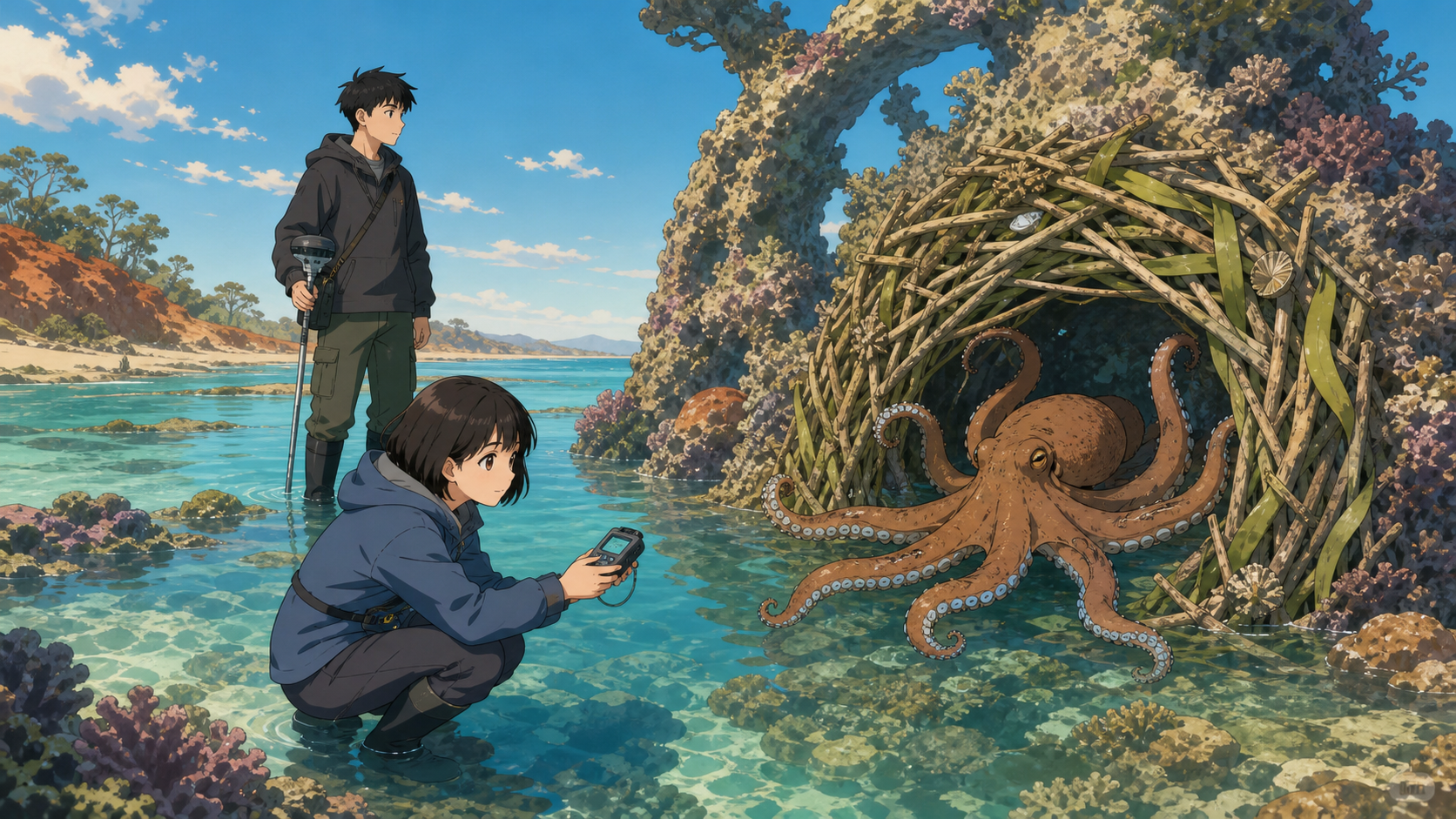
Observation LevelCoastal field note
First SeenDay 03 · Reef-Weaver Gate Pore
HabitatFlexible pores within the crystal-coral breakwater, shell-and-seagrass dens, maintenance hollows, and migration channels along the Tide Vein outside Coral Ark Harbor
VariantsPalm-sized juveniles, adults with a two-meter arm span, and a single den keeper tending a flexible-knot nest
Habitat and Mechanism
Flexible pores within the crystal-coral breakwater, shell-and-seagrass dens, maintenance hollows, and migration channels along the Tide Vein outside Coral Ark Harbor。Crystal coral forms a hard breakwater, but larvae, fish, and large migrants can pass only while flexible reef pores and deep channels remain open. The Gate-Pore Reef-Weaver Octopus braids empty shells, fallen coral branches, and seagrass fibers into knots that flex with tidal pressure and preserve those openings. Loose crystal debris from excessive automated reef harvesting jammed the knots on the harbor side. The octopus sealed that entrance, and the direction of the closure led back to the stalled harvesting arm.
Enter Tide-Vein Crystal-Reef Restoration Corridor ↗Behavior and Ecological Role
The octopus uses eight arms and pale cyan suckers to loosen, tighten, and rebuild flexible knots as tidal pressure changes. It works with empty shells, naturally fallen coral branches, and seagrass fibers rather than cutting living reef. When mechanical debris jams a pore, it closes the exposed entrance while maintaining water exchange through safer openings. It remains alert but does not attack.
Its woven knots keep water moving through an otherwise rigid reef wall. The direction of the sealed pores shows that loose crystal fragments are entering the migration corridor from the stalled harvesting arm. The octopus preserves flexible openings for larvae and fish until the human obstruction is removed.
Form and Identification
Palm-sized juveniles, adults with a two-meter arm span, and a single den keeper tending a flexible-knot nest
- Biologically plausible reef-octopus anatomy with eight natural arms and a two-meter span
- Warm umber matte skin and pale cyan suckers
- A flexible den woven from empty shells, fallen coral branches, and seagrass fibers
- Pressure-responsive knots that preserve water flow through hard reef pores
- Alert, intelligent, and non-aggressive behavior around the den
Observation Rule
Fang and K remain outside the den, do not chase the octopus or force it to change direction, and leave its flexible knots intact. Fang relies on non-invasive observation. K removes only artificial mechanical debris, keeps active weapons stowed, and works outside the animal's route. The octopus decides which reef pores remain open.
At Reef-Weaver Gate Pore, an octopus kept the flexible openings working but had sealed the harbor-side entrance. Fang observed from beyond the den and separated its response into current, suspended particles, and direction. K remained outside the pore, marked load-bearing points, return flow, and retreat routes, and kept every active weapon stowed.