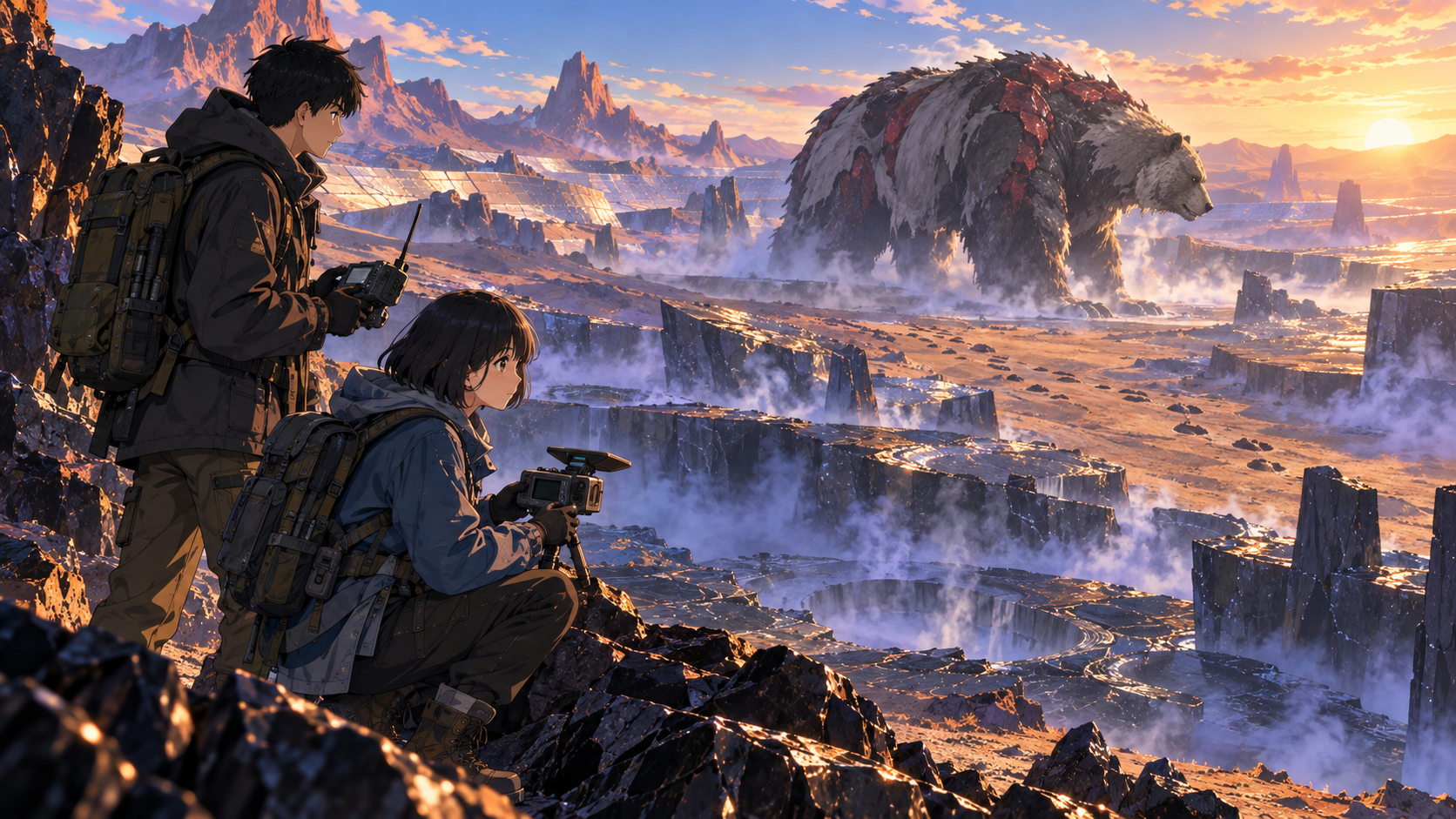
Heat-Veil Mirror-Rift Giant Bear
At night, the bear reads the scent of large foothill herbivores carried on descending cold air and lies in wait along the outer edge of the wells. Its heavy muzzle remains turned into the wind while its canines stay behind closed lips. Hollow fur bundles insulate the body through temperature swings; shoulder heat plates store phase-change heat, charcoal skin releases it, and enormous pads draw heat from the ground. When overheated, repeated steps fracture empty-basin obsidian and drive hot convection upward. Cooling air quiets that gait and allows the bear to withdraw along an unoccupied cold valley to its den.
Observation TypeField observation
First SeenDay 05 · Day 05 · Heat-Veil Bear Boundary
HabitatThe dry ocher valley beyond Atlas Gate, outside the black-obsidian death basin, across abandoned solar-mirror terraces, black-glass scree, underground cooling tunnels, and three night-cooling wells in the Lights-Out Cold-Well Corridor
VariantsYoung known only through reports from deeper mountain dens, seventeen-meter adults, and the single overheated individual awakened in this corridor
Habitat and Mechanism
The dry ocher valley beyond Atlas Gate, outside the black-obsidian death basin, across abandoned solar-mirror terraces, black-glass scree, underground cooling tunnels, and three night-cooling wells in the Lights-Out Cold-Well Corridor. The abandoned mirror field collects heat by day. After sunset, the main mirrors must lock into a lights-out angle so descending valley air can cross the underground tunnels and rise through three cold wells. When Atlas Gate restarted the sun-tracking array, the old controller treated living shadows as contamination, kept the mirrors tracking into the night, and sealed the cooling passages. The bear's den overheated, waking it and turning its steps into a source of obsidian fracture and rising hot convection.
Enter Lights-Out Cold-Well Corridor ↗Behavior and Ecological Role
At night, the bear reads the scent of large foothill herbivores carried on descending cold air and lies in wait along the outer edge of the wells. Its heavy muzzle remains turned into the wind while its canines stay behind closed lips. Hollow fur bundles insulate the body through temperature swings; shoulder heat plates store phase-change heat, charcoal skin releases it, and enormous pads draw heat from the ground. When overheated, repeated steps fracture empty-basin obsidian and drive hot convection upward. Cooling air quiets that gait and allows the bear to withdraw along an unoccupied cold valley to its den.
As the corridor's apex ambush predator, the bear shapes the avoidance routes of large herbivores and marks whether the cold-well passage remains usable. Its overheating does not make it an enemy to defeat: it reveals a failure in human mirror control. Locking the main mirrors dark and restoring airflow returns enough distance for predator, herbivores, and smaller corridor species to use the habitat on their own terms.
Form and Identification
Young known only through reports from deeper mountain dens, seventeen-meter adults, and the single overheated individual awakened in this corridor
- Massive but believable ursid anatomy at approximately seventeen meters
- A heavy scent-tracking muzzle with canines held behind the lips at rest
- Pale hollow insulating fur bundles over charcoal heat-radiating skin
- Restrained dark-crimson phase-change heat plates across the shoulders
- Enormous black heat-sink pads whose overheated steps fracture obsidian plates
Observation Rule
Fang and K do not chase, bait, corner, touch, sample, aim at, fire on, or injure the bear. Fang reads only heat, tracks, airflow, and the routes already chosen by other animals. K changes only human infrastructure, keeps active scanning off and his weapon secured, and never enters the ambush line. The bear decides when to stop, where to withdraw, and how much distance the restored corridor requires.
At Heat-Veil Bear Boundary, tracks ran in two opposing directions across the obsidian ground. Large herbivores had turned away along the cold-well edge; the bear's prints followed the scent route carried by the descending night air. Fang measured the heat veil and avoidance line from the safety boundary. K disabled active scanning and recorded the fractures left by each distant step. They did not approach the ambush line. No pursuit, attack, or injury was needed for the terrain to establish the danger.