Mist-Sail Arboreal Lizard
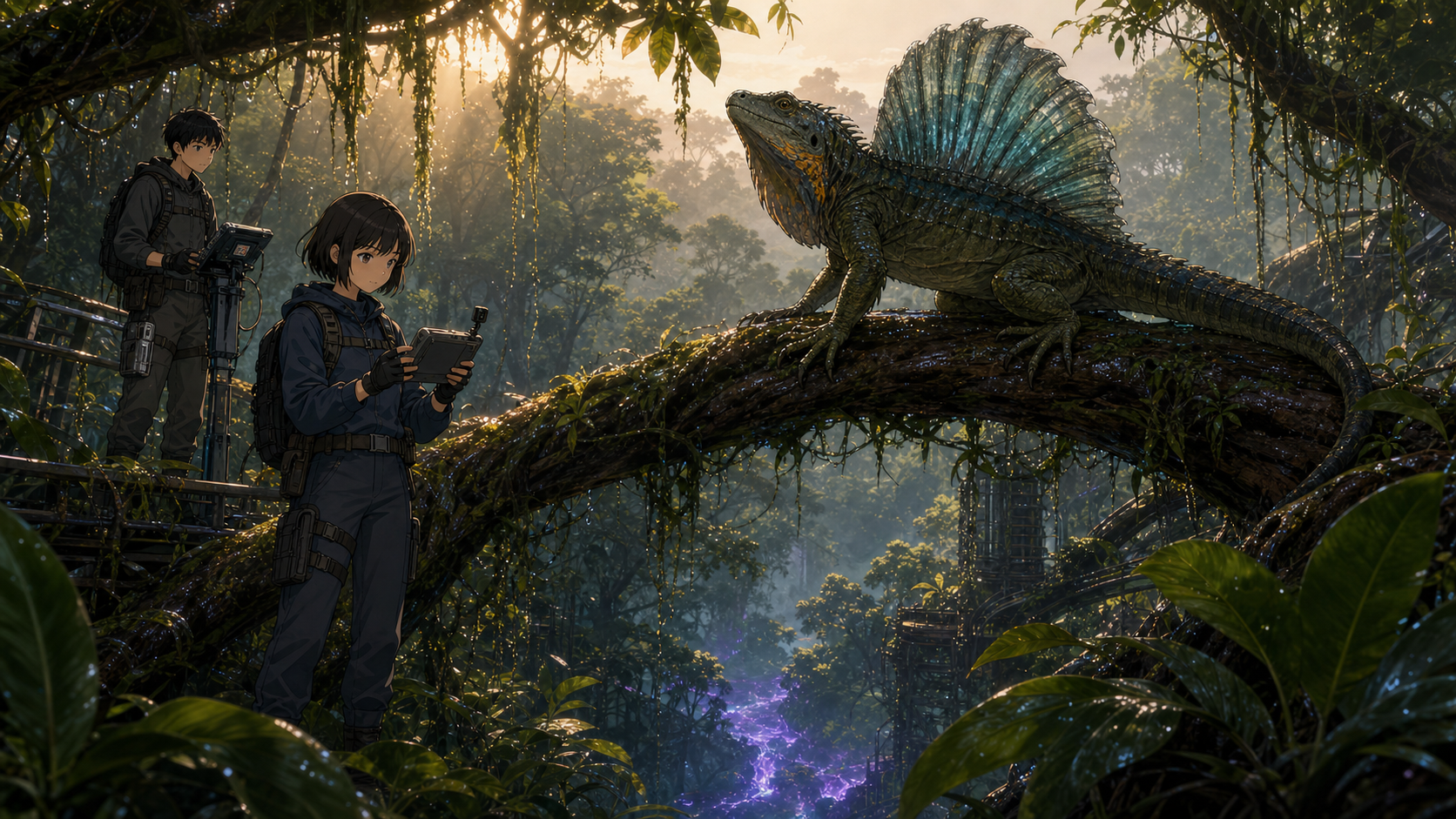
The lizard is a high-risk territorial predator, but it warns before any contact. When water is scarce, it raises its sail, strikes the trunk with its tail, and blocks the branch. It does not pursue observers who stop outside the guarded bridge and leave its wet retreat open. During this encounter it remained on the last stable branch while Fang and K abandoned the direct route.
Observation LevelCoastal field note
First SeenDay 04 · Day 04 · Mist-Sail High Branch
HabitatWet canopy bridges, tower-shaded branches, wind-pressure corridors, and upper hunting grounds within Mist-Crown Mycelial River Buffer Forest
VariantsOlive juveniles whose sails have not yet mineralized, cyan-green adults, and solitary patrol animals that hold one wet canopy bridge
Habitat and Mechanism
Wet canopy bridges, tower-shaded branches, wind-pressure corridors, and upper hunting grounds within Mist-Crown Mycelial River Buffer Forest。The tall dorsal sail gathers water droplets and registers changes in air pressure. Under normal conditions, the lizard waits on upper canopy bridges and controls populations of large insects, tree frogs, and juvenile crabs. Continuous mist extraction dried those upper hunting grounds and forced the animal down to the last stable wet branch on the shaded side of the tower. The rate at which its sail dried matched the extraction cycle exactly. Its territorial position therefore marked both the surviving moisture corridor and the human equipment still removing water from it.
Enter Mist-Crown Mycelial River Buffer Forest ↗Behavior and Ecological Role
The lizard is a high-risk territorial predator, but it warns before any contact. When water is scarce, it raises its sail, strikes the trunk with its tail, and blocks the branch. It does not pursue observers who stop outside the guarded bridge and leave its wet retreat open. During this encounter it remained on the last stable branch while Fang and K abandoned the direct route.
By controlling large insects, tree frogs, and juvenile crabs, it links the upper canopy food web to the root channels below. Its downward shift identified the last usable wet branch. Remote spectral readings of the sail showed drying synchronized with the mist-condenser cycle, and the bypass route confirmed that mist extraction and concentrated acidic discharge came from the same backup module.
Form and Identification
Olive juveniles whose sails have not yet mineralized, cyan-green adults, and solitary patrol animals that hold one wet canopy bridge
- Biologically plausible arboreal-lizard anatomy at about five meters long
- Deep olive scales, amber throat markings, and long gripping toes
- A tall translucent cyan dorsal sail that catches mist and senses air pressure
- A heavy tail used for balance and for striking trunks as a territorial warning
- A solitary individual holding a wet canopy bridge without pursuing observers
Observation Rule
Fang and K do not lure, chase, illuminate, tag, restrain, or displace the lizard. They remain outside its guarded branch bridge, use remote spectroscopy, stow every active weapon, and give up the shortest route. Their only intervention is to stop human equipment that is removing moisture from the animal's habitat.
At Mist-Sail High Branch, the lizard raised its sail on the last wet branch and blocked the direct route. Fang and K stopped outside its territory and shut down the lift equipment that was drawing mist from the canopy. The lizard stayed in place and did not pursue them.