Monsoon Canopy-Crown Elephant Herd
The herd is not actively aggressive. Its divine-class risk comes from scale: a migration can reshape canopy gaps, tributaries, and seed distribution across the island. The animals follow lost groundwater and seed corridors rather than human settlements. They change course when the habitat's water signal returns.
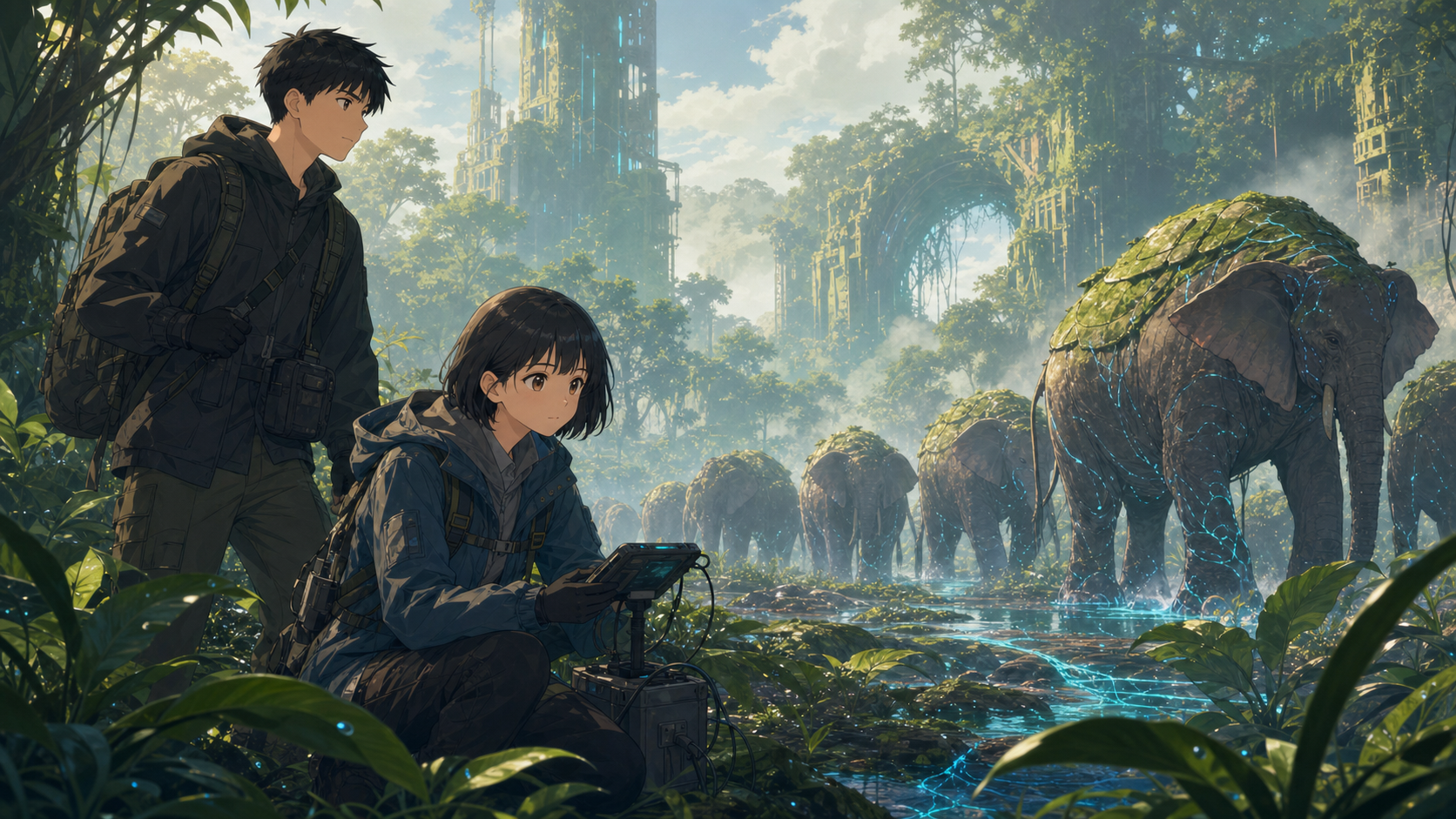
Observation LevelCoastal field note
First SeenDay 05 · Day 05 · Canopy-Crown Migration Gate
HabitatMonsoon migration corridors, canopy openings, shallow waterways, seed routes, and groundwater paths within Mist-Crown Mycelial River Buffer Forest
VariantsSlate-blue juveniles whose crown ridges have not yet formed, moss-crowned adults, and a migrating herd composed of several matrilineal families
Habitat and Mechanism
Monsoon migration corridors, canopy openings, shallow waterways, seed routes, and groundwater paths within Mist-Crown Mycelial River Buffer Forest。The herd follows seasonal rain and senses underground water through broad foot pads. As it moves, it pushes aside deadwood, opens gaps in the canopy, presses shallow channels into the ground, and carries seeds and fungal spores on the mossy crown ridges across its shoulders. Continuous mist extraction erased the wet signal of the Mycelial River and pulled the herd toward the South Seas outpost. Once the condenser was stopped and gravity overflow restored the branch channels, the herd detected the returning moisture and turned back into the forest without being driven away.
Enter Mist-Crown Mycelial River Buffer Forest ↗Behavior and Ecological Role
The herd is not actively aggressive. Its divine-class risk comes from scale: a migration can reshape canopy gaps, tributaries, and seed distribution across the island. The animals follow lost groundwater and seed corridors rather than human settlements. They change course when the habitat's water signal returns.
These elephants are ecosystem engineers. Their passage opens light gaps, creates shallow water routes, and distributes seeds and fungal spores throughout the island. The moths, frogs, crabs, and arboreal lizards of the buffer forest redistribute along the water routes left by the herd. The herd's course therefore reveals whether the forest's vertical water network is connected.
Form and Identification
Slate-blue juveniles whose crown ridges have not yet formed, moss-crowned adults, and a migrating herd composed of several matrilineal families
- Biologically plausible tropical elephants standing about eight meters at the shoulder
- Broad cooling ears and slate-gray skin suited to a humid equatorial forest
- Dome-like crown ridges across the shoulders, covered in moss and symbiotic fungi
- Faint cyan mycelial threads and wide foot pads that sense underground water
- A calm multigenerational herd formed by several matrilineal families
Observation Rule
Fang and K do not chase, lure, fence, strike, tag, or redirect the herd. Fang uses non-invasive BCI sensing only to read its response to groundwater. K changes the human infrastructure instead of the animals: he shuts down faulty mist extraction and concentrated discharge, then opens gravity overflow. The herd chooses its own route once the waterway is restored.
At Canopy-Crown Migration Gate, the herd was drifting toward an outpost branch line while following the vanished moisture of the Mycelial River. Fang used non-invasive BCI sensing to confirm its groundwater perception. K kept the observation perimeter clear and left every active weapon stowed.