Prism-Crest Nursery Pheasant
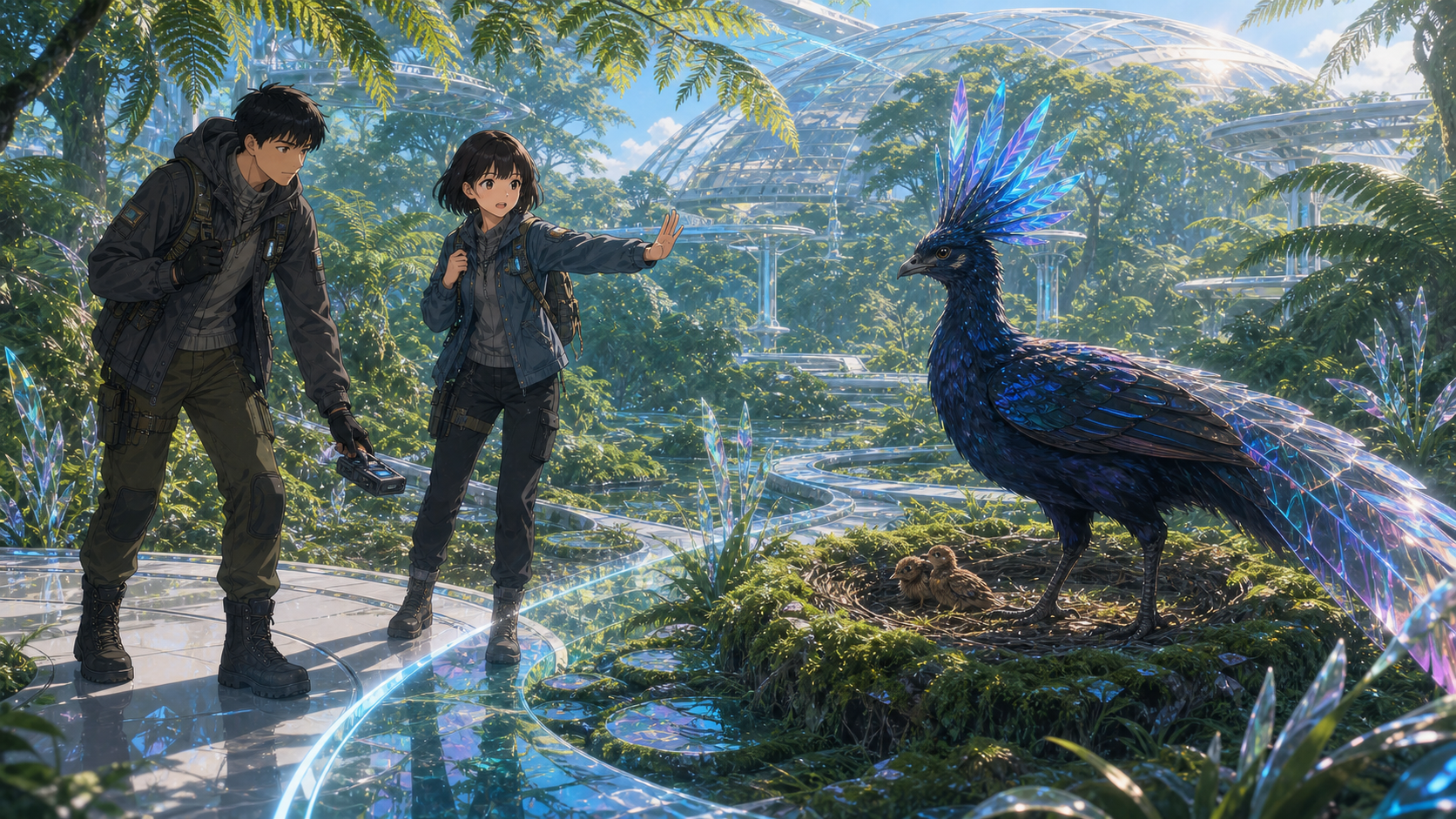
Adults jointly guard the nursery. They raise their prism crests, give low-frequency calls, and stand across an approach to mark a boundary. They do not need to strike when an observer stops outside the reflected light line. Once Fang and K take the longer lightless route, the adults lower their crests and the nest circle settles.
Observation LevelCoastal field note
First SeenDay 04 · Day 04 · Prism-Crest Nursery Wood
HabitatFungal-ring nesting ground, reflective canopy margins, and sealed lightless maintenance paths inside Diffraction Mycelium Reserve
VariantsBrown downy chicks, deep-navy adults, and nursery groups gathered around a single fungal-ring nest
Habitat and Mechanism
Fungal-ring nesting ground, reflective canopy margins, and sealed lightless maintenance paths inside Diffraction Mycelium Reserve。Fungal rings grow where dome condensation, wild mycelium, and mineral film meet beneath the retired photonic test zone. The birds feed there and raise their chicks under a leaf canopy that breaks intense light into bands. The abandoned exposure sequence extends the apparent daytime, keeping adults in a prolonged state of nest defense and closing the shortest maintenance corridor.
Enter Diffraction Mycelium Reserve ↗Behavior and Ecological Role
Adults jointly guard the nursery. They raise their prism crests, give low-frequency calls, and stand across an approach to mark a boundary. They do not need to strike when an observer stops outside the reflected light line. Once Fang and K take the longer lightless route, the adults lower their crests and the nest circle settles.
By eating fungal fruit and controlling small arthropods, the pheasants help regulate the nursery grove around the fungal rings. Their sustained daylight-defense posture is also independent evidence that the city's automatic exposure sequence has stretched the reserve's light cycle beyond its natural rhythm.
Form and Identification
Brown downy chicks, deep-navy adults, and nursery groups gathered around a single fungal-ring nest
- A two-meter body with believable ground-bird anatomy
- Deep navy plumage and sturdy dark legs
- A tall iridescent prism crest that reflects strong light
- Layered translucent tail plates
- Brown downy chicks sheltered inside a fungal-ring nest
Observation Rule
Fang and K never enter the fungal-ring nest, test the warning distance, flush the chicks, or challenge the adults. They treat the display as information, surrender the shortest route, and record the boundary from a sealed maintenance path that produces neither light nor sound.
At Prism-Crest Nursery Wood, the first adult raised its crest and turned the grove into a wall of refracted light. Fang stepped back first. K lowered the sensor. The adults were protecting chicks inside the fungal ring, and the warning did not escalate once both observers moved outside the boundary.