Rainbow-Sac Tree Frog
The frogs are alert and non-aggressive. They cling to wet branches with broad toe pads, hunt fungal gnats and moth larvae, and move spores and seeds between pools. During this encounter they called only downstream. They continued feeding above the active fungal film at Calcifying Mycelial Terrace, then crossed the first dry branch again as soon as a blocked low-flow return gate was reopened.
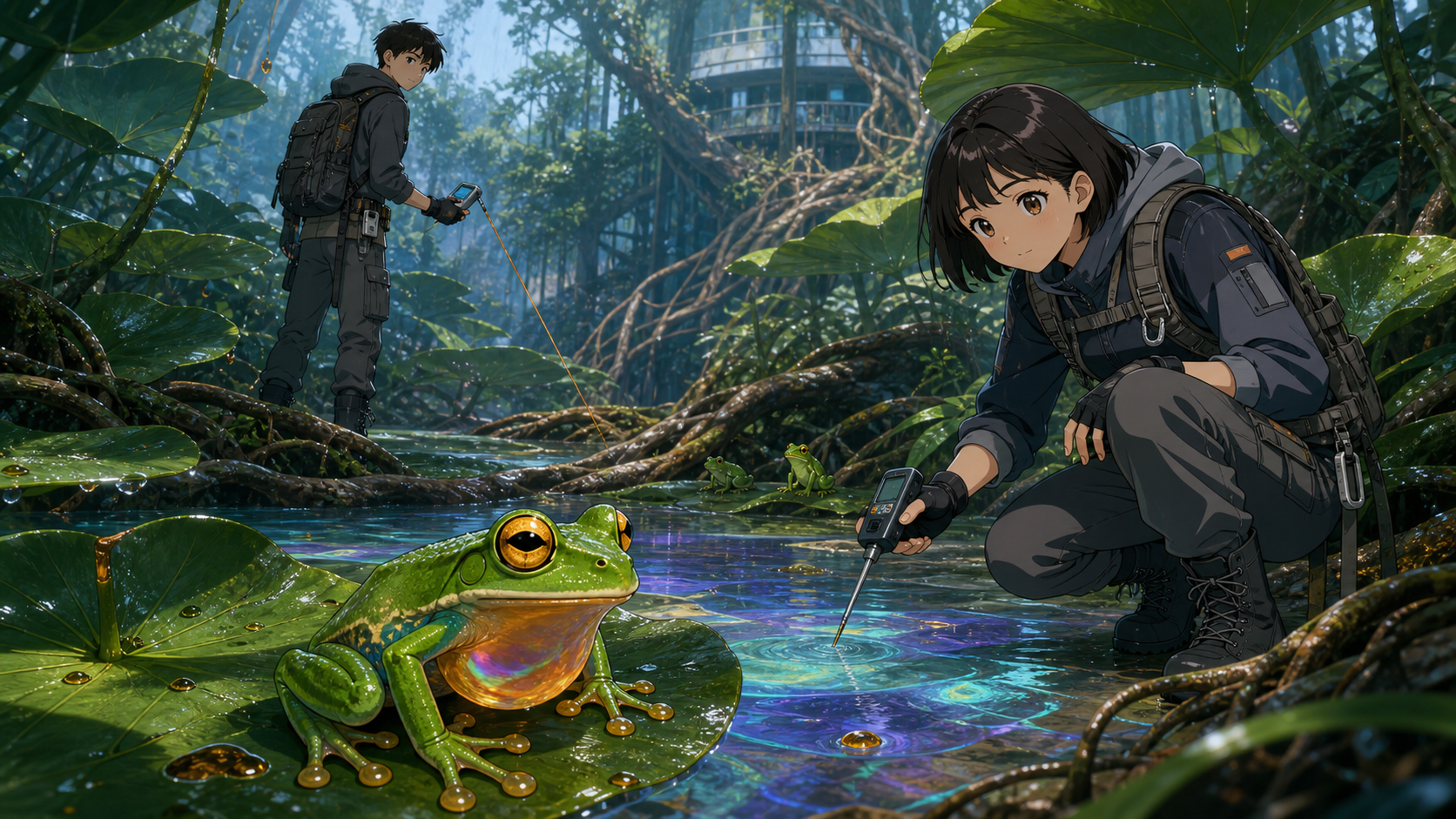
Observation LevelCoastal field note
First SeenDay 02 · Day 02 · Rainbow-Sac Tree Pool
HabitatTree pools, wet branches, calcifying fungal films, and low-flow return channels within Mist-Crown Mycelial River Buffer Forest
VariantsTranslucent tadpoles, palm-sized green-gold juveniles, and forearm-length adults with iridescent throat reservoirs
Habitat and Mechanism
Tree pools, wet branches, calcifying fungal films, and low-flow return channels within Mist-Crown Mycelial River Buffer Forest。Giant leaves catch acid rain, and symbiotic fungal films reduce its acidity before the water descends through the roots into the Mycelial River. Rainbow-Sac Tree Frogs retain small amounts of this neutralized water in translucent throat reservoirs. As they feed on fungal gnats and moth larvae, they carry fungal spores and seeds between tree pools. When continuous mist extraction interrupted the upstream flow, only downstream pools remained wet. Differences in throat-reservoir acidity and the distribution of calls traced the break in the river more precisely than the remaining surface water could.
Enter Mist-Crown Mycelial River Buffer Forest ↗Behavior and Ecological Role
The frogs are alert and non-aggressive. They cling to wet branches with broad toe pads, hunt fungal gnats and moth larvae, and move spores and seeds between pools. During this encounter they called only downstream. They continued feeding above the active fungal film at Calcifying Mycelial Terrace, then crossed the first dry branch again as soon as a blocked low-flow return gate was reopened.
Their calls map connected wet branches, while the acidity held in their throat reservoirs distinguishes flowing, neutralized rainwater from isolated pools. Feeding at the terrace confirmed that the forest's fungal recovery system was still functioning; the frogs' immediate return across one rewetted branch showed that continuity of flow, not the absence of life, was the missing condition.
Form and Identification
Translucent tadpoles, palm-sized green-gold juveniles, and forearm-length adults with iridescent throat reservoirs
- Biologically plausible equatorial tree-frog anatomy with adults about the length of a human forearm
- Emerald skin, warm amber eyes, and broad adhesive toe pads for wet canopy branches
- A translucent orange-gold throat reservoir with a subtle rainbow sheen
- Palm-sized green-gold juveniles and translucent tadpoles in sheltered tree pools
- Spores and seeds carried between pools while the frogs feed on fungal gnats and moth larvae
Observation Rule
Fang and K remain outside the frogs' movement corridor. They do not catch, tag, touch, illuminate, chase, or redirect the animals. Fang uses remote measurements and samples only naturally fallen material. K keeps all active weapons stowed and changes only a verified, reversible obstruction in human infrastructure. The frogs decide whether and when to return.
At Rainbow-Sac Tree Pool, the frogs called only from the downstream side. Fang compared the acidity of water held in their throat reservoirs from a distance. K marked the dry branches and kept the retreat route open. The difference between upstream and downstream frogs showed that the broken Mycelial River was not a normal seasonal drying event.