Reverse-Fall Sucker Goby
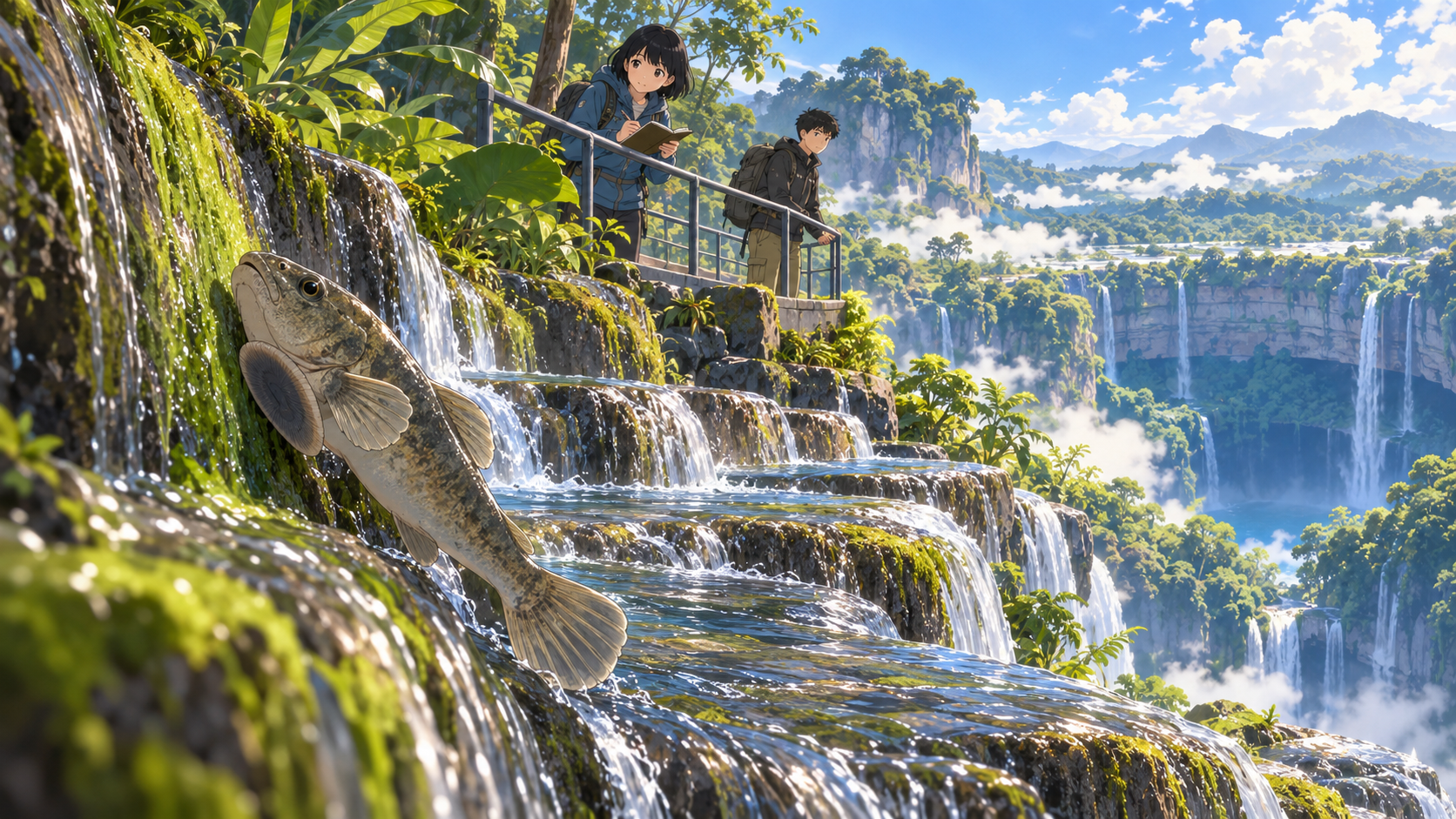
One blunt-headed goby presses a broad, pliant disc made from fused pelvic fins against wet rock. Its short, strong pectoral fins brace it as it inches upward between neighboring channels and scrapes a thin attached algae film. It neither flies nor enters the lightless core.
Observation TypeField observation
First SeenDay 04 · Day 04 · Reverse-Fall Shallow Channel
HabitatThin, wet basalt channels on the safe outer waterfall terraces of the Amazon Lightless Sinkhole; the fish remain outside the lightless core.
VariantsFinger-joint-length juveniles and adults around 40 cm; several fish inhabit different shallow channels at a distance from one another.
Habitat and Mechanism
Thin, wet basalt channels on the safe outer waterfall terraces of the Amazon Lightless Sinkhole; the fish remain outside the lightless core.. Continuous buoy pulses rebound between waterfall steps while transient pressure changes interrupt the thin water film. A goby briefly releases and resets its fused pelvic-fin disc as pressure shifts. The shared height where algae scrape marks stop locates the unstable flow. After K changes the buoy to intermittent ranging, several separate channels recover stable shallow flows.
Enter Mist-Step Echo Rim ↗Behavior and Ecological Role
One blunt-headed goby presses a broad, pliant disc made from fused pelvic fins against wet rock. Its short, strong pectoral fins brace it as it inches upward between neighboring channels and scrapes a thin attached algae film. It neither flies nor enters the lightless core.
The height at which the disc repeatedly releases indicates a transient pressure difference; algae scrape trails distinguish channels with sustained water from channels whose flow has stalled. The fish are feeding and moving normally, not repairing the observers’ equipment.
Form and Identification
Finger-joint-length juveniles and adults around 40 cm; several fish inhabit different shallow channels at a distance from one another.
- Blunt head and short strong pectoral fins
- One broad suction disc under the body, formed from fused pelvic fins
- Thin algae scrape trails at a consistent height
- Separate individuals in separate shallow channels
Observation Rule
Fang and K remain on dry terraces, keep the retreat route open, and change only their buoy pulse. They do not move, feed, capture, or gather the gobies.
At Reverse-Fall Shallow Channel, Fang saw several algae scrapes end at one height. A single goby held to wet rock below the line. Fang marked the waterline from above while K watched the dry retreat route; neither approached the fish.