
Mist-Step Echo Rim
Waterfall mist feeds a tiered outer water route. Continuous pulses from an old positioning buoy distort echoes and pressure alarms. Fang and K follow the safe observation line, then change the buoy remotely without entering the abyss.
- Parent Domain
- NB-12 · Amazon Lightless Sinkhole
- Location
- The outer rim of the Amazon Lightless Sinkhole, between a temporary base and the waterfall. Moss-covered basalt collection terraces stand above separate catch pools; the deep core remains off limits.
The problem begins with the base’s continuous ranging setting, not with the animals. Fang and K compare water marks, drop intervals, breathing pauses, root-curtain drips, goby positions, and caiman tracks from the outer safe line. K changes the buoy to intermittent low-frequency ranging remotely. They leave the caiman catch pool and the lightless core beyond the exclusion line.
How Mist-Step Echo Rim Works
Waterfall spray settles on layered mossy basalt ledges and feeds separate catch pools. The upper fruit slope links to the forest, damp decaying wood releases stored mist drops, hanging root curtains conduct water downward, and algae-lined shallows carry the flow toward the outer catch pool. The temporary base set an old positioning buoy to pulse continuously while tracking water level. Echoes rebound between rock steps, so alarms lag or misread local drops and shallow falls. Drop intervals, tapir breathing pauses, separate bagworm cases, goby suction-disc releases, and distant caiman patrol signs let Fang and K test the disturbance at each layer without treating the species as one food chain.
Observation Ethic
Fang reads habitat signs without collecting or steering life. I mark a dry retreat route, compare records with equipment timing, and change only the human-made signal. We do not chase, bait, touch, or displace any creature. A corrected alarm is a testable first step, not proof that the whole sinkhole has recovered.
Five-Day Route
- At Drip-Bell Moss-Basalt Terrace, compare the fungus’s three-fold drop cycle with the buoy alarm.
- On the upper fallen-fruit slope, use the tapir’s valve closure, pauses in breathing, and seed route to map a mist-pressure node.
- At the hanging root curtain, read separate bagworm cases and their downward drip path without moving them.
- At the outer waterfall shallows, compare goby suction-disc releases and algae scrape marks with a stable channel.
- At the catch-pool exclusion line, read the caiman’s feeding and nest-patrol signs from a distance; keep the pool closed and change only the buoy setting.
Five species maintaining this local ecology
 Day 01
Drip-Bell Stone-Ear Fungus
Mist gathers on the three inner cup folds. The outer fold relaxes first, then the next releases its drop, in a sequence governed by water pressure. It has no eyes, legs, voice, or purposeful movement toward observers. Mycelium holds to wet decaying wood and basalt. It breaks down leaves and rotten wood; water carries the resulting organic matter slowly into a root corridor that also supports bagworm habitat.
 Day 02
Mist-Lung Tapir
Two broad, continuous fleshy valve lips meet at a visible central notch at the end of its short flexible snout. They close together for a moment in waterfall mist. Broad shallow folds continuous with the skin of its shoulders and ribs flatten and gather slowly with the chest; they are not protruding air sacs. The tapir eats fallen fruit and tender leaves along the outer rim and disperses seeds onto mossy rock terraces. After the mist pressure falls, the solitary adult resumes feeding and follows the upper route without approaching the observers.
 Day 03
Curtain-Case Bagworm
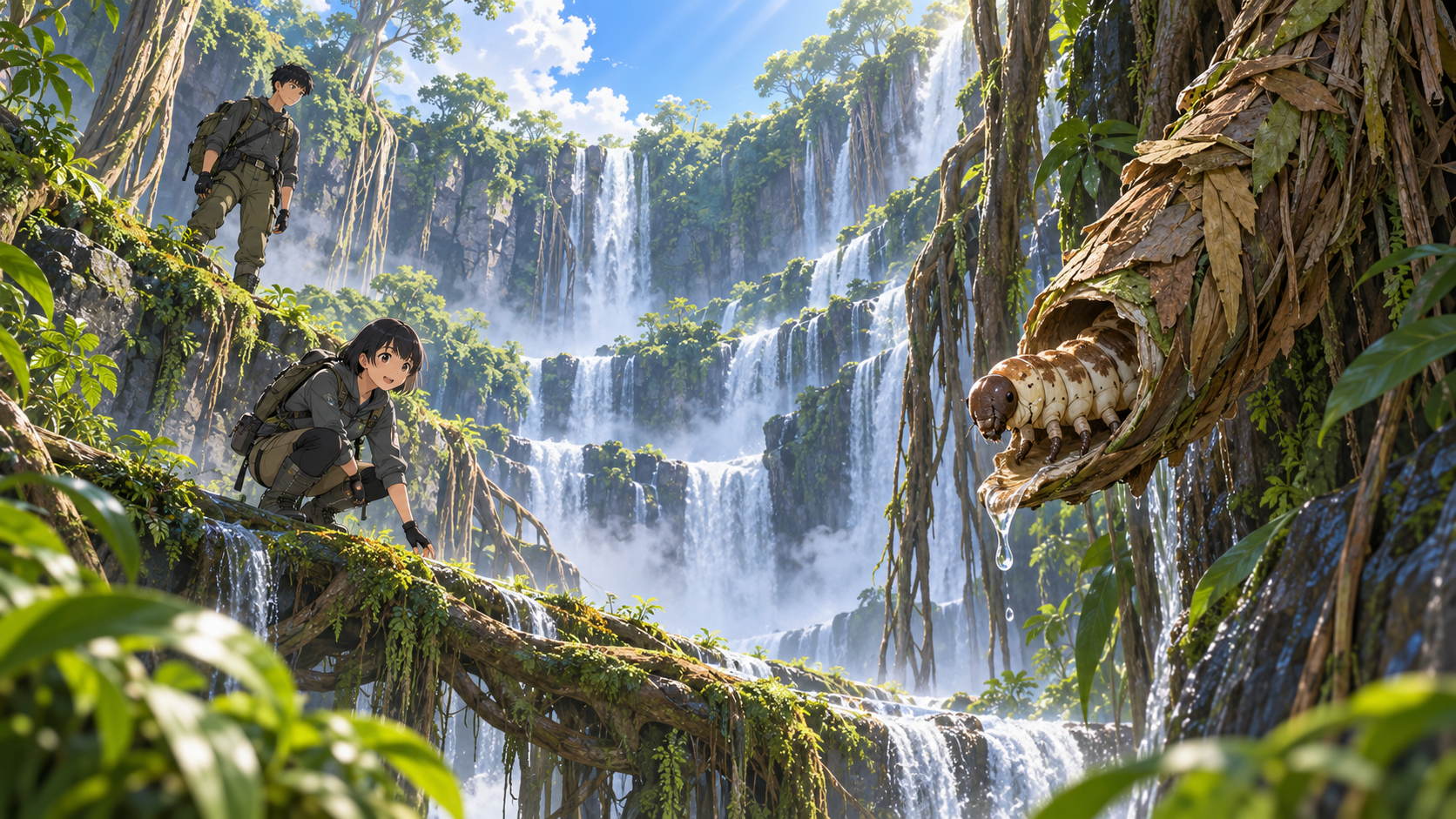
The wingless larva extends its head, thorax, and six short thoracic legs from a narrow case woven of root fibers, fallen-leaf fibers, and a little moss. It grazes moss along a vertical root curtain. A pliant water-guiding rim at the case opening catches mist and releases drops toward the lower ledge. Each larva lives in its own case.
 Day 04
Reverse-Fall Sucker Goby
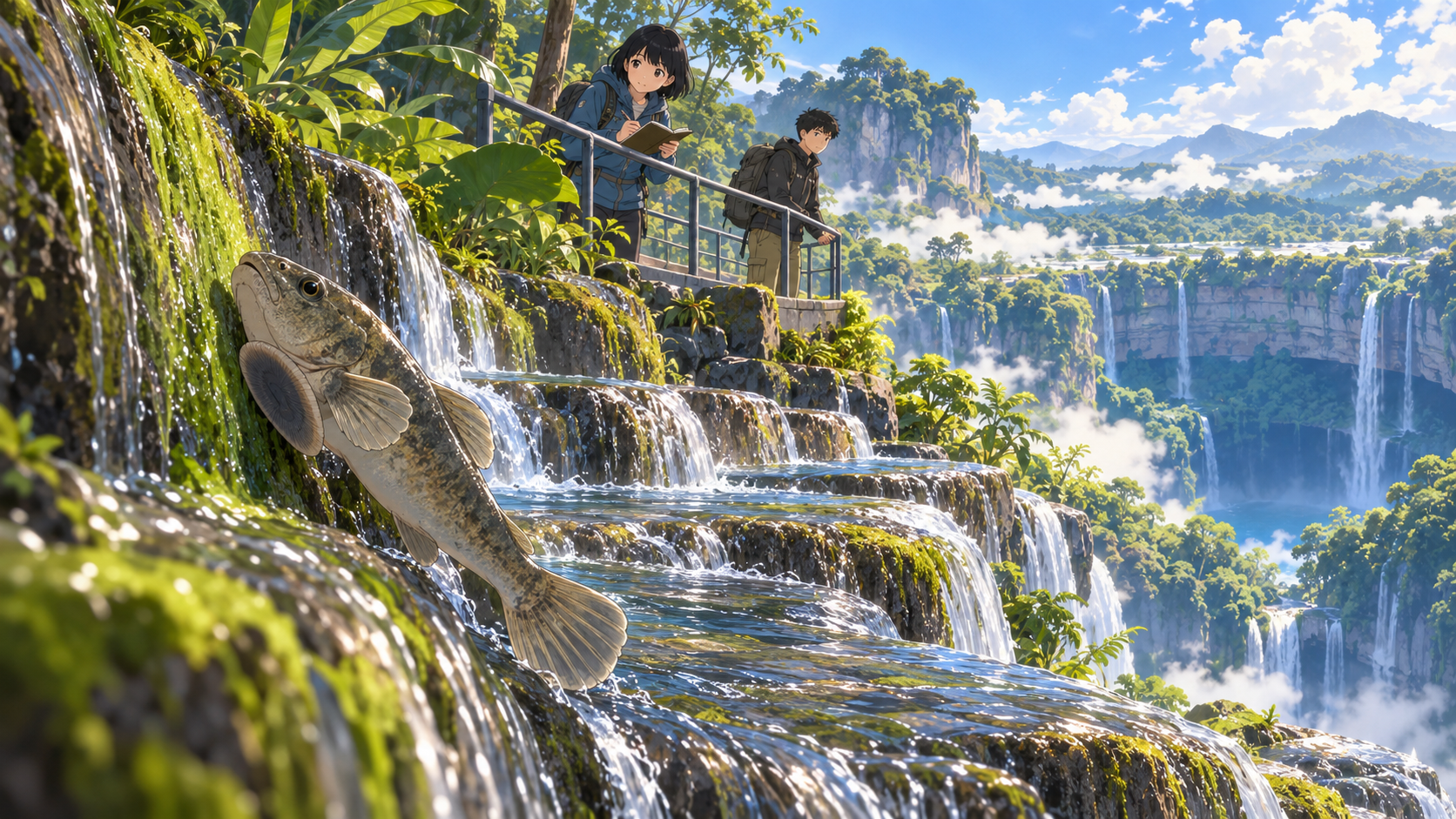
One blunt-headed goby presses a broad, pliant disc made from fused pelvic fins against wet rock. Its short, strong pectoral fins brace it as it inches upward between neighboring channels and scrapes a thin attached algae film. It neither flies nor enters the lightless core.
 Day 05
Broken-Fall Pressure-Crest Caiman
The low, broad snout and naturally aligned dorsal osteoderms belong to a powerful ambush predator. Paired pressure-sensitive bony crests sit behind the eyes; lateral flow vanes edge the flattened tail. It feeds on medium to large fish and small mammals near the water. Its nest-bay patrol is independent of Fang and K.
「Five species record different layers of one outer-rim water system. The fungus marks the first timing error; the tapir, bagworm, and goby trace air, roots, and shallow water; the caiman defines a boundary that still matters after the alarm is corrected. Remote intermittent ranging lets us compare a quieter reading with the water itself. I keep the exclusion line and the next check in the log. We have adjusted our measurement, not claimed the abyss or its life as ours.」