A Route Around the Copper Veins
Cold fog hid most of the old cableway support. The new copper band on the stone did not align with the old one. Fang stopped outside the safety rail. I marked the upper path around the lichen before we took another reading.

Field Observation
Morning at Copper-Vein Miststone Steps: compare the offset color bands. Noon at Lichen Absorption Face: take a distant metal reading and switch off the sample lamp. Evening at Outer Thin-Soil Terrace: mark the protected wet-dry strip and withdraw above the stone steps.
Morning · Copper-Vein Miststone Steps
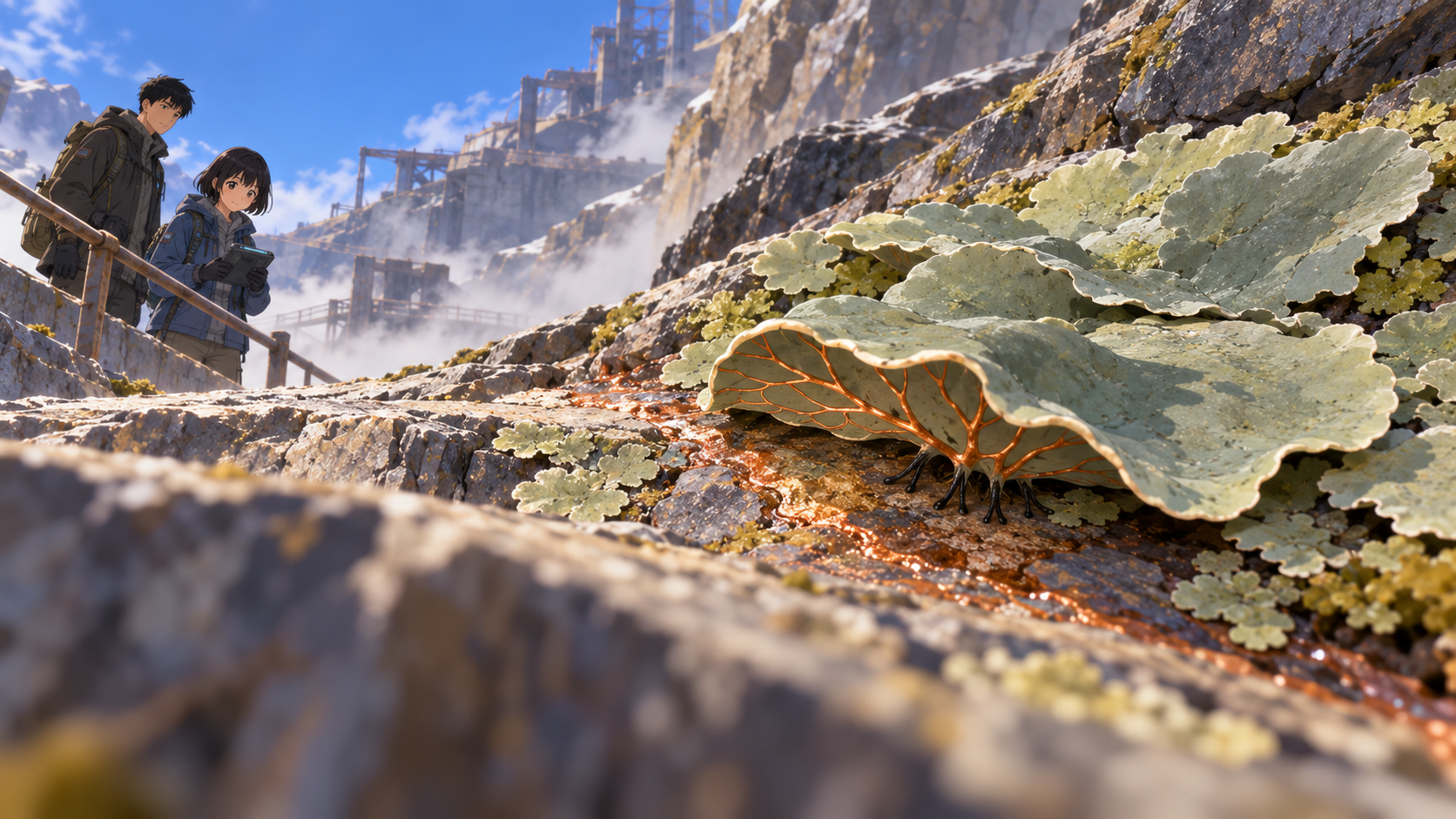
Cold fog left only one span of cableway support visible above the stone steps. Old and new copper-colored bands did not align. The lichen was still clear: palm-wide, broad gray-green lobes lay flat over one another. Copper-colored veins crossed their undersides; short black filaments fixed them to the rock. Fang compared the bands from outside the rail. I marked the upper detour and the way back. The organism binds a little metal at the abandoned mine edge, but it lives only where cold mist and dry stone alternate. The old line vibrates continuously. The two changes might overlap; one mark cannot speak for the whole slope. I wrote down the wind, the step, and the time, then checked them against the previous day's clues before drawing a conclusion.
Noon · Lichen Absorption Face
From our distant point, the underside veins and short holdfasts came into view. Mineral seepage stayed on the rock face instead of washing straight into the thin soil. Fang read a noncontact metal value against the wider slope. I remained beyond the rail and switched off the sample lamp. We took nothing from the lichen. Its copper pattern darkened near one edge and paled beyond it, a possible boundary for seepage, not a fault signal from a living sensor. I checked the same wind direction against the first stone step. The records were still too few to blame the old cableway for every change.
Evening · Outer Thin-Soil Terrace
The fog drew back. Separate lichen patches followed the boundary between damp and dry rock; the thin soil beyond them had no fresh mine-cart track. Fang and I left the steps and marked a protected strip from higher ground. There was no need to put a wheel through it to test the reading. The lichen held trace metal, the slope held the first grass, and the wildlife corridor lay farther on. I compared the three places, then drew a maintenance route outside the living strip. Fang asked me to put our retreat on the same map. I did. The mountain has its own rhythm. Equipment can make way.
Habitat Causality
Old cableway supports transmit continuous mine-line vibration into cold-fog terraces; seepage reaches the outer rock. Copper-Vein Rock Lichen binds trace metal at the wet-dry boundary and protects thin soil. Comparing three separated observations narrows a possible seepage edge, but cannot prove the entire slope has changed. A rerouted maintenance line reduces human pressure on the habitat.
Species Behavior
The lichen forms scattered fingertip-sized young lobes and palm-wide smooth gray-green layers. Copper-toned underside veins adsorb trace metal; short dark filaments hold fast to stone. Growth follows alternating cold mist and dry rock. It neither moves toward observers nor acts as an alarm.
「I left the lichen on its rock and the retreat route on our map. The mine line can turn before the habitat has to.」