Ash Compass Limpet
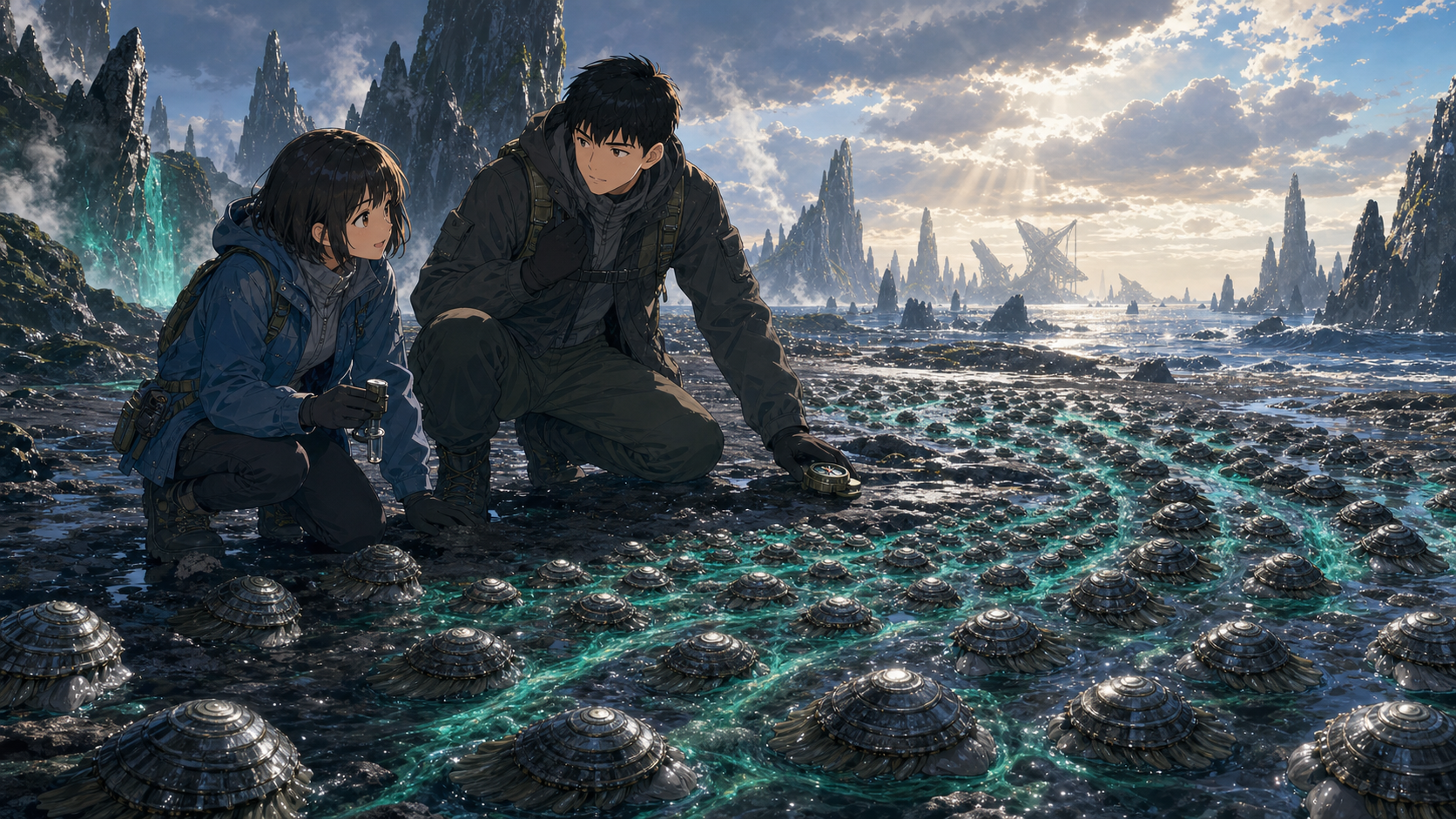
The limpets graze chemosynthetic algae in geothermal fissures. Their concentric shell plates accumulate magnetite, and entire colonies align along invisible magnetic lines before reversing direction together when the field's polarity flips.
Observation LevelCoastal field note
First SeenDay 01 · Day 01 · Black-Sand Needle Beach
HabitatWet basalt, black-sand tide pools, and geothermal algae beds inside Broken-Needle Thermal Fjord
VariantsRice-grain-sized transparent juveniles, palm-sized black-and-silver adults, and spiral colonies numbering in the hundreds
Habitat and Mechanism
Wet basalt, black-sand tide pools, and geothermal algae beds inside Broken-Needle Thermal Fjord。Magnetite-rich basalt is charged by years of thunderstorms and slowly releases that charge as tides and geothermal vents shift. Cold seawater and turquoise geothermal algae form a feeding ground where magnetic polarity changes remain legible in the animals' arrangement.
Enter Broken-Needle Thermal Fjord ↗Behavior and Ecological Role
The limpets graze chemosynthetic algae in geothermal fissures. Their concentric shell plates accumulate magnetite, and entire colonies align along invisible magnetic lines before reversing direction together when the field's polarity flips.
Their synchronized turns prove that the compass error comes from a periodic magnetic field inside the fjord, not a fault in the storm harbor's instruments.
Form and Identification
Rice-grain-sized transparent juveniles, palm-sized black-and-silver adults, and spiral colonies numbering in the hundreds
- Low conical shell with believable marine gastropod anatomy
- Black-and-silver magnetite plates marked by concentric compass-like ridges
- Muscular slate-colored foot gripping wet volcanic rock
- Hundreds of individuals arranged in orderly spirals around turquoise geothermal algae
- A colony-wide turn that matches the deflection of a mechanical compass
Observation Rule
Fang and K do not move or collect the limpets. They use passive comparison, keep clear of the feeding spiral, and carry the question onward instead of breaking the pattern to obtain an answer faster.
At Black-Sand Needle Beach, the colony changed direction in the same second. Fang examined the shell ridges while K placed a mechanical compass on the wet rock; both shifted by the same angle.