Diffraction Spore Spider
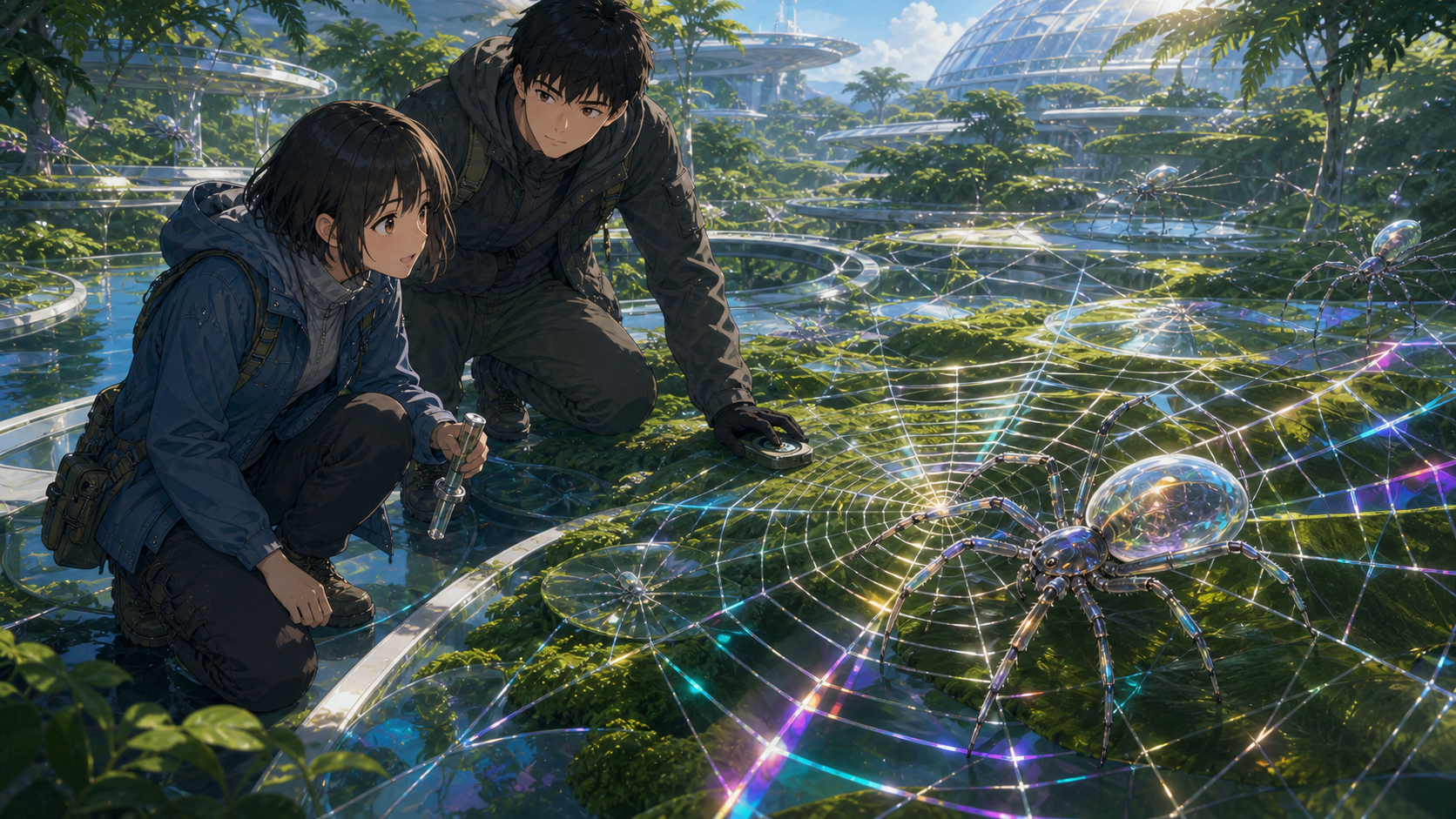
The spiders anchor all eight legs to the edges of wafer-glass leaves and weave clean radial webs. They prey on small insects from the retired test zone without threatening Fang or K. Fungal spores adhere to the silk and are carried into new cracks beneath the canopy as the colony rebuilds.
Observation LevelCoastal field note
First SeenDay 01 · Day 01 · Outer-Ring Photoalgae Channel
HabitatMoss-covered wafer-glass terraces, condensation channels, and feral fungal rings inside Diffraction Mycelium Reserve
VariantsRice-grain-sized mist-white spiderlings, palm-sized translucent silver adults, and communal polarized webs spanning several fern trees
Habitat and Mechanism
Moss-covered wafer-glass terraces, condensation channels, and feral fungal rings inside Diffraction Mycelium Reserve。Retired photonic wafer glass has been overgrown by mycelium and roots. Dome condensation, low-grade waste heat, and mineral films left by maintenance machines create a polarized light habitat. The spiders' silk splits dome light into cyan, magenta, and gold bands, making two conflicting daily light cycles visible.
Enter Diffraction Mycelium Reserve ↗Behavior and Ecological Role
The spiders anchor all eight legs to the edges of wafer-glass leaves and weave clean radial webs. They prey on small insects from the retired test zone without threatening Fang or K. Fungal spores adhere to the silk and are carried into new cracks beneath the canopy as the colony rebuilds.
The angle of the polarized webs proves that the conflicting spectrum is not a sensor failure. The forest is receiving two incompatible light cycles, and every spider adjusts the same radial line when the second cycle arrives.
Form and Identification
Rice-grain-sized mist-white spiderlings, palm-sized translucent silver adults, and communal polarized webs spanning several fern trees
- A biologically plausible orb-weaver body with eight clearly separated legs
- A translucent silver abdomen and thin dark joints
- Iridescent cyan, magenta, and gold bands along the carapace
- Clean radial webs stretched between mossy wafer-glass leaves
- Luminous fungal spores carried on the silk without damaging the web
Observation Rule
Fang and K never cut an active web or disturb the colony. They collect only naturally shed silk, keep maintenance machines outside the grove, and let the spiders continue moving fungal spores through the habitat.
At Outer-Ring Photoalgae Channel, one sun stood above the water while the web held two different times of day. Fang traced the angle across the silk. K fixed a dark reference ruler outside the illuminated band. The spiders did not flee; their web made the repeated error legible.