Lightbreak Solifuge
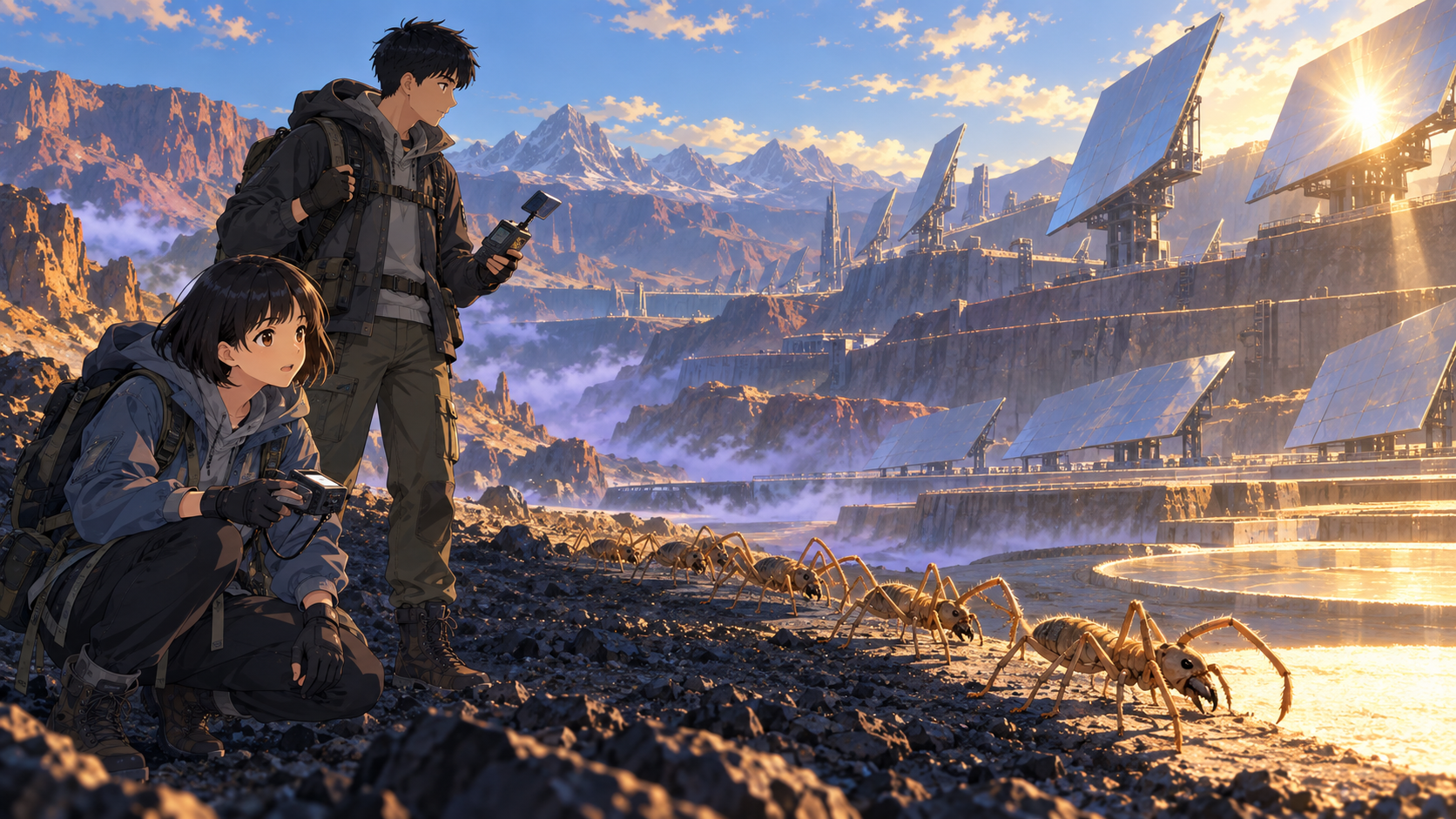
The solifuges use long pedipalps to read surface-temperature gradients and hunt glass-dust mites along shaded gravel. Their eight legs remain inside continuous shade. When a moving hotspot approaches, individuals raise their pedipalps, draw back the forelegs, lower the body, and stop together until the light has passed. They do not spin webs and have neither scorpion tails nor stingers.
Observation LevelCoastal field note
First SeenDay 01 · Day 01 · East Mirror-Trace Slope
HabitatComplete shadow lanes, matte black-glass gravel, weathered solar-mirror terraces, cooling-stone troughs, rock-shelf shade, and cold-air mist within the Lights-Out Cold-Well Corridor
VariantsMilky-white juveniles the size of a finger joint, forearm-long ochre adults, and diurnal individuals dispersed along complete shadow boundaries
Habitat and Mechanism
Complete shadow lanes, matte black-glass gravel, weathered solar-mirror terraces, cooling-stone troughs, rock-shelf shade, and cold-air mist within the Lights-Out Cold-Well Corridor。The abandoned mirror field gathers heat by day and should lock into a lights-out angle at night so descending valley air can pass through underground tunnels and rise from three cold wells. After the harbor remotely restarted the heliostat array, an old controller misread moving animal shadows as mirror contamination and continued tracking them with concentrated light. Lightbreak Solifuges detected the approaching surface-temperature change and stopped in formation forty-one seconds before the overheat alarm. Their footprints let Fang and K identify the misaligned mirror row without handling an animal or repeating a live test.
Enter Lights-Out Cold-Well Corridor ↗Behavior and Ecological Role
The solifuges use long pedipalps to read surface-temperature gradients and hunt glass-dust mites along shaded gravel. Their eight legs remain inside continuous shade. When a moving hotspot approaches, individuals raise their pedipalps, draw back the forelegs, lower the body, and stop together until the light has passed. They do not spin webs and have neither scorpion tails nor stingers.
Their synchronized stop line is an early-warning map of mirror heat, appearing forty-one seconds before the harbor alarm. By marking which shadows remain thermally continuous, they preserve a small-predator route between cold fissures and cooling troughs. That prey route later supports small nocturnal mammals and helps connect the wider night-cooling corridor.
Form and Identification
Milky-white juveniles the size of a finger joint, forearm-long ochre adults, and diurnal individuals dispersed along complete shadow boundaries
- Eight natural legs and long sensory pedipalps on a biologically plausible solifuge body
- Matte amber adults reaching approximately forearm length
- Compact dark chelicerae without oversized venom fangs
- Broad heat-safe foot pads for black-glass gravel
- A synchronized stop posture at the edge of an approaching mirror hotspot
Observation Rule
Fang and K do not chase, trap, touch, relocate, bait, aim at, strike, or use the solifuges to prove a repair. Fang measures from outside their activity line with noninvasive instruments. K keeps weapons secured, uses passive records, modifies only the human-made mirror axis, and does not restart it for another test. The animals choose when to stop and when to cross.
At East Mirror-Trace Slope, Fang saw a line of small ochre forms moving along the shadow edge. K shut down active scanning and used only a passive light meter. The solifuges stopped together, and forty-one seconds later a heliostat hotspot crossed the ground ahead of them. Their response showed that the danger came from an uncalibrated control program, not aggression from the animals.