Mist-Step Foldwing Katydid
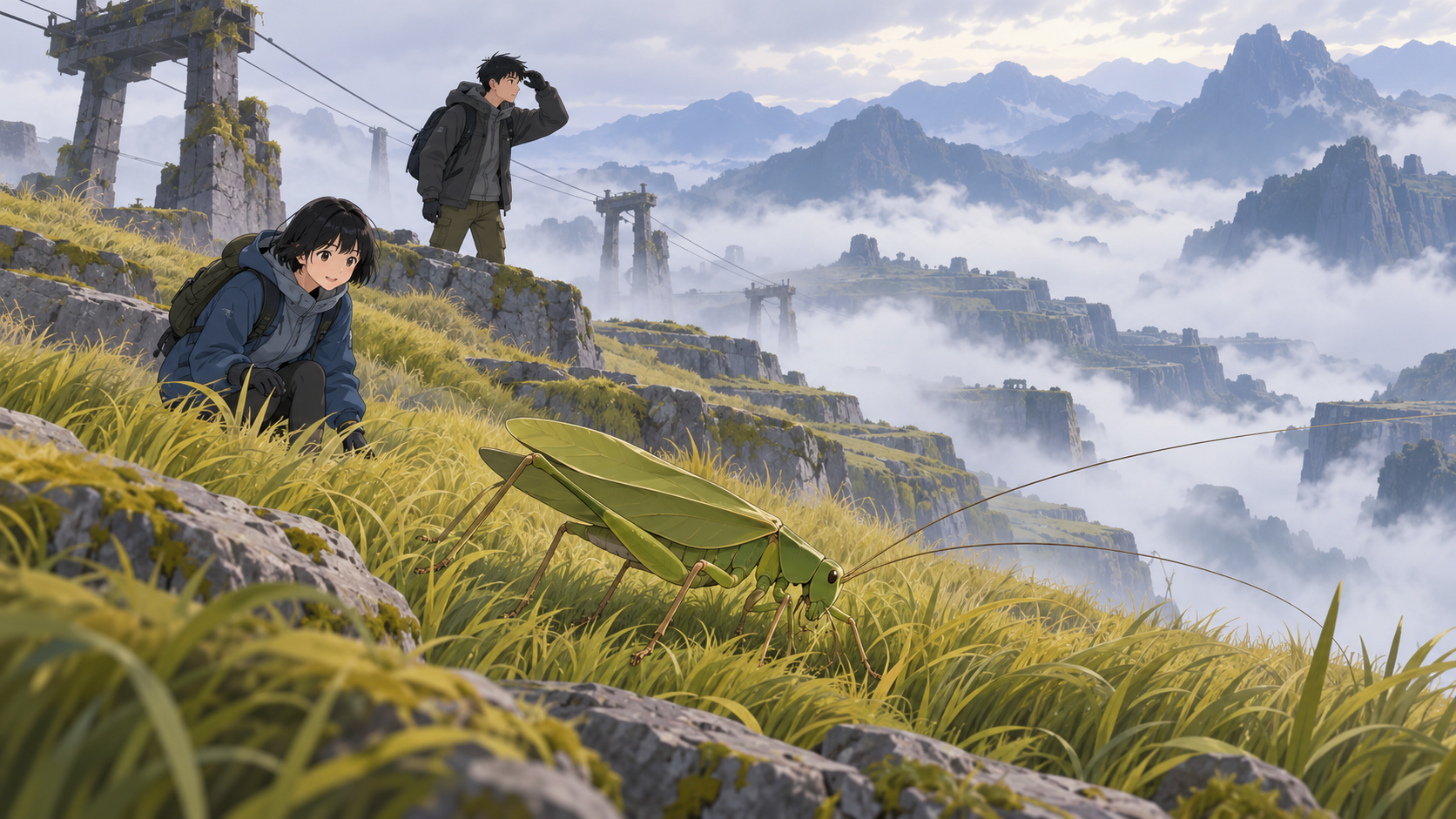
A hand-length adult has two neatly folded hindwing sections, long fine antennae, and broad, flexible hind tarsi. It grazes cold-fog grass close to the ground. In strong wind it folds its wings and crouches in a rock crevice, where the soft hind feet absorb vibration. After the fixed-frequency vehicle test stops, a lone katydid returns to graze.
Observation TypeField observation
First SeenDay 02 · Day 02 · Foldwing Grass Belt
HabitatCold-fog grass on the terraces above the Andean mist port, beside old cableway supports and outside the restricted thundercloud salt lake. Individuals shelter separately in rock crevices when strong wind crosses the slope.
VariantsShort-winged young; hand-length adults; separate grass-slope individuals that do not form a group.
Habitat and Mechanism
Cold-fog grass on the terraces above the Andean mist port, beside old cableway supports and outside the restricted thundercloud salt lake. Individuals shelter separately in rock crevices when strong wind crosses the slope.. Continuous vibration from the old mining line travels through cableway supports into the terraces, shifting readings from wildlife paths and aerial wind windows. Lichen fixes mineral seepage on the outer rock face. Breaks in grazed leaves and places where broad hind feet rest help locate the affected strip, but one trace cannot explain an entire mountainside. Fang and K compare wind, stone steps, lichen, grass, wildlife paths, and aerial wind windows before moving the maintenance route away from the habitat.
Enter Cloud-Stair Mining Bypass ↗Behavior and Ecological Role
A hand-length adult has two neatly folded hindwing sections, long fine antennae, and broad, flexible hind tarsi. It grazes cold-fog grass close to the ground. In strong wind it folds its wings and crouches in a rock crevice, where the soft hind feet absorb vibration. After the fixed-frequency vehicle test stops, a lone katydid returns to graze.
Its sparse droppings return plant matter to thin soil. Grazed leaf gaps and resting points show where conditions on the grass terrace have shifted, without making the animal an alarm for the mine or blaming it for equipment faults. Keeping the grass belt continuous also leaves a passage for other life.
Form and Identification
Short-winged young; hand-length adults; separate grass-slope individuals that do not form a group.
- Hand-length adult with a matte olive body and two folded hindwing sections
- Long, fine antennae and broad, soft hind tarsi rather than a beetle shell
- Ground-level feeding marks on cold-fog grass and separate resting points in stone crevices
- Solitary adults; short-winged young do not imply a flock or colony
Observation Rule
Fang and K observe from a safe distance, keep a retreat route, and never touch or drive the katydid. They check yesterday's evidence before attributing a slope-wide change to the old mining line. The maintenance route can bend around the living grass belt.
At Foldwing Grass Belt, grazing marks stopped beside an old cableway support. Fang followed the gap in the leaves while I checked the wind from the higher path. We saw one katydid's broad hind foot and recorded the place from a safe distance.