The Grass Belt Can Keep Its Rhythm
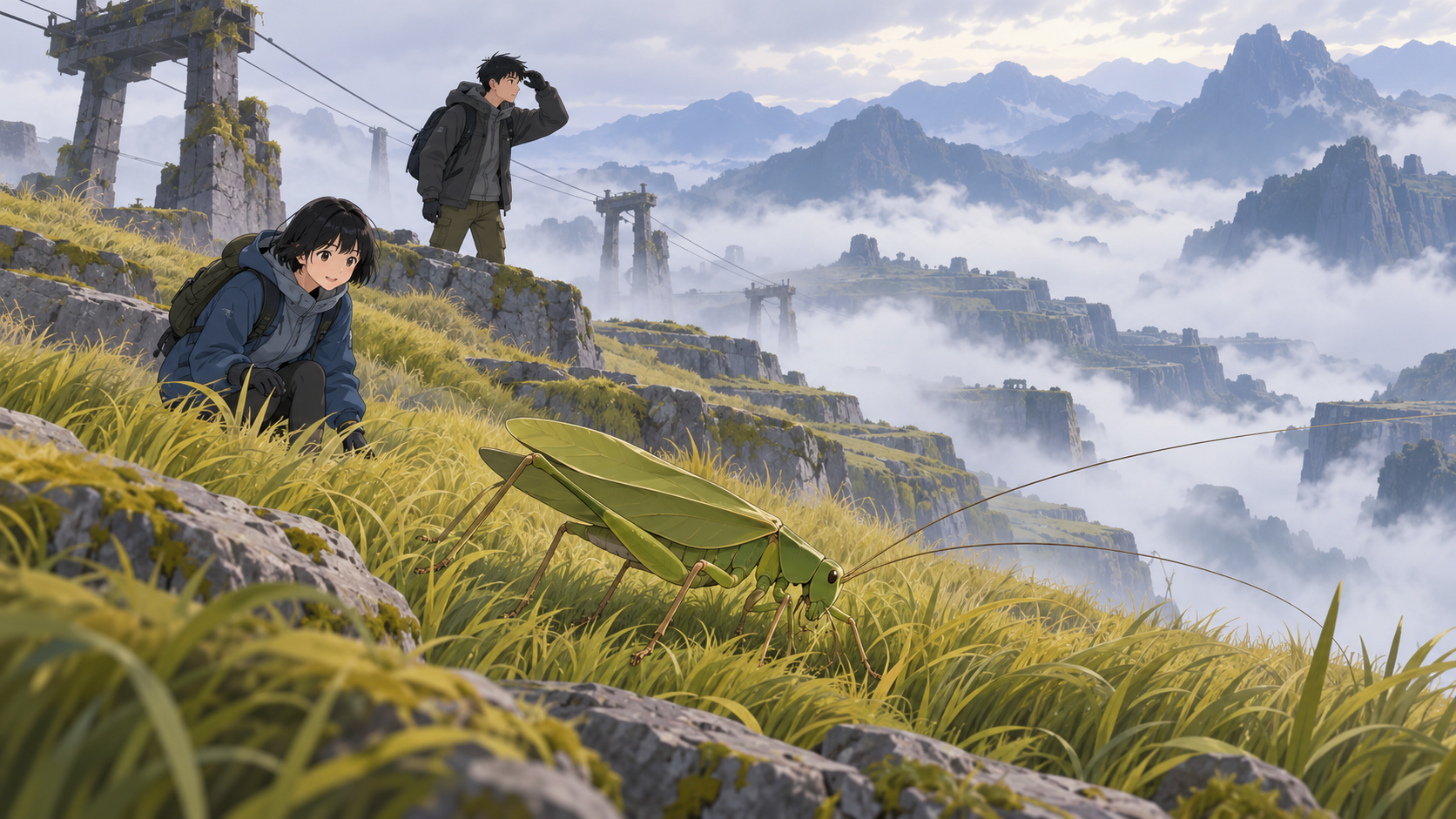
Cold fog reduced the old cableway support to one outline. A line of grazed grass ended beneath it. Fang followed the gap; I took the higher path to check the wind. A lone katydid showed its broad hind foot between the leaves.
Field Observation
Morning at Foldwing Grass Belt: follow broken grazing marks and check the wind. Noon at Hind-Tarsus Windbreak Crevice: compare support pulses and stop the fixed-frequency test. Evening at Lower Cloud-Sea Grass Slope: withdraw along the side slope, leaving the grass corridor unbroken.
Morning · Foldwing Grass Belt
The cold fog left only a section of the old cableway support visible. Grazed leaves stopped in its direction. Fang followed their gap while I checked the wind from a higher path. One hand-length katydid stayed low in the grass. Its long, fine antennae moved ahead of two folded hindwing sections; broad, soft hind tarsi held it against the ground. It grazed the cold-fog leaves rather than gathering with others. The breaks in the grass might coincide with continuous vibration from the old mining line, but a single mark cannot speak for the whole slope. I wrote down wind direction, stone step, and time, then compared them with yesterday's clues. Fang asked me to mark a safe way back. I did.
Noon · Hind-Tarsus Windbreak Crevice
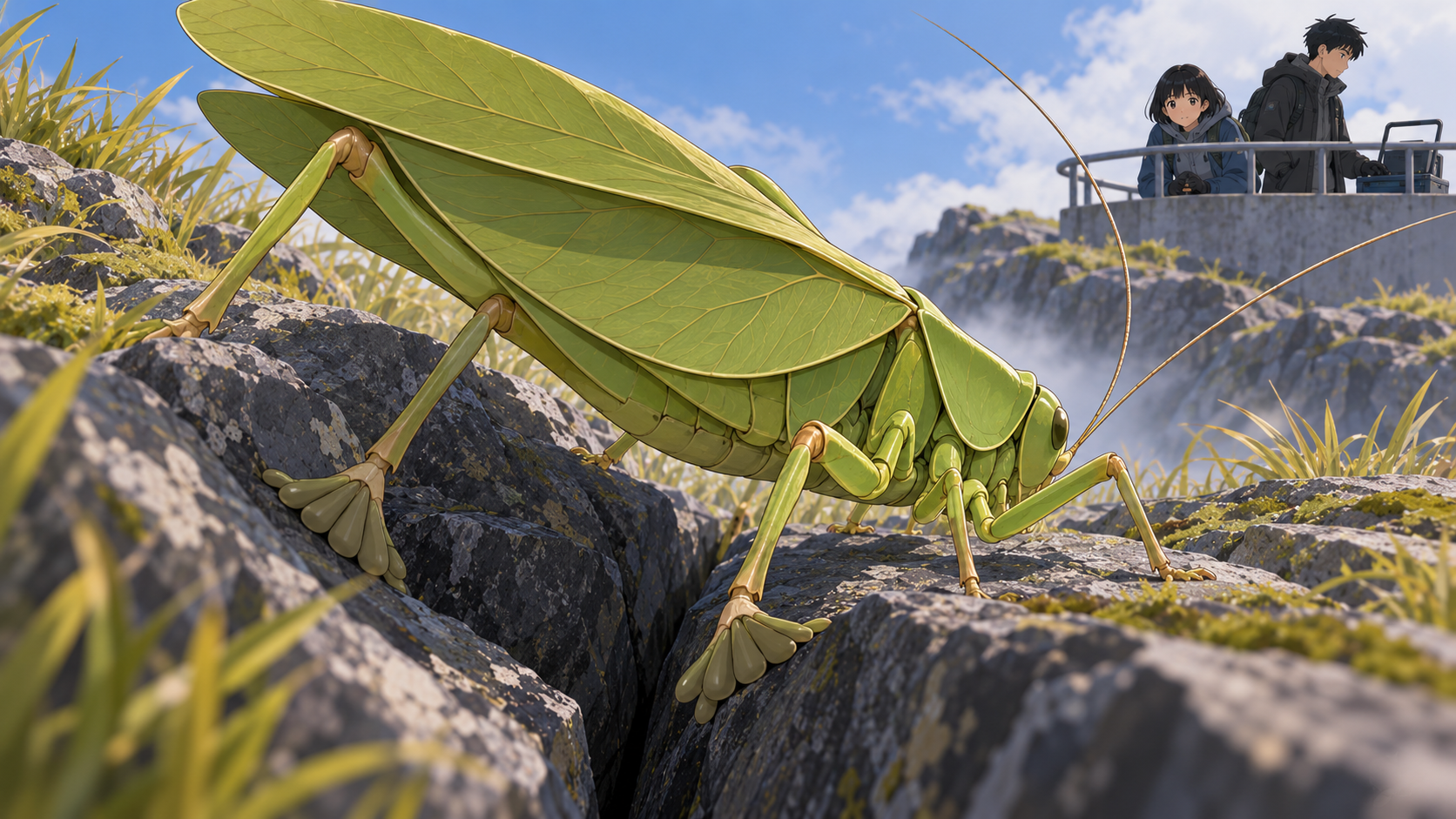
From a low viewpoint, I saw the katydid close both sections of its hindwings. Its flexible hind feet braced in the stone crevice and absorbed vibration as the wind rose. Fang compared the pulse at the old support from farther back. I switched off the nearby maintenance vehicle's fixed-frequency test. We did not handle the animal or blame it for equipment faults. Its shelter, the lichen on the rock, the grass belt, the wildlife path, and the wind window each gave us a different piece of the route. I checked the time and wind against the morning record; there was still too little evidence to blame one machine for every change on the mountain.
Evening · Lower Cloud-Sea Grass Slope
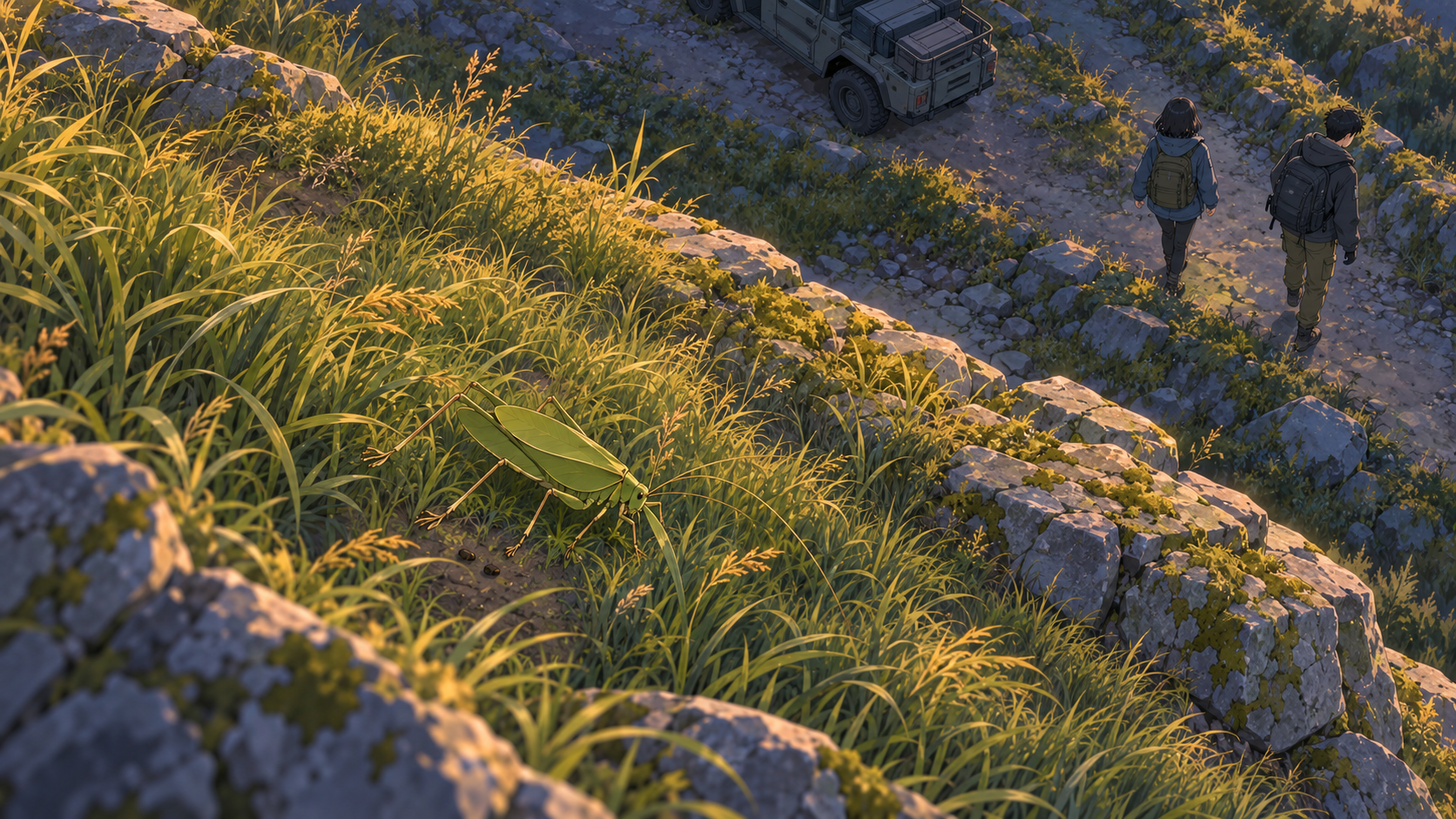
The vehicle stayed still. One katydid returned to the grass and grazed alone. A few droppings fell into the thin soil, returning plant matter to the slope. Fang and I moved away along the side path so the grass belt remained continuous. I compared the three sites and yesterday's clues before drawing a maintenance line around the habitat. Nothing required us to drive through the grass to confirm a reading. I put our retreat on the same map. The mountain has its own rhythm. Equipment can make way.
Habitat Causality
Old mining-line vibration can travel through cableway supports into the cold-fog grass terraces, shifting readings from wildlife paths and aerial wind windows; lichen fixes mineral seepage on the outer rock face. Grazing gaps and hind-foot resting points may mark an affected strip, but wind, lichen, wildlife paths, and earlier observations must be compared before drawing a wider conclusion. A stopped fixed-frequency test and a rerouted maintenance line leave the grass habitat intact.
Species Behavior
The solitary hand-length katydid folds two hindwing sections, braces with broad flexible hind tarsi, grazes grass close to the ground, shelters in stone during strong wind, and returns plant matter to thin soil through sparse droppings.
「I left the grass belt unbroken and the retreat route on our map. The maintenance line can turn before the habitat has to.」