Root-Channel Armored Crab
The crabs sort fallen leaves and fungal matter, turn humus, and press sediment into arches that let water seep through dense buttress roots. They are wary but do not attack. During molting, the colony protects clean-water chambers and closes openings facing contamination while leaving its other channels intact.
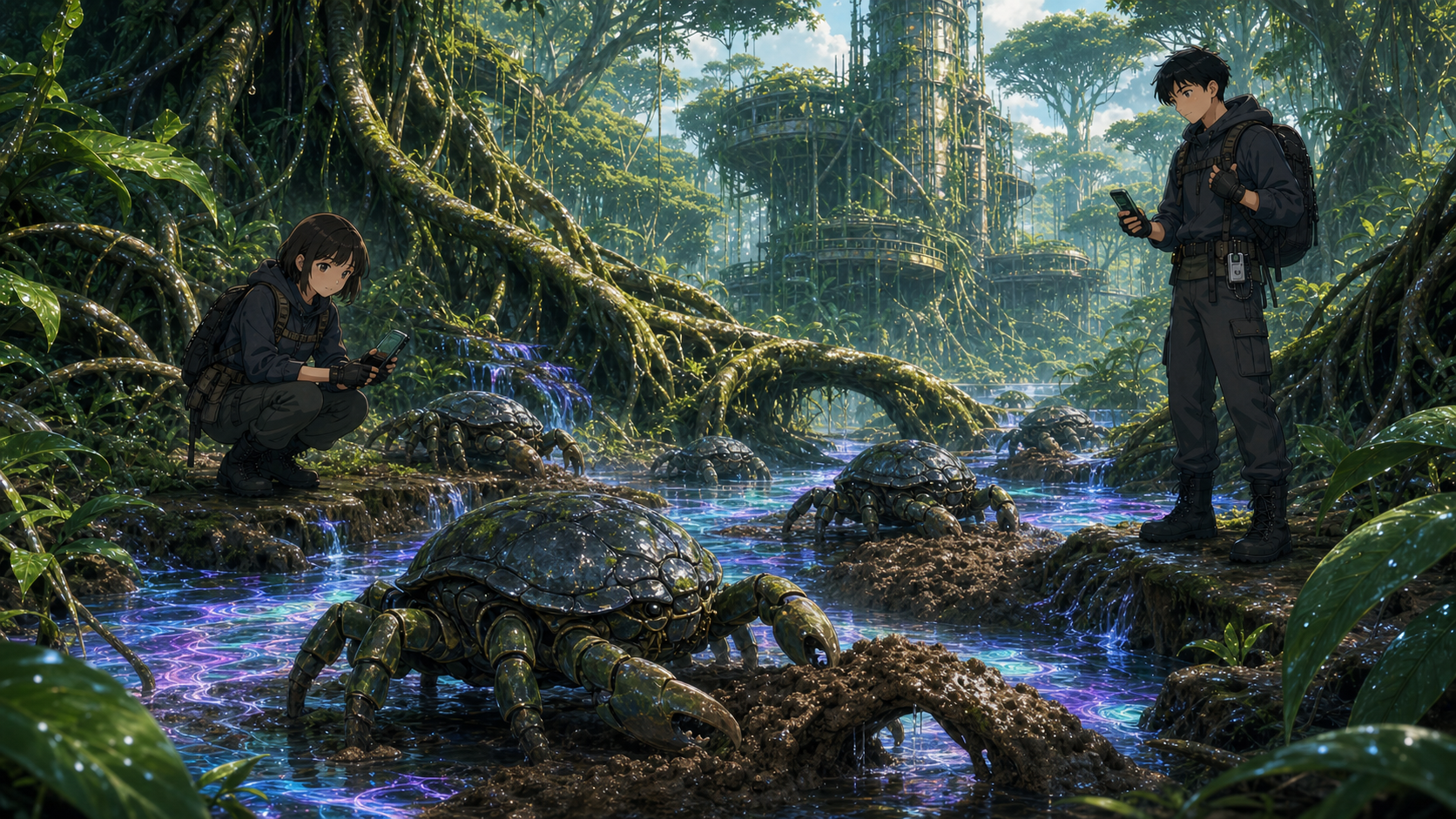
Observation LevelCoastal field note
First SeenDay 03 · Day 03 · Root-Channel Armored Crab Bank
HabitatButtress-root channels, leaf-fall troughs, porous mud arches, and clean reaches of the Mycelial River within Mist-Crown Mycelial River Buffer Forest
VariantsGray-brown soft-shelled juveniles, blue-black mineral-armored adults, and channel-building colonies that share one root-water network
Habitat and Mechanism
Buttress-root channels, leaf-fall troughs, porous mud arches, and clean reaches of the Mycelial River within Mist-Crown Mycelial River Buffer Forest。Acid rain is softened by leaf minerals and symbiotic fungal films before entering the root channels. Root-Channel Armored Crabs feed on fallen leaves, fungal mats, and humus, then use blunt claws to build porous seepage arches beneath giant buttress roots. Their mineralized carapaces tolerate acidic rain, but newly molted animals require clean Mycelial River water. When concentrated acidic discharge entered from beneath the alloy root bridge, the colony sealed only the upstream-facing openings with fresh mud. The location of those seals preserved the direction of the leak.
Enter Mist-Crown Mycelial River Buffer Forest ↗Behavior and Ecological Role
The crabs sort fallen leaves and fungal matter, turn humus, and press sediment into arches that let water seep through dense buttress roots. They are wary but do not attack. During molting, the colony protects clean-water chambers and closes openings facing contamination while leaving its other channels intact.
Their feeding breaks down fallen leaves and humus on the forest floor, while their porous arches keep the Mycelial River moving through dense roots. Fresh mud closures reveal the direction of unsafe water. Mineral scorch marks on leaves they carried from upstream distinguished concentrated condenser discharge from ordinary acid rain, and a drain beneath the root bridge linked that discharge to Third Mist-Condenser Tower.
Form and Identification
Gray-brown soft-shelled juveniles, blue-black mineral-armored adults, and channel-building colonies that share one root-water network
- Biologically plausible terrestrial-crab anatomy with a carapace about one meter wide
- A broad blue-black mineralized carapace and moss-green joints
- Six sturdy walking legs and two blunt claws adapted to moving earth rather than striking
- Gray-brown soft-shelled juveniles
- Porous mud arches built beneath giant buttress roots
Observation Rule
Fang and K do not enter the molting core, open burrows, handle crabs, break mud seals, or force a route through the colony. Fang studies seepage and naturally discarded material from the perimeter. K keeps all active weapons stowed and removes only a verified piece of loose human infrastructure that is pressing on an existing arch. The crabs keep control of their channels.
At Root-Channel Armored Crab Bank, fresh mud sealed only the openings facing upstream. Fang and K stayed at the colony's edge, outside the molting core. By watching seepage direction instead of entering the burrows, they learned that water quality had failed before water volume did.