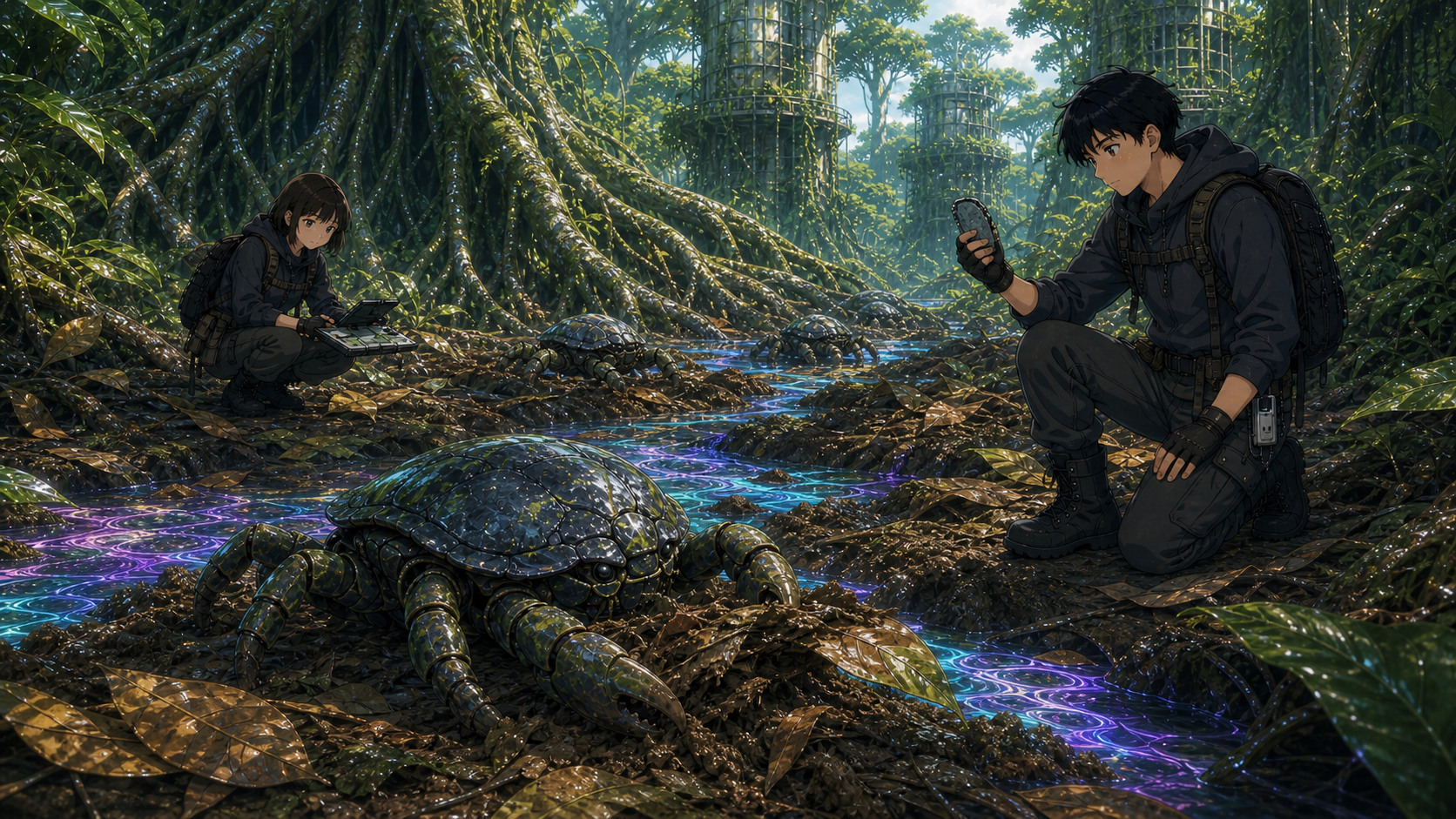
The Mud Seals Pointed Upstream
Fresh mud closed only the upstream openings. Fang watched the seepage. I marked the load-bearing roots, wind, and retreat line from outside the molting core. The crabs had not blocked the river. They had marked the side that was no longer safe.
Field Observation
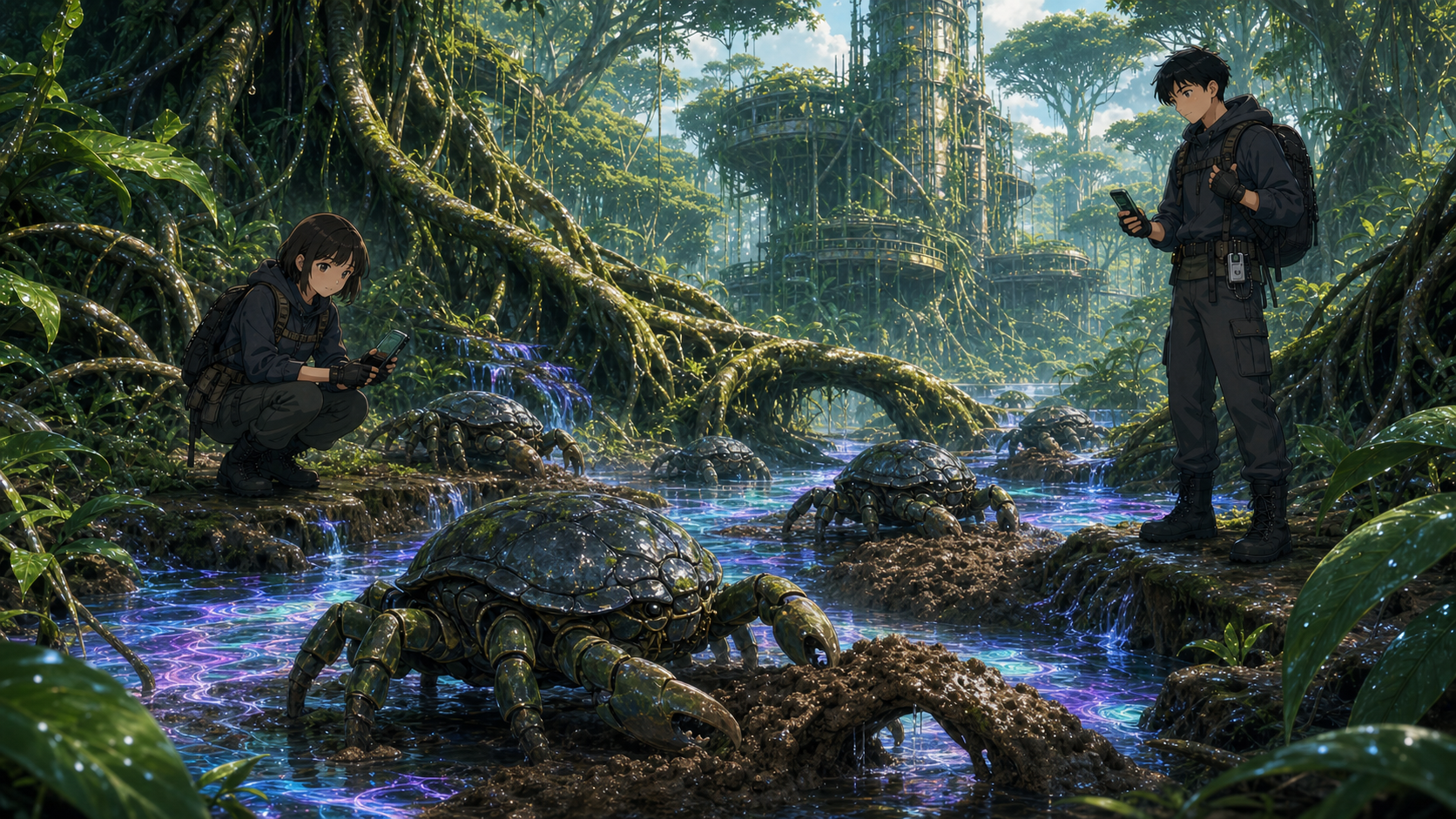
We followed the remaining flow below Frog-Call Return-Flow Gate into the buttress-root zone at Root-Channel Armored Crab Bank. From the colony's perimeter, we traced the short route used to carry fallen leaves into Mycelial-River Leaf-Fall Trough. The marks on those leaves led upstream to Alloy Root-Bridge Sluice, where an old drain ran beneath the roots toward Third Mist-Condenser Tower.
Morning · Root-Channel Armored Crab Bank
The colony sealed the upstream burrow mouths with fresh mud. Fang separated water volume, acidity, and movement direction while I stayed outside the channel-building line with every active weapon stowed. Because the seals appeared only on the side facing the mist-condenser towers, water quality had failed before the flow disappeared.
Noon · Mycelial-River Leaf-Fall Trough
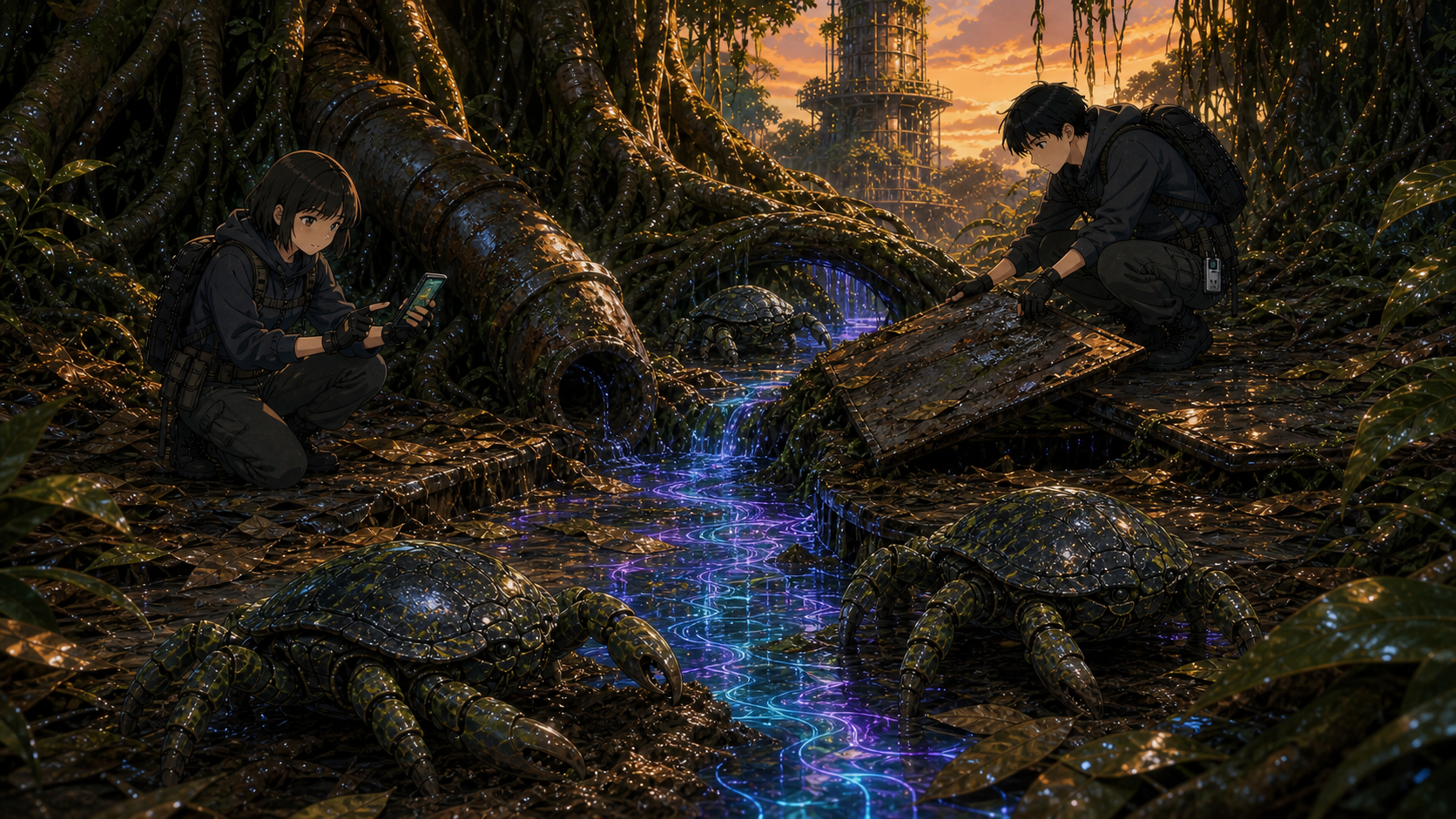
Fang examined leaves the crabs had already carried out. We took only naturally discarded material. Mineral scorch marks on the surfaces matched concentrated discharge from mist-condensing equipment, not ordinary acid rain. I removed loose alloy fragments only when they were clearly separate from the colony's arches.
Evening · Alloy Root-Bridge Sluice
We left the crabs' natural channels intact. I lifted one loose gate plate that was pressing on a seepage arch while Fang located the acidic drain from the maintenance side. The pipe beneath the root bridge led directly toward Third Mist-Condenser Tower.
Habitat Causality
Root-Channel Armored Crabs break down fallen leaves, fungal mats, and humus, then build porous mud arches that carry the Mycelial River through dense buttress roots. Their mineralized carapaces tolerate acidic rain, but molting chambers depend on clean water. Concentrated acidic discharge from the restarted condenser system entered below the alloy root bridge. The colony protected its molting ground by sealing openings on that side, while scorch marks on discarded leaves separated the discharge from ordinary rainfall. The drain beneath the bridge connected both signs to Third Mist-Condenser Tower.
Species Behavior
The crabs use six sturdy walking legs and two blunt earth-moving claws to sort leaf litter, turn humus, and maintain seepage arches. They are wary but not aggressive. They did not approach us and continued working when we remained outside the molting core. The colony closed only contaminated openings and preserved the rest of its water network.
「The crabs did not need us inside their channels. Their mud had already drawn the direction. We removed one human obstruction and left every living structure where it was.」