
Tidal Echo Wetland
Warm vapor from the dome, periodic pressure releases from old flood-control works, and seawater intrusion converge here. Transit tubes, maintenance towers, and tide gates surface only at low tide, while submerged metal frames carry sound through the shallows and turn the whole wetland into a resonator.
- Parent Domain
- NB-01 · Vancouver Dome Frontier
- Location
- A salinized wetland on the drowned former coast southwest of Vancouver Dome, after roughly twenty meters of sea-level rise.
For seven consecutive nights, Outer-Ring Maintenance Station received an unclassified low-frequency echo. Automated flood gates then began misreading the tide. Fang and K entered without sealing the wetland or driving out its wildlife, and traced the signal from the outer shallows to an ancient channel blocked by human infrastructure.
How Tidal Echo Wetland Works
Local life has evolved pressure sensing, low-frequency communication, salt-crystal excretion, and reflective defenses in response to the wetland's resonance, salinity, and drowned infrastructure.
Observation Ethic
The route treats hunting as observation, sampling, rescue, and coexistence. No species is attacked; Fang and K change their own passage before forcing the habitat to yield.
Five-Day Route
- Read the Mirrorwing Tide Herons' collective orientation in the outer shallows.
- Follow Saltvein Antler Deer to the buried pump line.
- Measure the Sunken-Bell Frog Chorus inside submerged transit tubes.
- Free a Tideshell Matron calf without provoking the adult female.
- Synchronize with the Sky-Tide Crownwhale and reopen the ancient tidal route.
Five species maintaining this local ecology
 Day 01
Mirrorwing Tide Heron
Flocks gather on maintenance buoys and use mirrored mineral feather plates to reflect the dome's morning light, driving fish into the shallows. When startled, they flash their wings and retreat rather than attack.
 Day 02
Saltvein Antler Deer
They lick minerals from old concrete and cables, depositing excess salt along their backs. Their hollow antlers detect vibrations in buried pipes. At the old pump, a stag's crystal antlers resonated with the machinery, and the adults later guided the fawns away from flooded ground.
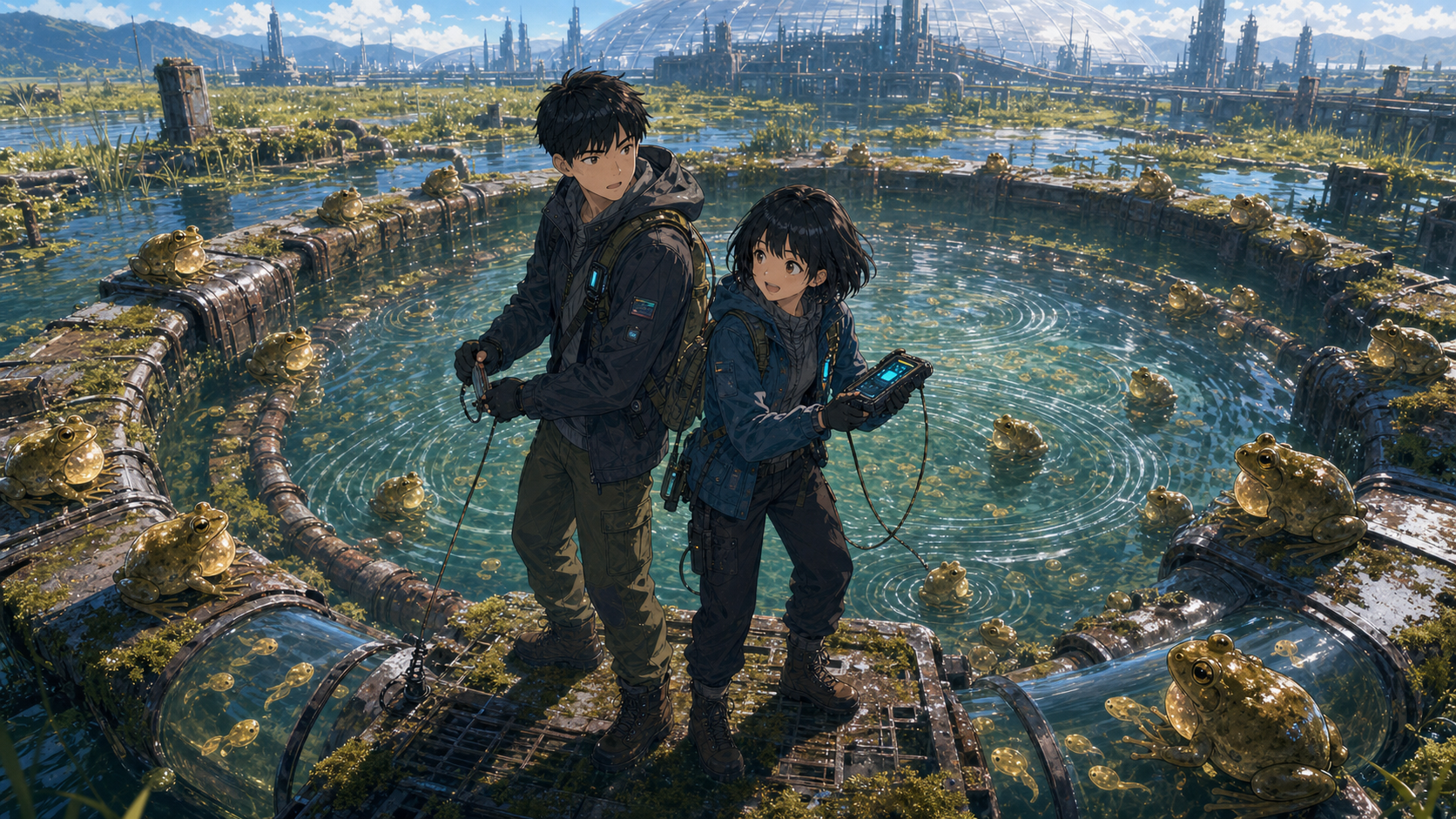 Day 03
Sunken-Bell Frog Chorus
They cling to submerged buildings. At high tide, thousands inflate translucent bronze, bell-shaped throat sacs in synchrony to signal water pressure. Their pressure-sensitive lateral lines and synchronized pulses create visible ripples, while the resonance can loosen corroded metal.
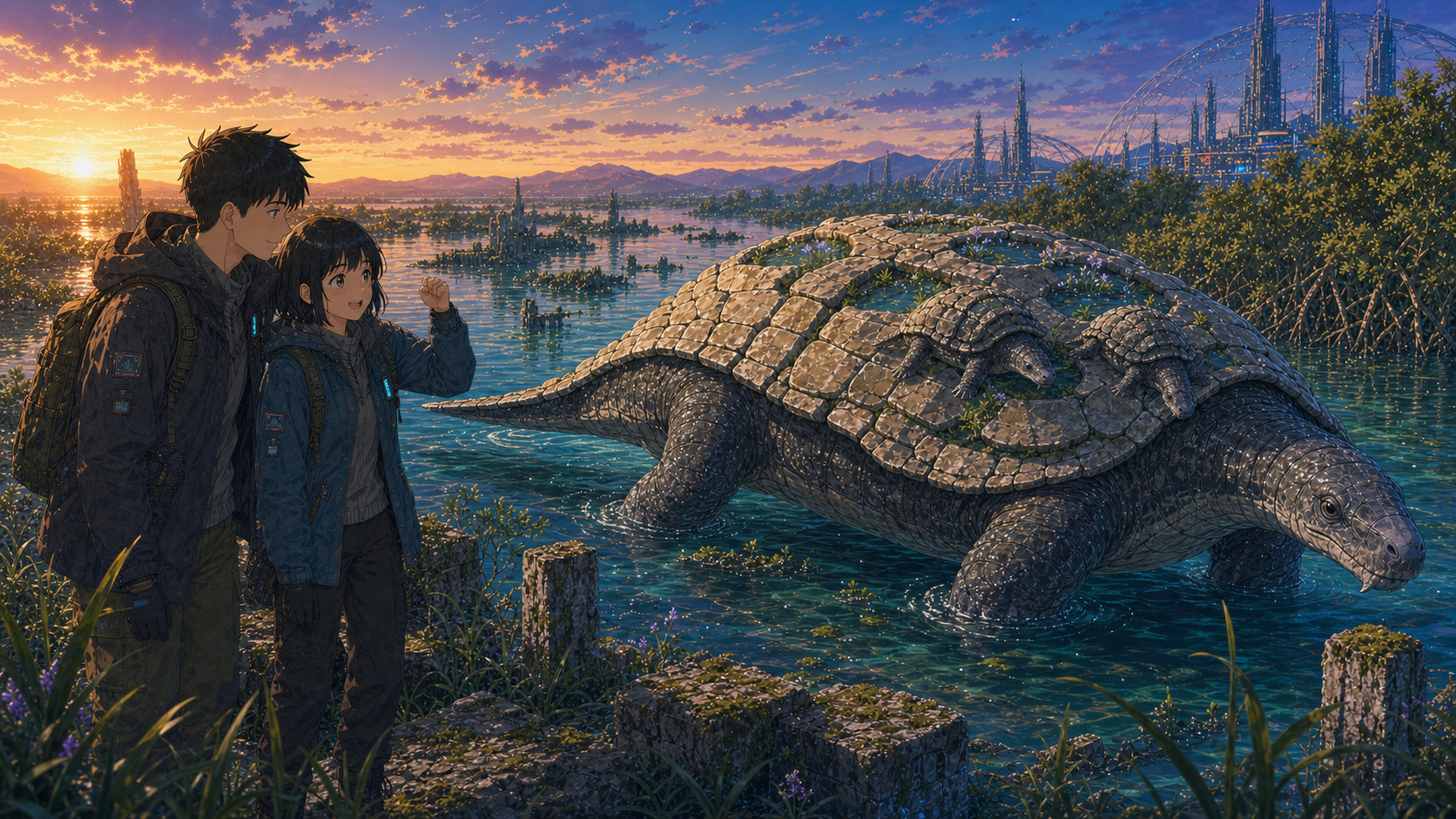 Day 04
Tideshell Matron
An adult female carries freshwater in layered basins on her back, where calves can rest. The species is not normally aggressive and charges only when a calf or one of those freshwater basins is threatened.
 Day 05
Sky-Tide Crownwhale
The 18-meter adult is non-aggressive. It filters food from the wetland and uses enormous hollow crown antlers to emit a low-frequency song that gathers multiple species for migration along the ancient tidal channel.
「The anomaly was not a creature invading human territory. It was a migration asking for the route that human infrastructure had taken away.」